
There are only five ways humanity knows how to keep things cool at consumer scale. Every product in this entire niche, from a ceiling fan to a central air system, from a camping icebox to a wearable neck cooler, is built on one of five physical principles, and there is no sixth waiting in a startup’s garage. Engineers can execute each principle better or worse, package it larger or smaller, price it higher or lower. What they cannot do is escape the principle’s built-in limits.
That makes this one of the highest-leverage pieces of knowledge a cooling buyer can own. We have covered several of these technologies individually across this site, including a dedicated explainer on how portable coolers work for the personal-device end of the market. This article is the pillar that connects all of it: the complete map of every cooling principle at every scale, from whole-home systems down to gadgets that clip to your collar, including the emerging technologies that have not reached store shelves yet. How each one works, what each excels at, where each fails, and how to identify them on product pages that would sometimes rather you didn’t.
First Principles: You Cannot Destroy Heat, Only Move It
One law governs everything in this article. Heat energy cannot be destroyed; it can only be moved from one place to another or absorbed by something changing state. Every cooling technology is a different answer to the same question: where does the heat go?
- Fans don’t move heat out of a room at all; they help heat leave your body faster.
- Evaporative coolers move heat into water vapor.
- Compressor systems pump heat from inside a space to outside it.
- Thermoelectric chips pump heat from one face of a chip to the other.
- Ice and phase-change materials soak heat up into a melting substance.
Every strength and weakness that follows traces back to which of these answers a device uses. Keep the question “where does the heat go?” in mind on any product page and most marketing confusion evaporates on its own.
Vapor-Compression: True Air Conditioning
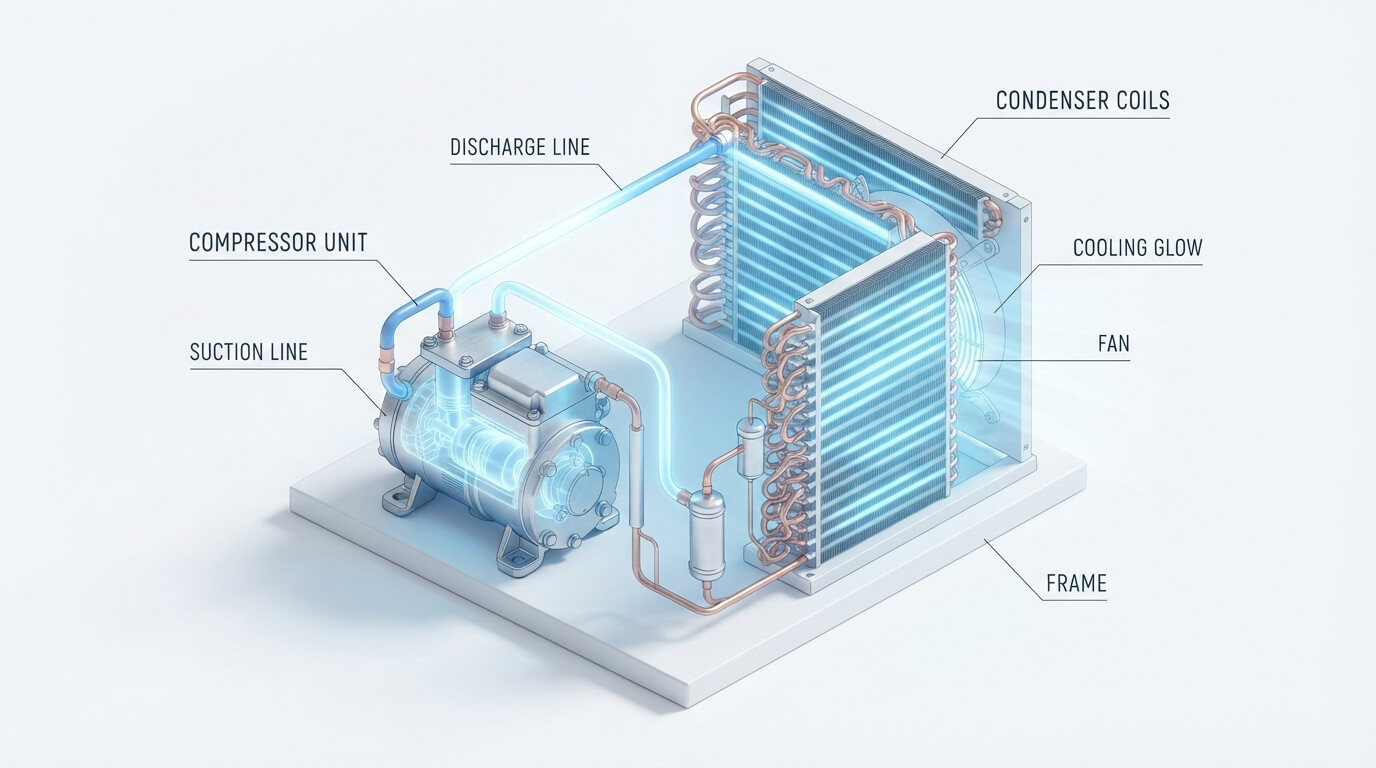
The compressor system is the technology inside your refrigerator, your window AC, central air, mini-splits, portable air conditioners, and powered cool-boxes. It is the only consumer technology that can reliably push a room’s temperature well below the outdoor temperature regardless of humidity.
How it works. A refrigerant fluid circulates through a closed loop with four stations. In the evaporator coil (inside), liquid refrigerant evaporates at low pressure, and evaporation absorbs large amounts of heat from indoor air blown across the coil. The compressor then squeezes the now-gaseous refrigerant, raising its pressure and temperature above the outdoor air temperature. In the condenser coil (outside), the hot gas releases its heat to outdoor air and condenses back into liquid. An expansion valve drops the pressure again, and the cycle repeats. The system is literally a heat pump, moving thermal energy uphill from a cool space to a warm one, spending electricity to do it.
What it delivers. Deep, controllable cooling, typically able to hold an indoor space 10 to 15°C below outdoor temperature; dehumidification as a built-in bonus, because moisture condenses on the cold evaporator coil; and thermostat precision. Reversed, the same loop becomes a heater, which is exactly how the combined units in our guide to whether a combined cooler and heater makes sense manage both jobs with one machine.
What it costs. Compressors are the heavyweights of home cooling: hundreds to thousands of watts, meaningful noise, meaningful purchase price, and in portable formats, an exhaust hose that must reach a window, because the extracted heat has to physically leave the room. A “portable AC” with no exhaust path is either an evaporative cooler in disguise or a machine heating the room it cools. The refrigerant itself is a regulated substance with its own history and phase-out politics, covered in our explainer on R22 versus R410A refrigerant.
Evaporative Cooling: Ancient Physics, Modern Packaging
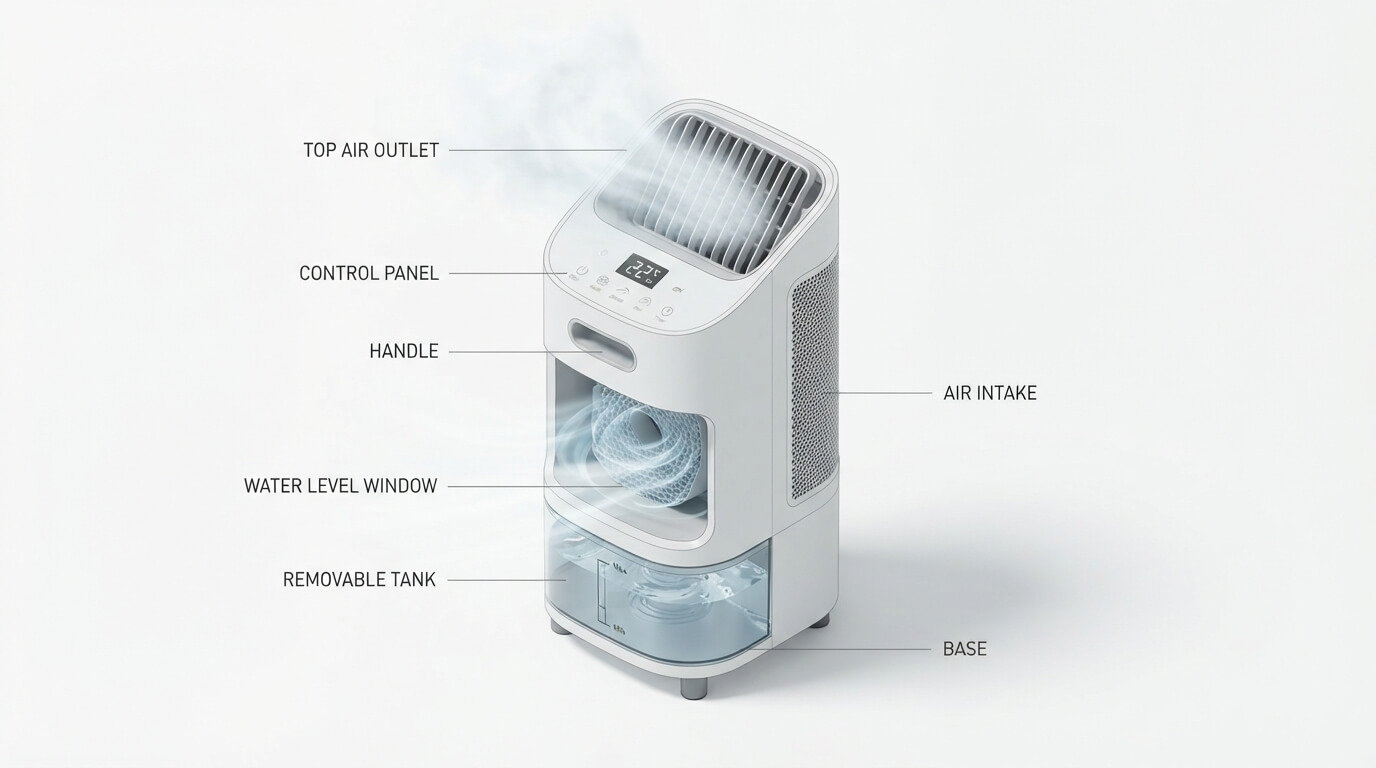
Evaporative cooling (the “swamp cooler”) is thousands of years old; Ancient Egyptians hung wet reeds in windows for the same effect. The modern version is a fan pulling warm, dry air through a water-saturated pad. As water evaporates from the pad, it absorbs heat from the passing air (about 2,260 joules per gram of water evaporated, an enormous figure), and the air comes out cooler and moister.
What it delivers. In genuinely dry air (relative humidity under roughly 40 percent), evaporative coolers can drop air temperature by 5 to 12°C while using a tenth of the electricity of a compressor unit, with no refrigerant, no exhaust hose, and simple mechanics. They also add humidity, which in arid climates is a comfort feature rather than a bug.
Where it fails. The technology’s entire power source is the dryness of incoming air. As humidity climbs, evaporation slows, and the cooling effect shrinks toward zero; at 70 to 80 percent humidity an evaporative cooler is essentially a fan that also makes your room stickier. This is not a quality problem that a better brand can fix; it is thermodynamics. We map the exact performance curve by climate in our deep-dive on how evaporative cooling works in dry vs humid climates, which is essential reading before buying any device in this category.
Maintenance reality. Standing water plus airflow means pads, tanks, and reservoirs need regular cleaning to prevent mineral scale, mildew, and odor. Any evaporative device that markets itself as maintenance-free is being optimistic on your behalf.
How to spot it. A water tank spec, no BTU rating, no exhaust hose, wattage in the tens rather than hundreds, and words like “air cooler,” “swamp cooler,” or “evaporative.” Many viral “mini AC” gadgets are small evaporative coolers, and knowing that instantly sets correct expectations: pleasant personal breeze in dry air, near-useless in a humid room.
Fans: Cooling People, Not Air
A fan adds a small amount of heat to a room (motors are not perfectly efficient) while making the people in it feel substantially cooler. The mechanism is entirely physiological. Your body sheds heat by sweating, and sweat only cools you when it evaporates; moving air strips away the saturated boundary layer hugging your skin and replaces it with drier air, accelerating evaporation. Moving air also carries heat away from skin directly by convection.
What it delivers. The best comfort-per-watt of any technology, by far. Elevated air speed can make a room feel 3 to 4°C cooler than the thermometer reads, which is why the U.S. Department of Energy’s fan guidance recommends fans as a first-line strategy that lets you raise the thermostat without losing comfort. Formats matter mostly for airflow pattern: ceiling fans cover whole rooms, pedestal and box fans deliver directional flow, towers trade some performance for footprint, and bladeless designs trade a little of everything for aesthetics and safety.
The two limits. First, fans cool people, not spaces; running a fan in an empty room is pure waste. Second, at extreme air temperatures (above roughly body temperature, around 37°C, especially in high humidity) fan use can add heat faster than it helps shed it. Public-health guidance, including the CDC’s extreme heat recommendations, notes that fans alone are insufficient protection in dangerous heat waves.
Where fans shine unexpectedly. Paired with other technologies. A fan pushing cooled air deeper into a room extends an AC’s reach; a fan in a window exhausting hot air at night and pulling in cool air is free air conditioning in climates with cool nights; a fan across your bed solves most warm-night sleep problems at negligible cost, one of the core strategies in our guide to getting your bedroom temperature right for sleep.
Thermoelectric (Peltier) Cooling: The Solid-State Middle Child
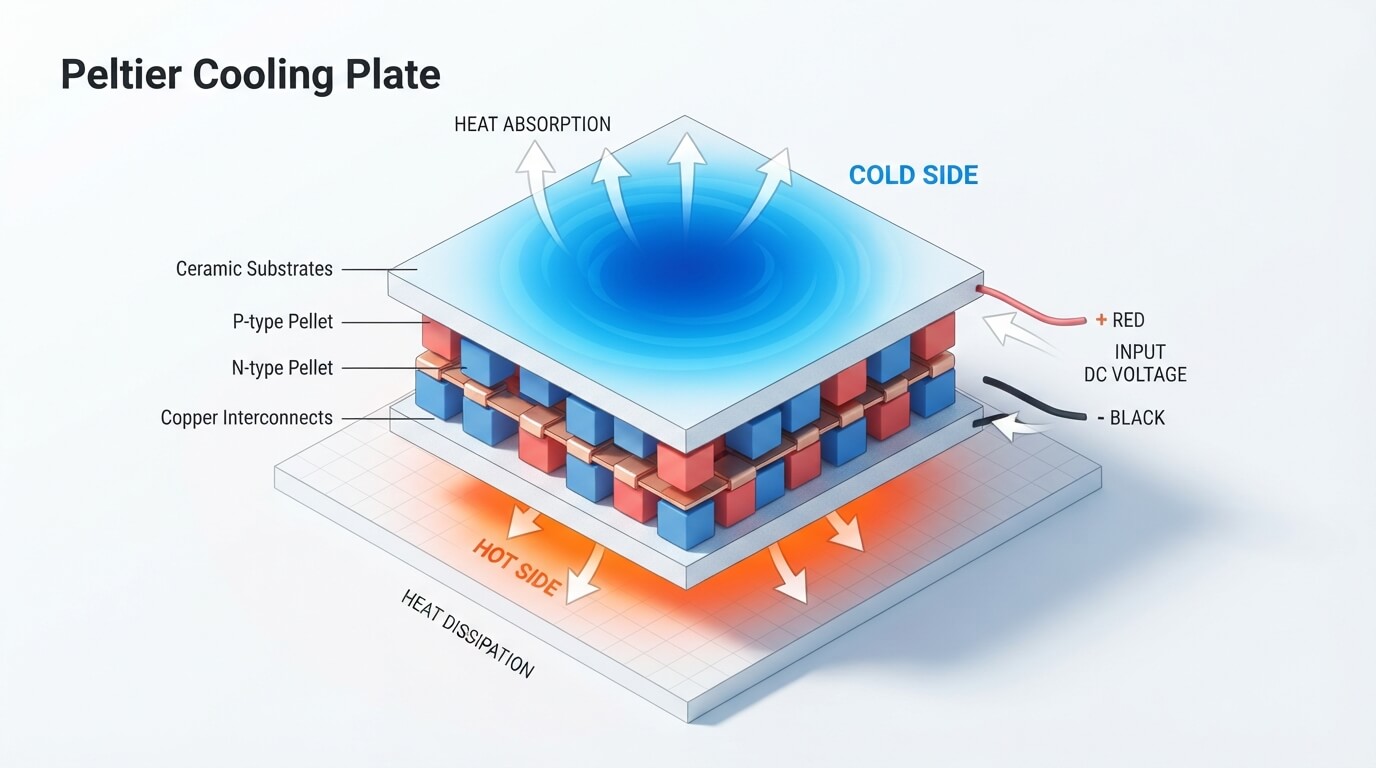
Pass electric current through a junction of two different semiconductor materials and one face of the junction gets cold while the other gets hot. This is the Peltier effect, and it powers a whole tier of consumer devices: 12-volt travel cool-boxes, mini beverage fridges, some wearable neck coolers, and small “personal AC” gadgets.
What it delivers. No compressor, no refrigerant, no moving parts except a small fan on the hot side. Peltier devices are lightweight, silent or nearly so, orientation-proof (unlike compressor fridges, they work at any angle, handy in vehicles), and cheap to manufacture.
The hard limit. Peltier modules are dramatically less efficient than compressors, often moving only a fraction of a watt of heat per watt of electricity consumed at useful temperature differences, versus two to four watts per watt for compressor systems. In practice, consumer Peltier coolers typically achieve interiors about 15 to 25°C below ambient, and cannot go further no matter how long they run. In a 35°C car, that means a “fridge” sitting at 10 to 20°C, cool but not cold, and never freezing. They also draw that power continuously, which matters for the battery-powered formats we assess in our piece on the pros and cons of rechargeable cooling devices.
How to spot it. Phrases like “thermoelectric,” “semiconductor cooling,” a spec expressed as “cools to X degrees below ambient” rather than an absolute temperature, and low prices on devices that superficially resemble compressor fridges. Neither scam nor miracle: Peltier is the right choice for light-duty, mobile, quiet applications and the wrong choice for anything that needs to be genuinely cold in genuinely hot surroundings.
Passive Cooling: Insulation, Ice, and Phase-Change Materials
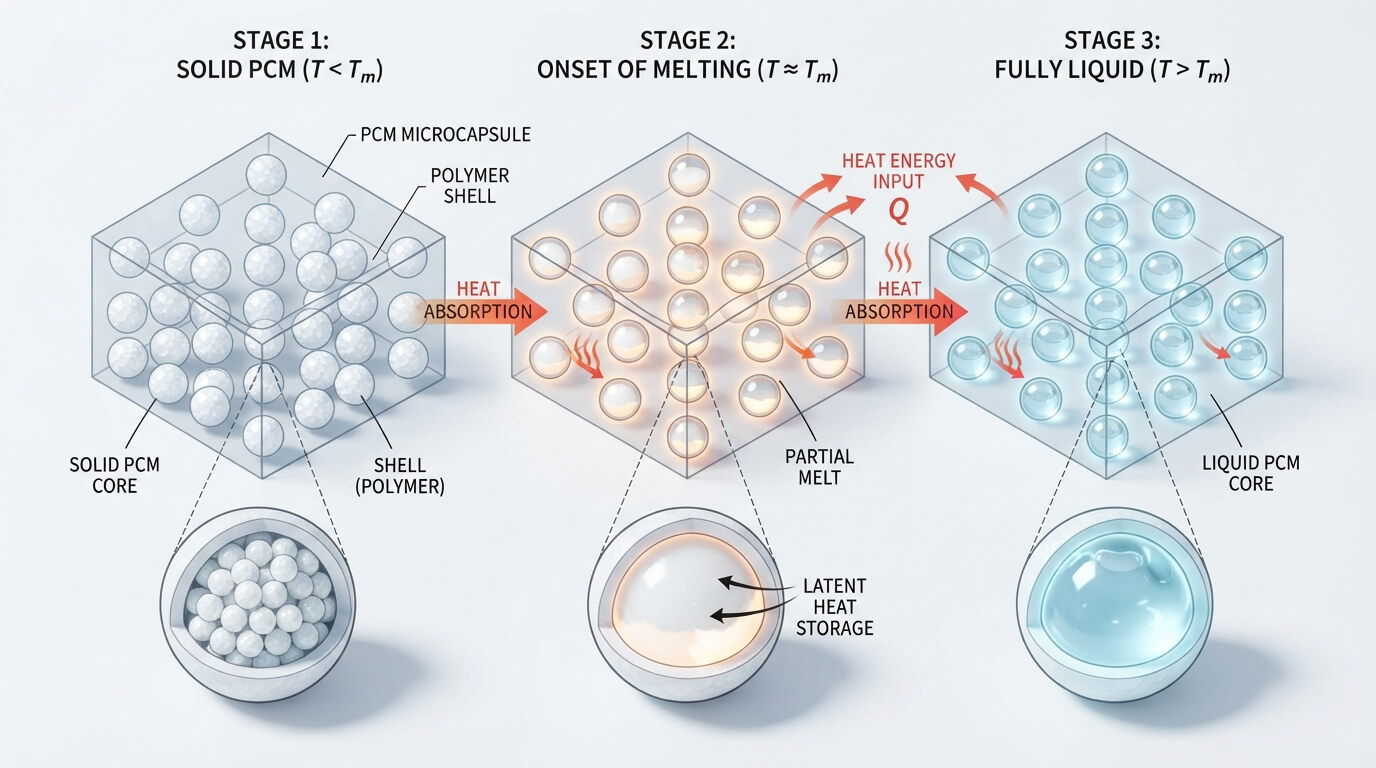
The oldest technology in this guide has no plug at all. An insulated cooler box does not create cold; it slows heat transfer while a stored medium (usually ice) absorbs incoming heat by melting. The melting process soaks up roughly 80 calories for every gram of ice, all without the temperature budging from 0°C, which is why an ice-and-box system outperforms almost any small powered device for keeping food and drinks cold; the energy was banked in your freezer in advance.
The interesting modern development is phase-change materials (PCMs) beyond plain water ice. PCMs are substances engineered to melt at specific chosen temperatures: 4°C packs for food-safety-critical cooling, 15°C packs for wine, 21°C packs inside cooling vests and mattress toppers that “melt” at just below skin-comfort temperature, absorbing body heat for hours and re-freezing at room temperature overnight. Salt-hydrate and paraffin PCMs are also appearing inside building materials and high-end cooler accessories. The physics is identical to ice, heat absorbed by a state change, but the melting point is tuned to the job.
Passive systems have one honest limitation: capacity is finite and prepaid. When the ice or PCM has fully melted, cooling stops until you re-freeze. Everything about maximizing that capacity, insulation thickness, packing ratios, pre-chilling, lives in our companion guide to the science of ice retention, and our field-tested list of coolers that keep ice frozen for five or more days shows what the top of the passive category can do.
Emerging and Niche Technologies Worth Knowing
Two-stage (indirect) evaporative cooling pre-cools air with a heat exchanger before the evaporative stage, delivering cooler, less-humid output than standard swamp coolers and extending the technology’s usable climate range. Increasingly common in commercial systems, trickling into premium consumer units.
Radiative sky cooling uses engineered films that emit heat in a wavelength band that passes straight through the atmosphere to cold outer space, allowing surfaces to cool below air temperature passively, even in sunlight. Real products (cooling roof films and fabrics) are beginning to ship, and it is one of the genuinely exciting frontiers in the field.
Magnetocaloric and elastocaloric cooling, refrigeration via magnetized alloys or stretched shape-memory metals, promise compressor-class efficiency with no refrigerant gases. They remain in labs and pilot products, but they are the likeliest long-term successors to vapor compression.
Wearable microclimate devices, neck fans, Peltier neck bands, PCM vests, ventilated jackets, apply the technologies above at body scale. The honest ones cool a small area modestly; the physics limits covered earlier apply with full force at this scale, which makes spec-reading skills even more valuable.
The Decision Framework: Matching Technology to Problem
Strip away brands and the choice collapses to four questions.
1. Do you need to cool a space, or a person? A person: start with fans, then wearables and PCM. A space: continue.
2. How humid is your climate? Dry (under ~40% RH): evaporative cooling is the efficiency bargain of the century. Humid: compressor technology is effectively your only room-cooling option, and dehumidification becomes part of the job.
3. How cold, exactly? “Below outdoor temperature, reliably” means compressor. “Noticeably cooler than ambient” opens Peltier and evaporative. “Feels cooler” is fan territory.
4. What are your power constraints? Grid power available: any technology. Battery or solar only: fans and small evaporative units are realistic, Peltier is marginal, compressors demand serious battery banks, and passive ice systems sidestep the problem entirely by pre-paying energy at home.
Run any product through those four questions and its category, and therefore its ceiling, becomes obvious. A device’s technology is its destiny. Reviews can tell you whether a particular gadget executes its technology well, and that is precisely what we test in our hands-on reviews across portable air conditioners and beyond. But no execution, however good, escapes the physics of its own category.
How Marketing Blurs the Categories, and How to Un-Blur Them
The technologies above are distinct in physics but deliberately blended in marketing, and most consumer disappointment in this niche traces to a device sold under the vocabulary of a more powerful category than the one it belongs to. A field guide to the common blurrings:
“Mini air conditioner” for an evaporative cooler. The most widespread. Air conditioning has a technical meaning (refrigeration-cycle cooling and dehumidification), and a water-tank device with a 10-watt fan is not it. The tells: a water tank or “ice tray,” no exhaust hose, no BTU rating, no compressor noise spec. Correctly reframed as a personal evaporative cooler, the same device can be a fair purchase in a dry climate; sold as an air conditioner, it is a guaranteed refund request in a humid one. This is precisely the confusion our personal air cooler versus portable mini AC comparison exists to untangle.
“No hose needed” compressor claims. Any true refrigeration device must reject heat somewhere. A compressor unit with no exhaust path is heating your room with one hand while cooling it with the other, minus efficiency losses, for a net warming. The rare legitimate hose-free formats either exhaust through a wall or window mount (the heat still leaves) or are not compressor devices at all.
“Cools any room” wearables and desk gadgets. Personal devices are honestly personal: they condition the centimeters around your skin, not cubic meters of room air. The wattage gives it away instantly; room-scale cooling at 5 watts would be a Nobel Prize, not a checkout page.
“Freezes drinks” thermoelectric boxes. Peltier devices state their limit as “X degrees below ambient” for a reason. In a hot vehicle, below-freezing interiors are outside the technology’s reach at consumer power levels. If freezing matters, the product you want is a compressor fridge, and the price difference between the categories is real because the capability difference is real.
Ambiguous “ionic,” “hydro-chill,” and invented-technology names. Proprietary-sounding technology names nearly always decode to one of the five categories in this guide wearing a costume. Find the wattage, look for a tank or a hose or a compressor, ask where the heat goes, and the costume comes off.
None of this requires assuming bad faith everywhere; category confusion is sometimes just sloppy copywriting. But the decoding skill is the same either way, and it costs you thirty seconds per product page.
Frequently Asked Questions
Can I use an evaporative cooler and an air conditioner in the same room? Generally no, and the reason is instructive: the evaporative unit adds humidity that the AC must then spend energy condensing out. The two technologies work against each other. In a dry climate, pick the evaporative unit alone for efficiency; in a humid one, the AC alone. The one good pairing across categories is a plain fan with an AC, circulating conditioned air and letting you raise the setpoint.
Why does my portable AC seem to work less well on the hottest days? Compressor systems lose capacity as the temperature of the air receiving the rejected heat rises, and single-hose portables suffer twice because they also draw more hot outdoor air into the building. It is real physics, not a defective unit, though generous shade for the intake and a short, insulated exhaust hose recover some of the loss.
Are bladeless fans a different technology? No; they are conventional fans with the blades hidden in the base, pushing air through a slot that entrains surrounding air. Same physics, same “cools people not air” rule, with trade-offs of easier cleaning and safety against some airflow-per-watt and price.
Is there any technology that cools without electricity or ice? Three honest answers. Evaporative devices can run on astonishingly little power, but not zero. Radiative sky cooling films genuinely cool below ambient with zero energy input, though consumer products remain early. And building-scale passive design (shading, ventilation, thermal mass, reflective roofs) is the oldest zero-electricity cooling technology of all, and still the highest-leverage one.
Which technology is best for a baby’s room or an elderly person’s room? Prioritize reliability of actual temperature control, which means compressor cooling in most climates, sized correctly and set moderately, with a fan for circulation. Both age groups regulate body temperature less effectively, which is why health guidance treats them as priority populations in heat; comfort-only devices that lower perceived rather than actual temperature are the wrong tool when overheating is a genuine health risk.
Do any of these technologies also help with heating? One does, elegantly: the compressor loop run in reverse is a heat pump, delivering two to four units of heat per unit of electricity and increasingly the standard for efficient homes. This dual capability is what makes combined units interesting, and what our guide on combined cooler and heater devices evaluates in practical terms.
Learn the five technologies, ask where the heat goes, and you will never again be surprised by what arrives in the box.
Quick-Reference: The Five Technologies at a Glance
Vapor compression (true AC). Where the heat goes: pumped outdoors via refrigerant. Power draw: hundreds to thousands of watts. Cooling depth: deep, below outdoor temperature, with dehumidification. Best for: whole rooms and homes, humid climates, anyone who needs guaranteed temperatures. Watch for: exhaust hose requirement on portables, ASHRAE-versus-DOE rating games, noise.
Evaporative. Where the heat goes: into evaporating water. Power draw: tens to low hundreds of watts. Cooling depth: 5 to 12°C below ambient in dry air, near zero in humid air, and it adds moisture. Best for: arid climates, garages and patios, efficiency-first buyers. Watch for: humidity dependence above all, pad and tank maintenance.
Fans. Where the heat goes: nowhere; heat leaves your body faster. Power draw: single to double-digit watts. Cooling depth: none in air temperature, 3 to 4°C in felt temperature. Best for: occupied spaces in any climate, pairing with every other technology, sleep. Watch for: useless in empty rooms, insufficient alone in dangerous heat.
Thermoelectric (Peltier). Where the heat goes: pumped from one chip face to the other, inefficiently. Power draw: tens of watts, continuous. Cooling depth: a fixed 15 to 25°C below ambient, never freezing. Best for: vehicle cool-boxes, mini fridges, silence and portability. Watch for: “below ambient” fine print, battery drain, mistaken refrigerator expectations.
Passive (insulation + ice/PCM). Where the heat goes: absorbed by a melting medium banked in your freezer. Power draw: zero in the field. Cooling depth: whatever your ice can hold, for as long as it lasts. Best for: food and drinks anywhere off-grid, reliability with no moving parts. Watch for: finite prepaid capacity, packing technique mattering as much as hardware.
Pin this section mentally, and every cooling product you meet for the rest of your life sorts itself into one of five boxes within seconds, complete with its powers and its limits.