
Summer heat can be unbearable, especially when you’re living in a dorm, renting an apartment, working in a stuffy office, or simply need targeted cooling without running central air. You’ve probably seen advertisements for both personal air coolers and portable mini AC units, often with similar-looking designs and promises of relief from the heat. But here’s the critical question: are these actually the same thing, or is there a meaningful difference that affects which one you should buy?
The answer might surprise you. Despite similar appearances and marketing claims, personal air coolers and portable mini air conditioners use completely different technologies and deliver vastly different results. In this comprehensive guide, we’ll break down exactly what each device does, how they compare, and which one is right for your specific situation and budget.
What Is a Personal Air Cooler?
A personal air cooler, also called an evaporative cooler or swamp cooler, is a device that cools air through water evaporation. The technology is elegantly simple and has been used for thousands of years in various forms, from ancient Egyptian wet cloth techniques to modern compact units.
Here’s how it works: you fill a water tank (and sometimes add ice), and the device pulls air through water-saturated cooling pads or filters. As the air passes through these wet surfaces, water evaporates into the air stream. Evaporation is an endothermic process, meaning it absorbs heat energy from the surrounding air, resulting in cooler air being blown out of the unit.
Most personal air coolers are compact, lightweight devices featuring a water reservoir, a fan, cooling pads or filters, and simple controls. They’re typically the size of a small desktop speaker or lunchbox, making them easy to move from room to room or place on a desk or nightstand.
Popular brands include Evapolar, Honeywell, Hessaire, and numerous budget options available through online retailers. These devices are marketed heavily as eco-friendly, energy-efficient alternatives to traditional air conditioning, often with eye-catching demonstrations showing ice water creating a cool breeze.
What Is a Portable Mini AC?
A portable mini air conditioner is a scaled-down version of traditional air conditioning technology. Unlike evaporative coolers, these units use actual refrigeration to cool air, the same fundamental process used in your refrigerator, car AC, and central home cooling systems.
The technology involves a refrigeration cycle: a compressor pressurizes refrigerant gas, which then flows through a condenser where it releases heat and becomes liquid. This liquid refrigerant passes through an expansion valve and enters an evaporator, where it absorbs heat from the air and turns back into a gas. The cooled air is blown into your space, while the absorbed heat is vented outside through an exhaust hose.
Portable mini AC units are compact air conditioners designed for small spaces. They typically include a compressor, evaporator, condenser, exhaust hose, and dehumidifying function. Most models require a window kit for venting hot air outside, though some newer units claim to be ventless (more on that later).
Common brands include Black+Decker, LG, Frigidaire, hOmeLabs, and Whynter. These units are considerably larger and heavier than evaporative coolers, often resembling a small rolling suitcase or tower speaker.
The Fundamental Difference: Technology That Matters
The crucial distinction between personal air coolers and portable mini ACs lies in their cooling mechanisms, and this difference dramatically affects their performance.
Personal air coolers don’t actually lower the temperature of the air in a room. Instead, they create a localized cooling sensation through evaporative cooling and airflow. The air coming out of the unit feels cooler than ambient temperature, but the overall room temperature remains largely unchanged or may even increase slightly due to the added humidity and heat from the fan motor. The cooling effect you feel is similar to stepping out of a pool on a dry day—the evaporation of moisture from your skin creates a cooling sensation even though the air temperature hasn’t changed.
Portable mini ACs genuinely lower the air temperature through refrigeration. They remove heat energy from the air and exhaust it outside (typically through a window hose). This means they can actually reduce the temperature in a room by several degrees, providing true air conditioning rather than just a cooling sensation.
The humidity impact also differs dramatically. Evaporative coolers add moisture to the air as part of their cooling process, which can be beneficial in extremely dry climates but problematic in humid regions. Mini ACs remove moisture from the air as part of the refrigeration process, actually dehumidifying while they cool; a feature many people find comfortable in humid climates.
This technological difference isn’t just academic. It fundamentally determines whether a device will work for your needs and climate.
Performance Comparison: The Reality Check
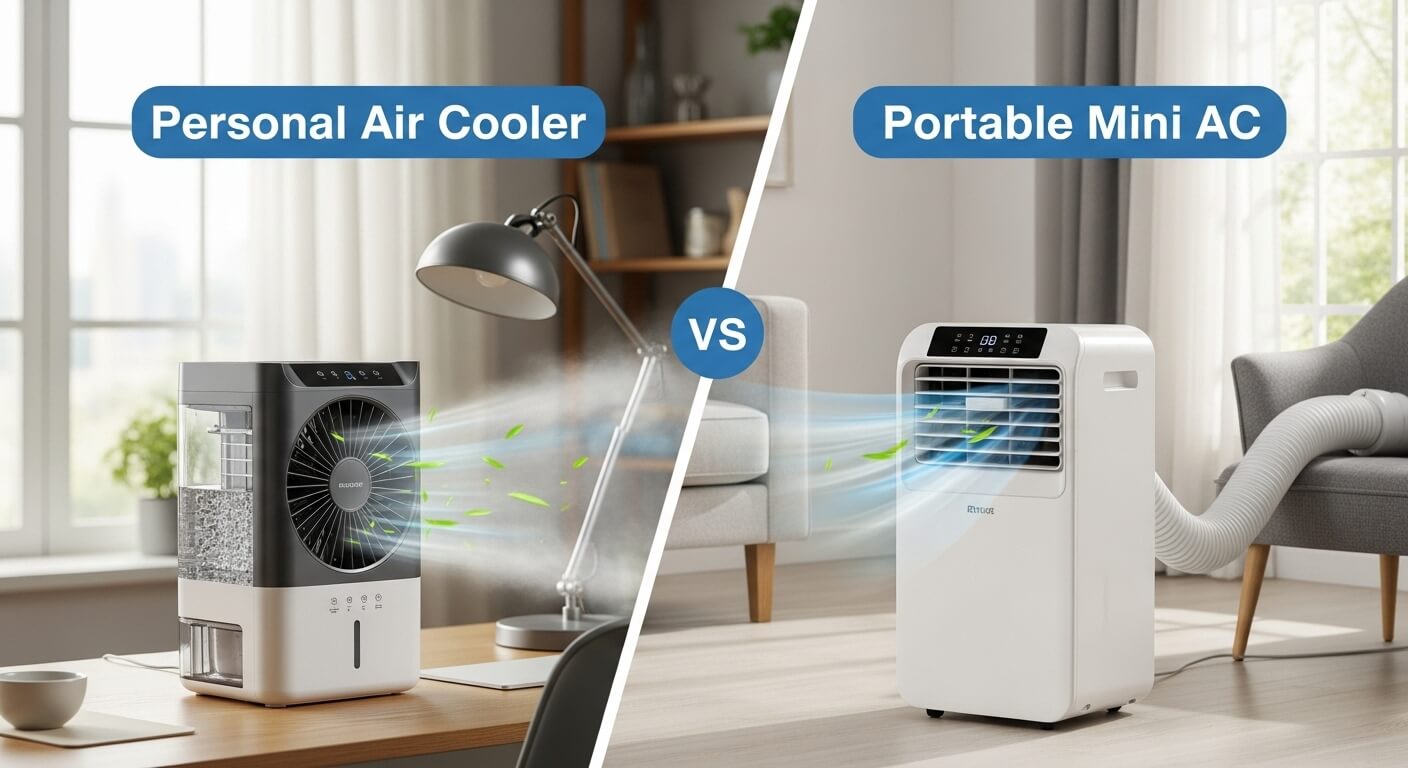
When it comes to actual cooling performance, portable mini ACs and personal air coolers aren’t even in the same category.
Personal air coolers are effective at providing a breeze of slightly cooler air in your immediate vicinity, typically within 3-5 feet of the device. The cooling effect is noticeable when you’re sitting directly in front of the unit but minimal elsewhere in the room. These devices cannot meaningfully reduce room temperature. If your room is 85°F, it will likely remain around 85°F with an evaporative cooler running, though the air blowing on you will feel cooler due to evaporation and airflow.
The effectiveness of evaporative coolers depends heavily on climate. In dry climates with low humidity (like Arizona, Nevada, or parts of California), they can provide a pleasant cooling sensation and may reduce perceived temperature by 5-10 degrees in the immediate airflow. However, in humid climates (like Florida, the Southeast, or coastal regions), evaporative coolers become nearly useless because humid air cannot absorb much additional moisture, severely limiting evaporative cooling.
Portable mini ACs, on the other hand, can genuinely cool small spaces. A typical 8,000 BTU portable AC can cool a room of approximately 150-250 square feet, actually reducing the temperature by 5-15 degrees depending on outside temperature, insulation, and other factors. The cooling is measurable, consistent, and works regardless of humidity levels. In fact, mini ACs work better in humid climates because they remove moisture, which itself reduces the perceived temperature.
The tradeoff is coverage area. While a mini AC can cool an entire small room, personal air coolers provide cooling only in their immediate vicinity—essentially a personal cooling zone rather than room cooling.
Energy Efficiency and Operating Costs
This is where personal air coolers shine and why they’re often marketed as eco-friendly alternatives.
Personal air coolers typically consume between 5-60 watts of electricity, comparable to running a laptop or several LED light bulbs. Running an evaporative cooler 24/7 for a month might cost $2-5 in electricity, depending on your local rates. They also consume water—usually requiring refills every 4-8 hours depending on tank size and usage—but water costs are negligible.
Portable mini ACs consume significantly more power, typically ranging from 900-1,400 watts depending on cooling capacity and efficiency. Running a portable AC for 8 hours daily could cost $25-60 per month in electricity, though this varies by local energy rates and usage patterns. However, this is still far less expensive than running central air conditioning throughout your entire home.
From a pure energy perspective, evaporative coolers are undeniably more efficient. However, energy efficiency is meaningless if the device doesn’t meet your cooling needs. A personal air cooler might use 10% of the energy of a mini AC, but if it fails to provide adequate cooling, that efficiency provides no practical benefit.
The environmental consideration is also worth noting. Evaporative coolers use only water and electricity, with no refrigerants. Mini ACs use refrigerants, though modern units use more environmentally friendly options like R-32 or R-410A rather than older, ozone-depleting refrigerants.
Portability and Installation
Personal air coolers live up to the “portable” name. Most weigh 5-15 pounds, feature handles, and require only a power outlet and water. You can easily move them between rooms, take them to the office, or pack them for travel. Setup takes seconds—fill the water tank, plug it in, and turn it on.
Portable mini ACs are technically portable in that they have wheels or handles, but they’re far less convenient to move. Most weigh 40-70 pounds and require window installation for the exhaust hose. Setting up a portable AC involves positioning the unit near a window, installing a window kit (which blocks part of your window), and running the exhaust hose. While you can move these units between rooms, you’ll need window access in each location and must set up the venting each time.
Some newer “ventless” portable ACs claim to work without window installation, but these are typically just evaporative coolers marketed misleadingly as air conditioners. True air conditioning requires heat exhaust—thermodynamics doesn’t allow a device to cool a closed space without expelling heat elsewhere.
For renters, window installation can be a concern. Personal air coolers have no installation barriers. Portable ACs require window access but don’t involve permanent modification—the window kit is easily removable.
Maintenance Requirements
Personal air coolers require regular maintenance to function properly and hygienically. You’ll need to refill the water tank every few hours during use, clean the water tank weekly to prevent mold and bacteria growth, replace or clean cooling pads every few weeks to monthly, and fully drain and clean the unit when storing. Neglected evaporative coolers can develop unpleasant odors and potentially spread mold spores.
Portable mini ACs require less frequent maintenance. You should clean or replace air filters every 2-4 weeks during heavy use, drain the condensate tank periodically (some models self-evaporate), clean the exterior vents occasionally, and store properly during off-season. The maintenance is less frequent than evaporative coolers but slightly more involved when needed.
Both types of devices can last several years with proper care, though mini ACs generally have longer lifespans (5-10 years) compared to evaporative coolers (3-5 years) due to more robust construction.
Noise Levels
Noise can be a deciding factor, especially for bedroom or office use.
Personal air coolers typically operate at 30-50 decibels, roughly equivalent to a quiet library or soft conversation. Since they only contain a fan and simple motor, they produce a gentle humming or white noise that many people find soothing. Some users actually prefer having this ambient sound for sleeping.
Portable mini ACs are noticeably louder, typically operating at 50-65 decibels, comparable to normal conversation or a window air conditioner. The compressor creates a distinct humming sound that cycles on and off as the unit maintains temperature. Some people find this noise disruptive for sleeping, while others adjust to it. Higher-quality units tend to be quieter than budget models.
If noise is a priority concern, evaporative coolers have a clear advantage, though quiet mini AC models are available at premium prices.
Price Range Analysis
Personal air coolers range from $30 for basic models to $150 for premium options with larger tanks, better build quality, and additional features. Most consumers find effective units in the $40-80 range. The low entry price makes them attractive for budget-conscious buyers or those wanting to try affordable cooling solutions.
Portable mini ACs start around $200 for small, basic units and can exceed $600 for high-efficiency models with smart features and better cooling capacity. Quality units typically cost $250-450. This represents a significant investment compared to evaporative coolers, but the actual cooling capability justifies the cost for those who need genuine temperature reduction.
Consider hidden costs: evaporative coolers add humidity that might make you run a dehumidifier elsewhere, potentially offsetting energy savings. Mini ACs increase electricity bills but eliminate the need for other cooling devices in the targeted room.
Pros and Cons: Personal Air Coolers
Advantages include extremely low energy consumption and operating costs, zero installation requirements beyond filling water and plugging in, lightweight and truly portable between any rooms, quiet operation suitable for sleep and concentration, no exhaust or venting needed, and affordable entry price point. They also add humidity, which can benefit people in very dry climates experiencing dry skin, nosebleeds, or respiratory discomfort from arid conditions.
Disadvantages include no actual temperature reduction in the room, effective cooling only in immediate vicinity (personal zone), completely ineffective in humid climates, increases room humidity which can feel uncomfortable in moderate to high humidity, requires frequent water refills during use, needs regular cleaning to prevent mold and bacteria, and limited lifespan compared to AC units. The marketing for these devices can also be misleading, with some companies showing dramatic demonstrations that don’t reflect real-world performance.
Best Use Cases: Personal air coolers work best for spot cooling at a desk or bedside in dry climates, providing gentle air circulation with slight cooling effect, temporary relief when central AC isn’t available, budget-conscious consumers who need something better than a fan, and situations where actual temperature reduction isn’t necessary, just improved comfort.
Pros and Cons: Portable Mini ACs
Advantages include genuine temperature reduction through refrigeration, ability to cool entire small rooms (150-300 sq ft depending on BTU), effective in any climate including humid regions, dehumidifying function that improves comfort, measurable and consistent cooling performance, and longer lifespan with proper maintenance. They provide real air conditioning without permanent installation.
Disadvantages include significantly higher purchase cost than evaporative coolers, substantial electricity consumption and operating costs, requires window access for heat exhaust, heavier and less convenient to move between rooms, louder operation due to compressor, and more complex setup process. They also may violate some rental agreements depending on window modification policies.
Best Use Cases: Portable mini ACs are ideal for small apartments or rooms without central AC, sleeping spaces where temperature control matters for comfort, home offices or studios requiring consistent cooling, humid climates where evaporative cooling doesn’t work, situations where you need actual temperature reduction rather than airflow, and supplementing central AC to avoid cooling entire home.
Which One Should You Choose?
Your decision should be based on several key factors:
Climate and Humidity: This is the most important consideration. If you live in a dry climate (relative humidity typically below 40%), personal air coolers can provide adequate cooling for personal comfort. If you live in a humid climate (relative humidity above 60%), personal air coolers will be largely ineffective, and you need a mini AC for meaningful cooling.
Cooling Needs: Ask yourself whether you need actual temperature reduction or just improved comfort. If you need to cool a room where you’ll sleep, work for extended periods, or store temperature-sensitive items, you need a mini AC. If you just want a cooler breeze while working at your desk for a few hours, a personal air cooler might suffice.
Budget: If you can only spend $50-100, a personal air cooler is your option, but understand its limitations. If you can invest $200-400, a mini AC will provide substantially better results if you actually need cooling.
Space Size: For spaces larger than 100 square feet where you need even cooling throughout, you need a mini AC. For personal space cooling (just your immediate area), an evaporative cooler can work in appropriate climates.
Rental Restrictions and Window Access: If you cannot modify windows or lack appropriate window access, a personal air cooler avoids installation issues. However, verify whether your building allows portable ACs, as most do permit the temporary window kits.
Energy Concerns: If minimal electricity use is your priority and you live in a dry climate, evaporative coolers are the clear winner. If you prioritize actual cooling and can accept higher energy costs, mini ACs are worth the expense.
Best Personal Air Coolers
Evapolar evaCHILL (around $90): This compact unit features an innovative evaporative material instead of traditional pads, offering better efficiency and lower maintenance. It’s extremely quiet and perfect for desktop use in dry climates.
Hessaire MC18M (around $60): A budget-friendly option with a decent-sized water tank providing 3-4 hours of cooling before refills. It includes oscillation and multiple speed settings for better air distribution.
Honeywell CO30XE (around $130): At the higher end of evaporative coolers, this unit offers a larger coverage area, bigger water tank, and robust construction. It’s better suited for cooling a personal space in a larger room.
Best Portable Mini ACs
Black+Decker BPACT08WT (around $320): An 8,000 BTU unit ideal for rooms up to 150 square feet. Features easy installation, remote control, and good energy efficiency for its class. It’s one of the more affordable true AC options.
Whynter ARC-14S (around $530): A 14,000 BTU dual-hose unit that cools more efficiently than single-hose models. It can handle rooms up to 500 square feet and includes a dehumidifier mode. The dual-hose design prevents negative pressure in your room.
HomeLabs Portable Air Conditioner (around $280): A solid mid-range 10,000 BTU option for rooms around 400 square feet. Features sleep mode, programmable timer, and relatively quiet operation for its class.
Alternative Cooling Solutions
Before committing to either option, consider whether other solutions might better meet your needs. Tower fans with oscillation provide excellent air circulation for $40-100 without adding humidity or using much energy. Window AC units offer superior cooling efficiency compared to portable units if you have appropriate window space and aren’t concerned about blocking the window view. Ceiling fans provide whole-room air movement with minimal energy use. For sleeping comfort specifically, cooling mattress pads, pillows, or blankets might address your needs more directly than room cooling.
Sometimes the best solution combines approaches. For example, a ceiling fan or tower fan paired with a portable mini AC in a bedroom can allow you to run the AC at a higher temperature setting, saving energy while maintaining comfort through air circulation.
Conclusion
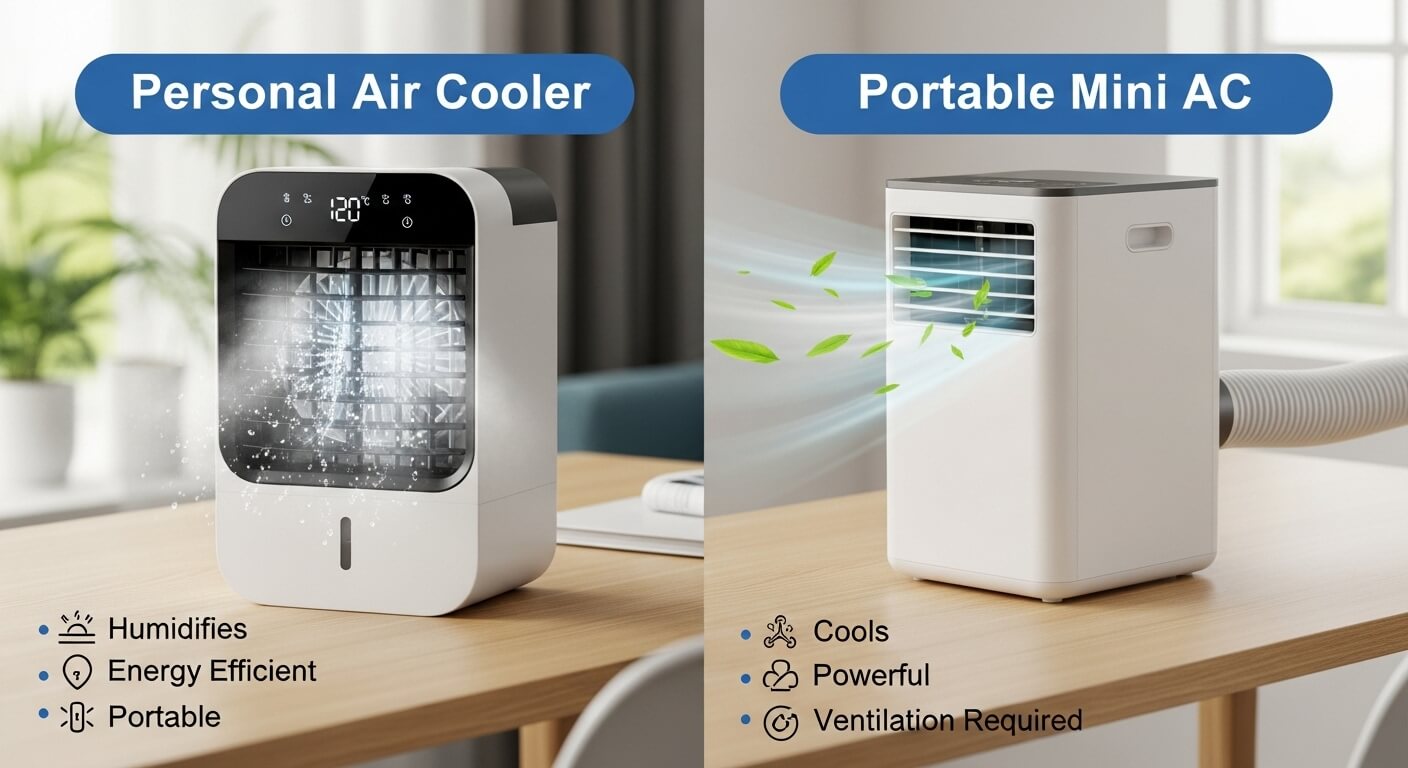
The personal air cooler versus portable mini AC decision comes down to a simple reality: they’re fundamentally different devices serving different purposes. Personal air coolers provide localized evaporative cooling at minimal cost and energy use, but they don’t actually cool rooms and fail completely in humid climates. Portable mini ACs deliver genuine air conditioning with measurable temperature reduction, but require greater investment and ongoing energy costs.
For most people in humid climates or those who need actual cooling, a portable mini AC is the only option that will deliver satisfactory results. The higher upfront cost and energy consumption are justified by the device actually working as intended. For those in very dry climates who only need personal spot cooling, evaporative coolers can provide adequate comfort at a fraction of the cost.
Don’t be swayed by misleading marketing that makes evaporative coolers seem like air conditioners. Understand the technology, assess your climate and needs honestly, and choose accordingly. Your comfort during hot weather depends on making an informed decision rather than hoping a $50 device can do the work of a $300 one. In this case, you really do get what you pay for, and understanding the difference will save you from disappointment and wasted money.