
A portable air conditioner that runs, blows air, and leaves the room exactly as warm as it was an hour ago is one of the more demoralising appliance failures, mostly because everything looks like it is working. The fan is going. The compressor is humming. The display says 68 degrees. The room says otherwise.
In the majority of cases the unit is not broken. It is fighting a setup problem, and the fix costs nothing. This guide works through the causes in the order they actually occur, starting with the ones that account for most complaints and ending with the ones that mean a service call.
Before anything else, one reality check. A portable air conditioner does not cool a room the way a window or split unit does. It is less efficient by design, because it takes air from the room it is cooling and dumps some of it outside. Expectations that were set by a wall mounted unit will not be met. Our explanation of how portable cooling technology actually works covers why.
Start Here: The Sixty Second Checks
| Check | What To Look For |
| Mode setting | Must be Cool, not Fan or Dry |
| Set temperature | At least 5 degrees below current room temperature |
| Exhaust hose | Attached, venting outdoors, not into the room |
| Hose length and shape | As short and straight as possible |
| Air filter | Clean, not clogged with dust |
| Water tank | Not full, no full tank warning light |
| Window seal | No visible gaps around the vent kit |
| Room doors | Closed, especially to unconditioned space |
Roughly three quarters of the complaints in this category are resolved somewhere in that table.
Cause One: The Exhaust Hose Setup
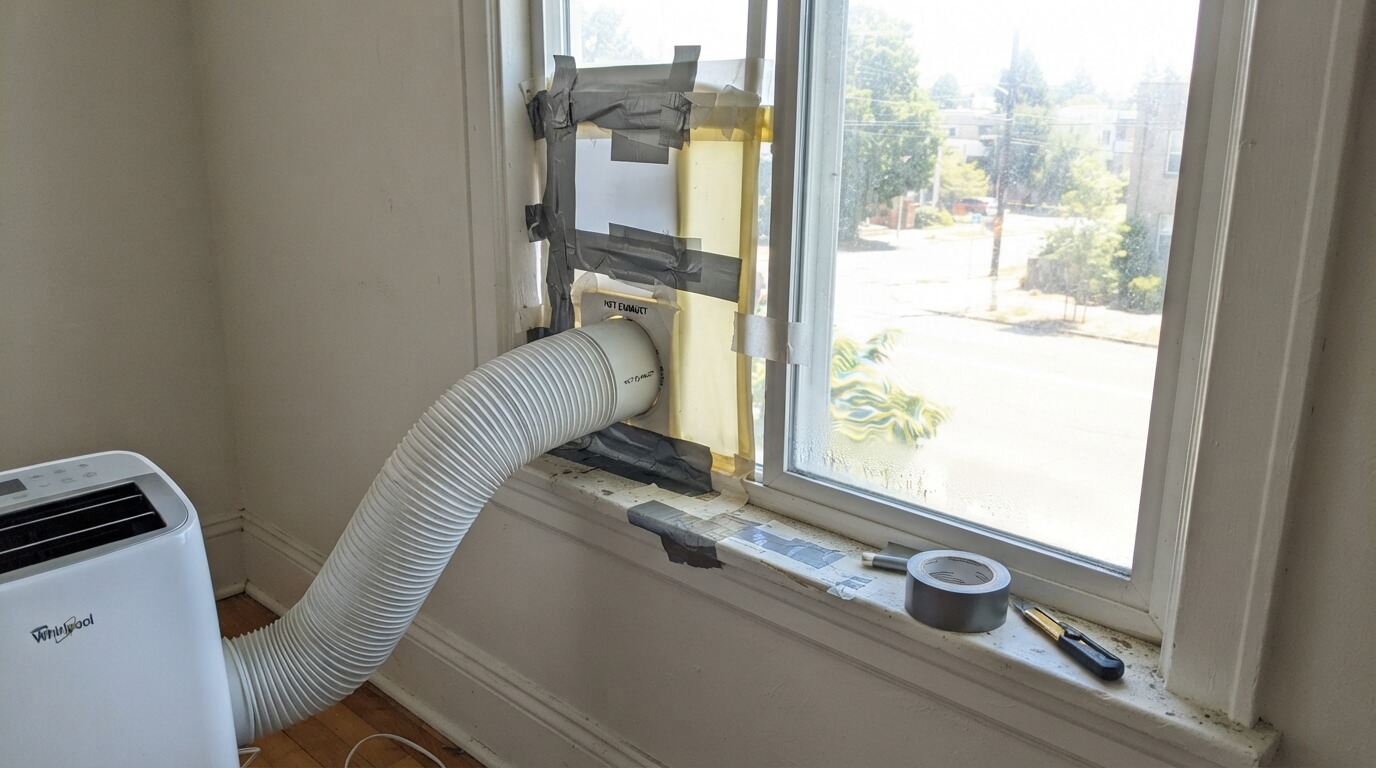
This is the single most common reason a portable unit fails to cool, and it is entirely about how the hose was installed.
A portable air conditioner works by extracting heat from room air and expelling it outside through the exhaust hose. Everything about how that hose is routed affects whether the heat actually leaves.
• The hose must vent outdoors. Not into a loft space, not into an adjoining room, not into a cupboard. Heat pushed into another indoor space makes its way back.
• Keep it short. Manufacturers supply hoses that extend considerably, but extended hoses radiate heat back into the room along their entire length. Use the minimum length that reaches.
• Keep it straight. Every bend, sag and coil creates back pressure and a radiating surface. A hose looping across the floor is a heater in the middle of the room you are cooling.
• Never extend it with additional ducting. Longer than designed means the unit cannot expel air at the rate it needs to.
• Insulate it if the room is struggling. Hose insulation wraps are inexpensive and make a genuine difference in hot conditions.
• Check the window seal. A vent kit with gaps around it lets hot air stream back in. Foam strip and tape close them.
If the hose gets hot enough to be uncomfortable to touch, it is working, and it is also radiating that heat into the room. Shortening, straightening and insulating it is the highest value thing most people can do.
Cause Two: Single Hose Versus Dual Hose
This is not a fault. It is a design characteristic that explains a lot of disappointment.
A single hose unit takes air from the room, uses it to cool the condenser, and blows it outside. Air leaving the room has to be replaced, and it gets replaced by warm air pulled in through every gap in the building: under doors, around windows, through vents. The unit is therefore continuously importing the heat it is trying to remove. This is called negative pressure and it is why single hose units underperform their rated capacity in practice.
A dual hose unit draws outside air in through one hose to cool the condenser and expels it through the other, so it does not depend on room air for that job. It is noticeably more effective in hot conditions and in larger rooms.
If you own a single hose unit, you cannot convert it, but you can reduce the penalty.
• Seal the room as well as possible, particularly door gaps to hotter areas.
• Keep the unit in a smaller space than its rating suggests.
• Run it before the room gets hot rather than trying to recover a room that already is.
Cause Three: Undersized for the Room
BTU ratings are calculated for ideal conditions, and real rooms are rarely ideal. A unit rated for a room your size may still be undersized if the room has large windows, direct sun, poor insulation, high ceilings, a west facing aspect, or heat generating equipment inside it.
| Room Size | Baseline Rating | Adjust Upward For |
| 150 square feet | 6,000 BTU | Sun exposure, add 10 percent |
| 250 square feet | 8,000 BTU | High ceilings, add 10 to 20 percent |
| 350 square feet | 10,000 BTU | Kitchens, add 4,000 BTU |
| 450 square feet | 12,000 BTU | Multiple occupants, add 600 BTU each |
| 550 square feet | 14,000 BTU | Poor insulation, add 20 percent |
Note also that many portable units are advertised with an older rating standard that reads considerably higher than the newer seasonally adjusted figure for the same machine. Two units with very different headline numbers can perform similarly. The Energy Star guidance on room air conditioners is a useful reference for interpreting ratings, and our explainer on cooling specifications and what they mean covers the BTU, CFM and EER alphabet in more depth.
If the unit is genuinely undersized, no amount of troubleshooting fixes it. Reducing the space it has to cool, by closing off part of an open plan area, is usually the only practical answer short of replacement.
Cause Four: Airflow Restrictions
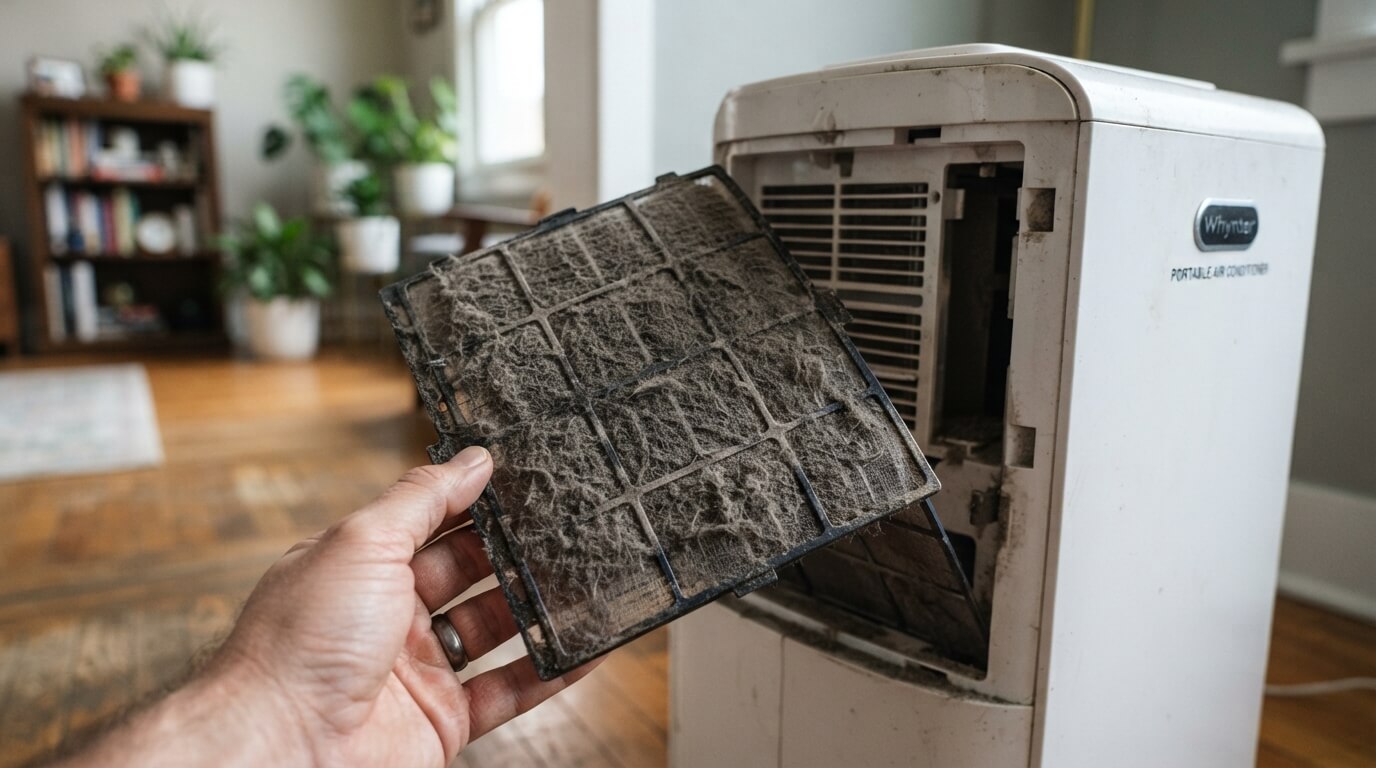
A clogged filter is the most common maintenance related cause, and it produces a distinctive symptom pattern: weak airflow from the outlet, the unit running constantly, and in some cases ice forming on the internal coil.
• Clean the filter every two weeks in heavy use. Most are washable. Rinse, dry completely, refit.
• Check both filters. Many units have one at the intake and one near the exhaust, and people clean only the accessible one.
• Clear the coils. Dust on the evaporator coil insulates it from the air it is supposed to be cooling.
• Give the unit space. At least 20 inches of clearance around the intake and outlet. Pushed against a wall or into an alcove, it recirculates its own air.
• Check the outlet louvres for obstruction and make sure furniture is not sitting in front of the airflow.
Our step by step guide on cleaning and maintaining a portable air conditioner covers the full service routine.
Cause Five: Drainage and Water Issues
Portable units remove moisture as well as heat, and that water has to go somewhere. Most units are self evaporating in moderate conditions, but in humid weather the tank fills faster than the unit can expel it.
• Full tank shutdown: Most units stop cooling and run the fan only when the tank is full, often with a warning light people miss.
• Continuous drain: Fitting a drain hose to a low point removes the problem entirely. This is worth doing in any humid climate.
• Blocked drain line: Algae and dust block drain lines over a season. Flush it if the tank is filling abnormally fast or water appears around the base.
• Unit must be level: A tilted unit drains incorrectly and can trigger false full tank warnings.
High humidity also makes a room feel warmer at the same temperature, which means a unit doing a reasonable job of cooling can still feel inadequate. Our explanation of why the same temperature feels completely different from one day to the next covers what is happening there.
Cause Six: Ice on the Coils
Ice inside an air conditioner seems like a sign it is working very well indeed. It is the opposite.
Ice forms when airflow across the evaporator coil is too low or when refrigerant pressure is wrong. The insulating layer of ice then blocks airflow further, and the unit ends up circulating room air across a block of frost while cooling nothing.
• Switch to fan only mode for an hour or two to melt the ice fully.
• Then clean the filter and coils, which is the cause in most cases.
• Check the room is not too cold for the unit. Running a portable AC below around 60 degrees ambient can cause freezing.
• If it reforms after cleaning, the likely cause is low refrigerant, which is a service issue rather than a maintenance one.
Cause Seven: Refrigerant and Compressor Problems
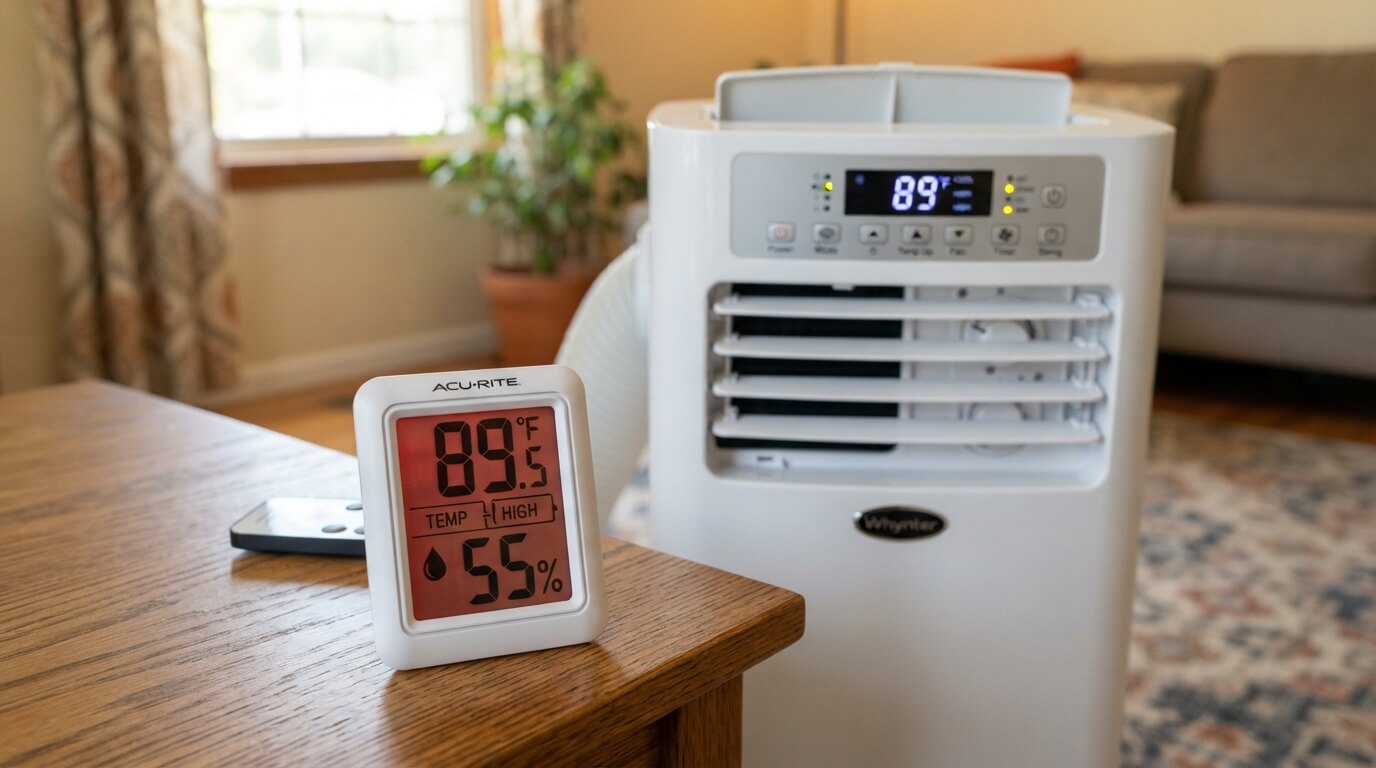
This is where the free fixes end. Signs that point to a sealed system fault include the unit blowing air that is barely cooler than room temperature despite clean filters and good venting, ice reforming immediately after defrosting, a hissing or bubbling noise, or the compressor cycling on and off rapidly.
Refrigerant does not get consumed. If a unit is low, it leaked, and topping it up without finding the leak is a temporary and legally regulated fix in most jurisdictions. This requires a qualified technician. Our explainer on the difference between R22 and R410A refrigerant covers why older units in particular can become uneconomic to repair.
Compressor failure usually announces itself as a unit that runs the fan normally but never gets cold, sometimes with a humming or clicking at start up. On most portable units, compressor replacement costs more than the machine is worth.
Electrical and Placement Checks
• Avoid extension leads. Portable ACs draw high current and undersized leads cause voltage drop and tripping. Wall socket directly.
• Check for a tripped breaker or a tripped plug mounted safety cutout, which some units have built into the cable.
• Wait three minutes between power cycles. Most units have a compressor protection delay. Switching on and off rapidly leaves the fan running with no cooling.
• Do not place it in direct sunlight, which makes the whole job harder.
• Close curtains on sun facing windows, which does more than most settings changes.
When To Repair and When To Replace
| Situation | Reasonable Action |
| Under warranty | Contact the manufacturer before opening anything |
| Filter, drainage, hose or seal issue | Fix it yourself, no cost |
| Fan motor failure, unit under three years old | Repair is usually worthwhile |
| Refrigerant leak | Get a quote, but weigh it against replacement |
| Compressor failure | Replacement is almost always the better value |
| Unit over eight years old with a major fault | Replace, and gain the efficiency improvement |
Frequently Asked Questions
Why is my portable air conditioner running but not cooling?
The most common causes are an exhaust hose that is too long, kinked, uninsulated or not venting outdoors, a clogged filter, a full water tank triggering fan only mode, or the unit being undersized for the room. Work through those four before assuming a fault.
Does the exhaust hose length really matter?
Yes, considerably. Extended and coiled hoses radiate the heat they are carrying back into the room and create back pressure that reduces the unit’s ability to expel it. Use the shortest, straightest run that reaches the window, and insulating the hose helps in hot weather.
Why is there ice on my portable air conditioner?
Ice forms when airflow across the coil is restricted, usually by a dirty filter or blocked coils, or when refrigerant is low. Run the unit on fan only until the ice melts, then clean the filter and coils. If ice returns quickly, it needs a technician.
Is a dual hose portable air conditioner better than a single hose?
In most circumstances yes. A single hose unit expels room air, which draws warm outside air in through gaps in the building to replace it, working against itself. A dual hose unit uses outside air for the condenser and avoids that penalty, which matters most in hot weather and larger rooms.
How often should I clean the filter?
Every two weeks during heavy use, and monthly otherwise. Most filters are washable. Rinse them, dry them completely, and refit, and check whether your model has a second filter people commonly miss.
Can I vent a portable air conditioner into another room?
No. The heat has to leave the building. Venting into a loft, hallway or cupboard simply moves the heat somewhere it will return from, and in a loft it can cause condensation and moisture damage.
The Short Version
Check the mode and temperature setting, then the hose, then the filter, then the tank, then the room size. That sequence resolves most cases without tools. Ice on the coil means airflow or refrigerant. Air that never gets cold with everything else correct means the sealed system, which means a technician or a replacement.
And keep the expectation calibrated. A portable unit in a sealed, shaded, appropriately sized room performs well. The same unit in a sunlit open plan space with a coiled hose out of a badly sealed window will disappoint no matter what the display says.