
The reassuring thing about a good cooler is that it still feels cold on day three. The dangerous thing about a good cooler is that it still feels cold on day three. Cold to the hand is not the same as safe to eat, and the gap between the two is where almost every cooler-related food safety problem lives.
There is one number that decides everything in this article, and it is 40 degrees Fahrenheit, or 4 degrees Celsius. Below it, bacterial growth in food slows to a manageable rate. Above it, growth accelerates, and the clock starts running on how long the food remains safe. A cooler holding a cheerful 45 degrees feels cold, has ice floating in it, and is nonetheless in the range where you are counting hours rather than days.
This guide covers the temperature thresholds, how long different foods last in practice, where to put a thermometer and why the placement matters, what to do about meltwater, which foods to worry about and which to relax about, and the specific rules for the situations people get wrong most often. If you want to know how long your cooler will hold ice in the first place, our roundup of coolers that keep ice frozen for five days or more covers the hardware side.
The Numbers That Matter
| Measure | Threshold | Why |
| Safe cold holding | 40 degrees Fahrenheit or below | Bacterial growth slows substantially |
| Danger zone | 40 to 140 degrees Fahrenheit | Range where bacteria multiply fastest |
| Maximum time in the danger zone | 2 hours | Cumulative, not per sitting |
| Maximum time above 90 degrees Fahrenheit | 1 hour | Hot day, car boot, direct sun |
| Frozen storage | 0 degrees Fahrenheit or below | Requires dry ice in a cooler context |
| Safe refreezing | Still contains ice crystals and at or below 40 | Quality drops, safety holds |
The two hour rule deserves particular attention because it is cumulative and people treat it as though it resets. Time spent on a picnic table, time in a warm car, and time spent with the lid open at the barbecue all add together. Two hours total, not two hours per occasion, and one hour when the ambient temperature is above 90 degrees Fahrenheit. The USDA Food Safety and Inspection Service sets out the same thresholds for domestic food handling generally.
How Long Foods Actually Last
Assuming the cooler holds at or below 40 degrees Fahrenheit throughout, these are practical working limits.
| Food | Safe Duration at 40F or Below | Notes |
| Raw ground meat | 1 to 2 days | Highest risk category, use first |
| Raw poultry | 1 to 2 days | Keep sealed and at the very bottom |
| Raw steaks, chops, roasts | 3 to 5 days | Whole cuts are more forgiving than ground |
| Raw fish and shellfish | 1 to 2 days | The most time sensitive item in most coolers |
| Cooked meat and leftovers | 3 to 4 days | Cool fully before it goes in |
| Fresh milk and soft cheese | 5 to 7 days | Hard cheese lasts considerably longer |
| Eggs in shell | Up to 3 weeks | Keep dry, discard any that get submerged |
| Deli meats, opened | 3 to 5 days | Sealed packs last longer until opened |
| Hot dogs and sausages, opened | 1 week | |
| Cut fruit and salad | 3 to 4 days | Quality fails before safety usually |
| Whole produce | Varies widely | Most does not require cooling at all |
| Condiments and hard cheese | Weeks | Low risk, do not waste ice space on them |
Two things cut every figure on this list. Any period above 40 degrees, and any cross contamination from raw meat juices. Both are avoidable with packing discipline.
Why Thermometer Placement Changes the Answer
A cooler is not one temperature. It is a stack of layers, and the difference between the bottom and the top can easily be ten degrees or more.
Cold air falls, which means ice at the top produces a cold bottom, and the food sitting at the top of the load is always the warmest thing in the cooler. A thermometer resting on the ice reads the ice. A thermometer clipped to the underside of the lid reads the air that rushes in every time you open it. Neither number tells you what you need to know.
The reading that matters is the temperature where the highest risk food sits. Put an inexpensive fridge thermometer alongside the meat, not on top of the ice, and check it when you open the cooler rather than after it has been open for five minutes.
Two coolers solve this problem more elegantly than any thermometer. One for drinks, which gets opened constantly, and one for food, which gets opened three times a day. The drinks cooler will run warmer and it does not matter. The food cooler will hold temperature dramatically better simply because the lid stays shut. If you only own one, our comparison of personal coolers and portable mini units and our guide to cooler sizing can help you decide whether a second smaller unit is worth the space.
Packing for Safety Rather Than Convenience
The order things go in determines both how long the cooler holds temperature and whether raw juices end up on ready to eat food.
1. Pre chill everything. The cooler itself, overnight if possible, and every item going into it. A cooler is an insulator, not a refrigerator. It preserves the temperature you put in and cannot create cold it was not given.
2. Freeze what you can. Meat frozen solid before departure buys you an extra day or two and acts as additional cooling mass.
3. Raw meat at the bottom, in sealed containers. Not bags that leak, not the supermarket tray with film over it. Sealed hard containers or double bagged, always below everything else.
4. Ready to eat food above, sealed. Anything you will not cook before eating never sits below raw meat.
5. Fill the gaps. Air is the enemy. Ice, towels, newspaper, anything that reduces the empty volume.
6. Block ice at the bottom and cubed ice around the sides. Block ice lasts far longer, cubed ice fills gaps and cools faster. Using both is better than either alone.
7. Keep it out of the sun and out of the car boot. A shaded footwell is markedly cooler than a boot, and a blanket over the cooler helps more than people expect.
The Meltwater Question
This is the most contested topic in cooler use, and both sides of the argument have a point.
Cold meltwater conducts heat far better than air, which means ice sitting in its own water actually holds the surrounding contents at a more uniform temperature than ice sitting in air. Draining a cooler every morning removes that thermal mass and often makes the ice disappear faster.
The counterargument is contamination. Meltwater that has come into contact with raw meat packaging is a contamination vector, and anything sitting in it, including sealed drinks you later hold to your mouth, is now in contact with that water.
The workable resolution is this. If everything in the cooler is sealed properly and no raw meat juice has escaped, leave the water. It is doing useful work. If any packaging has leaked, or if you are unsure, drain and clean rather than gambling. And never allow items with permeable packaging, such as paper wrapped food, cardboard boxes or anything in a bag that can wick, to sit in standing water.
Eggs deserve a specific mention. Shell is porous, and a submerged egg can draw contaminated water through it. Keep them above the waterline or in a sealed container.
When To Throw Food Away
This is the section people want a clever workaround for, and there is not one. Discard food if any of the following applies.
• It has been above 40 degrees Fahrenheit for more than two hours cumulative, or one hour if ambient temperature exceeded 90 degrees.
• The cooler was left in a hot car and the contents are no longer cold to the touch.
• Raw meat juice has leaked onto ready to eat food. The contaminated item goes, not just the surface of it.
• Meat is slimy, sticky, discoloured or smells off. Trust the assessment and do not attempt to rescue it by cooking.
• A perishable item has been sitting out at a picnic beyond the time limits above.
Three things that do not make food safe: cooking it thoroughly, freezing it after the fact, and the absence of a smell. Some bacterial toxins survive cooking, freezing pauses growth rather than reversing it, and plenty of dangerous contamination produces no detectable odour. The FoodSafety.gov guidance for outdoor events and seasonal cooking makes the same point in its guidance on barbecues and picnics.
Refreezing is the one area with a genuine allowance. Food that still contains ice crystals and has remained at or below 40 degrees can be refrozen safely. Texture and quality suffer, but safety holds. Food that has fully thawed and warmed past that threshold cannot.
The Situations People Get Wrong
Tailgating and Barbecues
The problem is not the cooler. It is the two hours of open lid and food sitting on a table in the sun while people graze. Serve in batches, return the rest to the cooler between servings, and keep raw meat in a separate cooler entirely from ready to eat items. Use a separate plate for cooked meat rather than the one the raw meat travelled on.
Fishing Trips
Catch goes on ice immediately, not at the end of the day. Fish deteriorates faster than almost anything else in this article, and a warm hour on a boat deck costs more than a warm hour would cost a steak. Keep a dedicated catch cooler and never mix it with food you plan to eat unprepared.
Long Road Trips
Boot temperatures in summer routinely exceed cabin temperatures by a wide margin, and a cooler sitting in a hot boot for six hours is working against a losing gradient. Keep it in the cabin, in shade, with air moving around it, and understand that your ice estimate from a shaded campsite does not transfer to a vehicle. Our article on how heat affects the body covers the related question of what those cabin temperatures do to passengers.
Camping Beyond Three Days
At some point the honest answer is to change the menu rather than chase the ice. Shelf stable proteins, tinned goods, hard cheeses and produce that does not need cooling extend a trip far more reliably than another twenty pounds of ice. Plan perishables for the first two days and eat the highest risk items first.
Power Outages
A cooler is the correct tool for a domestic outage, but only if it is already cold when you need it. Frozen water bottles in a freezer serve double duty as cooling mass and drinking water, and a fridge thermometer means you can make an informed decision about what to keep rather than a guess.
Cleaning Between Trips
Food safety does not end when the trip does. A cooler that goes into storage with residue in it grows a biofilm, and the next trip starts with a contaminated container.
• Empty and rinse it the day you get home, not the following weekend.
• Wash with warm soapy water, paying attention to the drain channel and under the gasket, which are where residue collects.
• Sanitise after raw meat contact. A dilute bleach solution rinsed thoroughly is the standard approach.
• Dry completely and store with the lid propped open. Sealed and damp is how coolers develop the smell people spend years trying to remove. Our guide to cooler odor retention and plastic types covers which liners are most prone to it and what removes it.
Liner material matters more than people assume for both cleaning and safety, and our breakdown of FDA food grade versus standard plastic safety standards explains what those certifications on the box actually cover.
Ice Strategy: Getting to Day Three and Beyond
Food safety in a cooler is really a question of how long you can hold the temperature, and that is an ice problem before it is a food problem.
• Use a 2 to 1 ratio of ice to contents by volume. This is the figure that surprises people. A cooler two thirds full of food and one third full of ice will not hold 40 degrees for long. The reverse ratio will.
• Block ice for duration, cubed ice for speed. Block ice has less surface area per pound and lasts two to three times longer. Cubed ice cools faster and fills the small gaps. Use block at the bottom and cubed around and above.
• Freeze water bottles as your cooling mass. They act as block ice, they do not add meltwater, and they become drinking water as they thaw. This is the single most efficient trick in cooler packing.
• Add salt to the meltwater if you need colder than freezing. Salt lowers the freezing point and drops the internal temperature below 32 degrees, which is useful for holding frozen items but hard on anything you do not want frozen.
• Pre chill with sacrificial ice. Put a cheap bag of ice in the cooler the night before, discard it in the morning, then pack. Cooling the cooler walls with your good ice wastes a significant portion of it.
• Insulate from outside too. A reflective blanket, a towel, or simply parking the cooler in shade changes ice life more than most gear upgrades do.
• Open it as rarely as possible. Every opening exchanges the cold air inside for warm air. This is why the second cooler for drinks pays for itself in a single trip.
Humidity affects how quickly ambient heat transfers into a cooler as well, which is part of why the same cooler performs differently on two days that read the same temperature. Our explanation of why the same temperature feels completely different from one day to the nextcovers the underlying physics.
A Pre-Departure Checklist
Print this, or copy it into your phone notes. It takes the guesswork out of the part of the trip where mistakes are made.
• The night before: Cooler pre chilled with sacrificial ice. Meat frozen solid. Water bottles frozen. Drinks chilled in the fridge.
• Loading: Sacrificial ice discarded. Block ice at the bottom. Raw meat sealed in hard containers on the block. Ready to eat food sealed above. Cubed ice filling every gap. Thermometer placed next to the meat.
• Separation: Drinks in their own cooler. Raw catch or raw meat separate from anything eaten without cooking.
• Transport: Cooler in the cabin rather than the boot. Out of direct sun. Covered with a blanket if the journey is long.
• On arrival: Cooler in shade, off hot ground, lid closed. Check the thermometer before anything else.
• During the trip: Highest risk foods eaten first. Serve in batches. Lid shut between servings. Two hour rule tracked cumulatively.
• Daily: Thermometer check each morning. Top up ice before it disappears rather than after.
• On return: Empty, wash, sanitise if raw meat was carried, dry fully, store with the lid propped open.
Powered Coolers Change the Maths
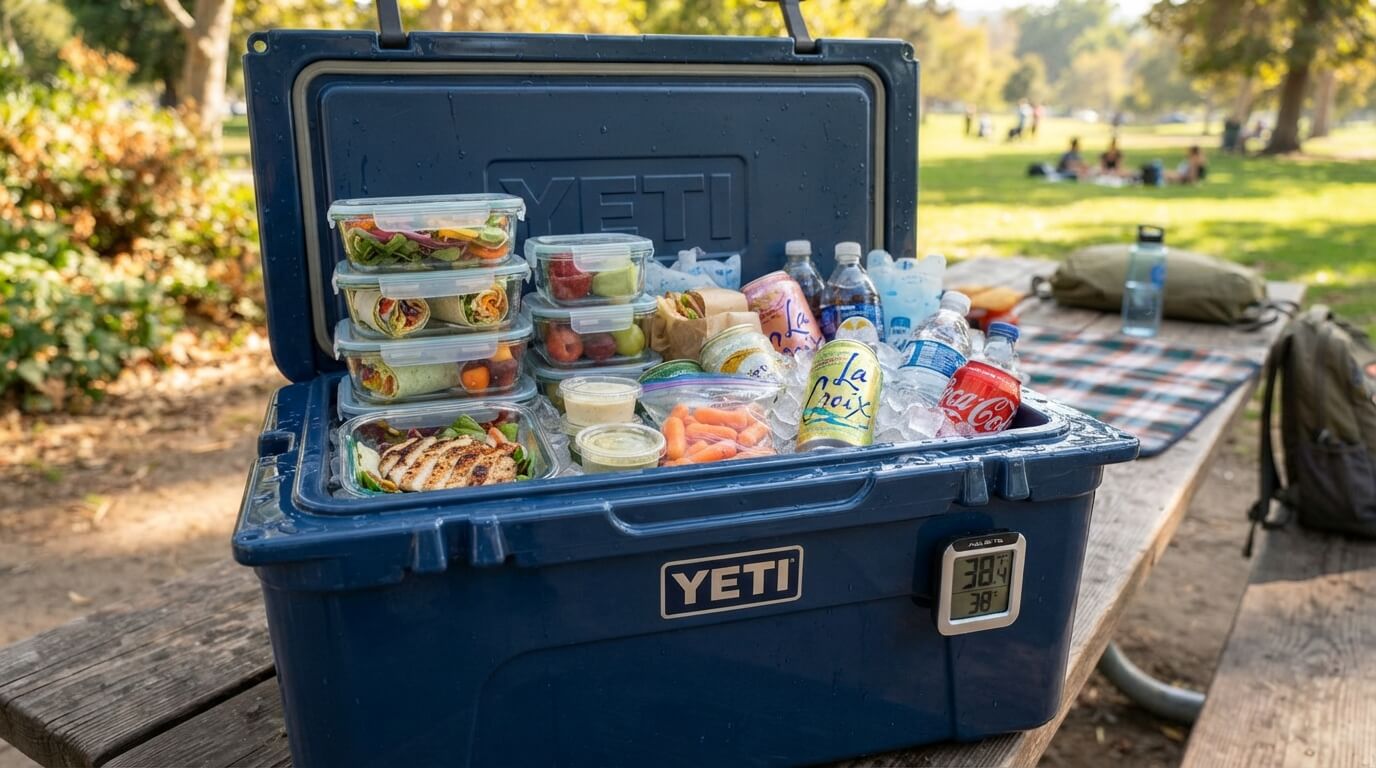
Everything above assumes an insulated box with ice in it. Electric coolers behave differently and it is worth knowing which type you have, because the safety implications are not the same.
• Thermoelectric coolers use the Peltier effect to move heat, and they typically cool to a fixed number of degrees below ambient rather than to a set temperature. On a 95 degree day, a unit rated at 40 degrees below ambient is holding around 55 degrees, which is inside the danger zone regardless of what the packaging implies. These are best treated as drinks chillers rather than food safety devices in hot conditions.
• Compressor coolers run an actual refrigeration cycle and hold a set temperature independently of ambient, often down to freezing. These are genuine portable refrigerators and the standard 40 degree rule applies exactly as it does at home.
• Hybrid and 12 volt units vary widely. Check whether the specification quotes a temperature or a differential below ambient, because that single distinction tells you which category you are in.
The failure mode people miss is power loss. A powered cooler with no ice in it has almost no thermal mass, so when the vehicle is switched off or the battery runs down, the interior warms far faster than an ice packed passive cooler would. Adding a couple of frozen water bottles to a powered cooler gives you a buffer for exactly that scenario.
Our look at whether one device for summer and winter makes sense covers the wider question of dual function units, and the same principle applies here: a device that does two jobs adequately is rarely the better choice when one of those jobs is food safety.
Frequently Asked Questions
How long does food stay safe in a cooler?
As long as the cooler holds at or below 40 degrees Fahrenheit, standard refrigerator timings apply: one to two days for ground meat, poultry and fish, three to five days for whole cuts and leftovers. Once the temperature rises above 40 degrees, you have two hours cumulative, or one hour above 90 degrees ambient.
What temperature should a cooler be?
At or below 40 degrees Fahrenheit, measured where the food sits rather than on the ice or at the lid. Below that threshold bacterial growth slows substantially, and above it the clock starts.
Should I drain the meltwater from my cooler?
Not if everything is properly sealed and no raw meat juice has escaped, because cold water holds temperature better than air and draining it shortens ice life. Drain and clean if any packaging has leaked, and never let permeable packaging or eggs sit submerged.
Can I refreeze meat that thawed in the cooler?
Yes, if it still contains ice crystals and has stayed at or below 40 degrees Fahrenheit. Quality will suffer but safety holds. Meat that has fully thawed and warmed above that threshold should be cooked immediately or discarded.
Is food still safe if the ice melted but the food feels cold?
Not necessarily. Cold to the touch can be anywhere from 40 to 60 degrees Fahrenheit, and the upper end of that range is firmly in the danger zone. Use a thermometer rather than your hand, and if the food has been above 40 degrees for more than two hours, discard it.
Does cooking spoiled food make it safe?
No. Cooking kills many bacteria, but some produce heat stable toxins that survive it. Food that has been in the danger zone too long is not rescued by thorough cooking.
Where should raw meat go in a cooler?
At the very bottom, in sealed containers, below everything else. Raw juices travel downward, and anything below raw meat is at risk of contamination. Ready to eat food goes above it, also sealed.
The Short Version
Forty degrees Fahrenheit is the line, two hours is the limit once you cross it, and a thermometer next to the meat is the only way to know which side of the line you are on. Pre chill everything, pack raw meat sealed at the bottom, fill every air gap, keep the food cooler separate from the drinks cooler, and eat the highest risk items in the first two days.
A good cooler makes all of this easier. It does not make any of it optional.
This article is for general information. Follow current national food safety guidance where you live, and when in doubt about whether a perishable item has stayed cold enough, discard it.