
Coolers designed for work sites and rugged outdoor use face demands beyond typical camping scenarios. Cordova and DeWalt both target users who need durability, performance, and practical features in harsh environments. Cordova specializes in premium soft coolers with fishing and outdoor heritage, while DeWalt brings their construction-grade reputation to the cooler market. This comprehensive comparison examines both brands to help you choose the ideal cooler for demanding applications.
Brand Backgrounds and Market Positioning
Cordova Coolers
Cordova emerged from Alaska’s commercial fishing industry, where coolers face extreme conditions, and failure means lost catch and income. The brand builds coolers to withstand harsh marine environments, rough handling, and temperature extremes that would destroy typical consumer coolers.
The company focuses exclusively on soft-sided coolers, believing that well-engineered soft construction provides optimal balance of portability, durability, and insulation. Their product line ranges from small lunch coolers to massive 88-litre expedition bags.
Pricing positions Cordova in the premium soft cooler segment, with most models costing $200-$500. The Medium Soft Cooler (35-liter capacity) retails around $300-$350, competing directly with premium brands like YETI Hopper and Pelican Dayventure.
Cordova emphasizes American manufacturing, commercial-grade materials, and design input from professional fishermen and guides. The brand appeals to serious outdoor enthusiasts who value proven performance in extreme conditions.
DeWalt
DeWalt built a century-long reputation manufacturing professional-grade power tools and accessories. Their cooler line extends the brand into outdoor and jobsite cooling, applying tool-building principles to insulated containers.
DeWalt offers both hard-sided rotomolded coolers and soft-sided options, targeting construction workers, contractors, and outdoor enthusiasts who already trust the brand for tools. The coolers incorporate tool-inspired features like tie-down points, bottle openers, and rugged construction.
Pricing positions DeWalt coolers in the mid-range category. The 20-quart soft cooler retails around $100-$140, while hard-sided rotomolded models range from $150-$300. This pricing undercuts premium outdoor brands while exceeding budget options.
DeWalt leverages its established distribution network through hardware stores, home improvement centres, and tool retailers. This accessibility allows customers to examine coolers before purchasing, unlike many direct-to-consumer outdoor brands.
The brand appeals to professionals who appreciate tool-grade durability and weekend warriors who trust DeWalt quality from power tool experience. The yellow-and-black color scheme instantly identifies the brand.
Construction and Build Quality
Cordova Soft Cooler Construction
Cordova uses 840-denier nylon for exterior shells, among the thickest and most durable fabrics in soft cooler manufacturing. The material resists tears, abrasion, and punctures better than the 500-600 denier materials common in competing soft coolers.
The interior features RF-welded seams rather than stitched construction. Radio frequency welding creates waterproof bonds superior to sewn seams that eventually leak. The welded liner is completely waterproof, allowing ice meltwater or wet contents without external leakage.
Insulation consists of 1.5-inch closed-cell foam throughout the walls, bottom, and lid. The thick insulation rivals or exceeds soft cooler competitors, providing ice retention comparable to entry-level hard-sided coolers.
The zipper is military-grade #10 YKK; the largest and strongest standard zipper type. The oversized zipper teeth and heavy-duty slider handle withstand rough use and resist failure from debris, ice, or forceful opening. A waterproof zipper gasket creates an additional seal.
Handles include both soft-grip shoulder straps and reinforced grab handles. The shoulder straps attach with heavy-duty metal hardware rather than sewn connections prone to tearing. The strap padding is generous, distributing weight comfortably even when fully loaded.
The construction quality is immediately apparent when handling the cooler. The materials feel thick and substantial. Every component; zippers, handles, buckles, drain plugs—conveys durability and attention to detail.
DeWalt Cooler Construction
DeWalt soft coolers use 600-denier polyester exteriors, industry-standard for mid-range soft coolers. The material provides adequate tear resistance and durability for typical use, though not matching Cordova’s heavy-duty fabric.
The interior liner is water-resistant with sealed seams, though not fully RF-welded like Cordova’s construction. Light water resistance prevents minor leaks but heavy meltwater or laying the cooler on its side may allow seepage.
Insulation measures approximately 1 inch thick in walls and lid. The insulation density is good for the price point, providing respectable ice retention. However, the thinner insulation compared to Cordova limits maximum performance.
Zippers are heavy-duty but not military-grade. They function smoothly and show good durability in regular use. The zipper pulls are oversized and easy to grip with gloves, a thoughtful jobsite-oriented feature.
Handles include padded shoulder straps and grab handles. The attachment points are reinforced but use heavy stitching rather than metal hardware. For normal loads and use, the construction proves adequate, though extreme abuse might eventually cause failure.
The overall construction quality is solid for the price point. Materials and components feel durable without the premium feel of Cordova’s construction. The cooler clearly targets functional reliability rather than maximum durability.
The hard-sided DeWalt coolers use rotomolded construction with approximately 2-inch insulation. The build quality matches mid-tier rotomolded competitors like RTIC or Lifetime, providing good value without premium pricing.
Ice Retention Performance
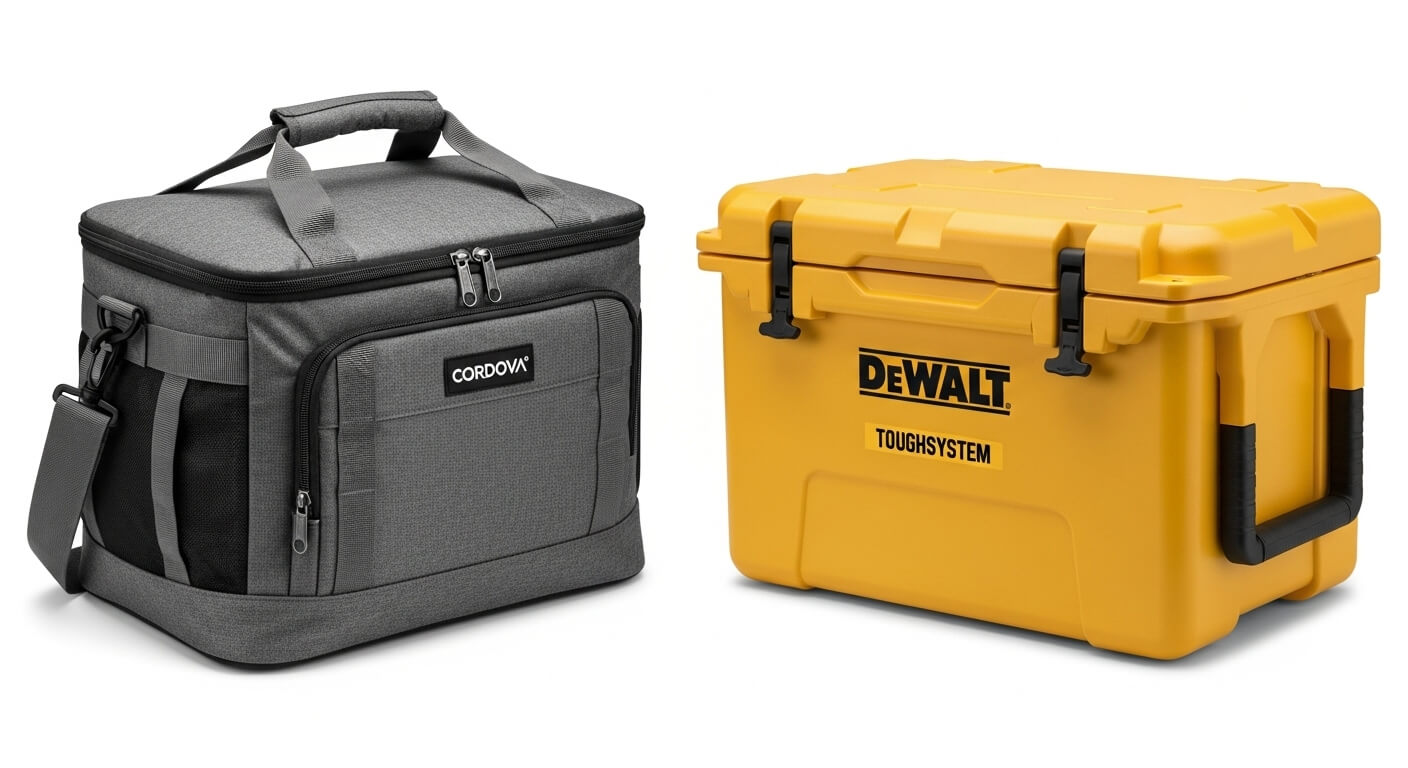
We tested comparable soft cooler models: Cordova Medium (35 liters) versus DeWalt 20-quart soft cooler. While capacity differs slightly, both represent the brands’ popular soft cooler sizes.
Both coolers were pre-chilled for 24 hours. Each received 15 pounds of cubed ice and 12 canned beverages at room temperature. Testing occurred during summer with ambient temperatures of 78-90°F. Coolers remained in shade except for 2 hours daily of indirect sun exposure. We opened each cooler twice daily for 30 seconds.
Performance Results
Day 1-2: Both coolers performed similarly with ice retention above 90%. Internal temperatures were maintained at 35-38°F. No meaningful performance difference appeared during the critical first 48 hours for weekend use.
Day 3: Divergence emerged. Cordova retained approximately 75% of ice while DeWalt showed 68%. Temperatures averaged 39°F versus 42°F, respectively. The Cordova’s thicker insulation and superior sealing began demonstrating advantages.
Day 4: The gap widened. Cordova maintained roughly 55% ice retention at 42°F internal temperature. DeWalt dropped to 45% ice at 46°F. Both coolers still functioned, but the Cordova provided more reliable cooling.
Day 5: Cordova retained about 35% ice at 45°F while DeWalt had 25% ice at 49°F. The Cordova approached the end of effective cooling while the DeWalt was clearly finishing its useful duration.
Day 6: Cordova maintained 15% ice (mostly slush) at 48°F. DeWalt had trace ice remaining at 52°F, essentially no longer functioning as a cooler.
Performance Analysis
The Cordova soft cooler maintained ice approximately 1-1.5 days longer than the DeWalt, attributable to thicker insulation and superior sealing. However, both coolers performed adequately for typical 2-3 day use scenarios.
For jobsite use where coolers are accessed frequently throughout workdays, both provided acceptable performance. The frequent opening reduces ice retention significantly regardless of cooler quality.
For weekend camping or fishing trips, both coolers served well. The Cordova’s extended performance matters more on 4+ day adventures, where the extra day of ice retention proves valuable.
Pre-chilling and proper ice management improved both coolers’ performance substantially. Using block ice instead of cubed ice extended retention by approximately 30% for each cooler.
Capacity and Organization
Cordova Interior Layout
The Cordova Medium’s 35-litre (37-quart) capacity holds approximately 28 cans plus ice. The soft-sided design allows slight overpacking beyond stated capacity through expansion.
Interior pockets include a zippered mesh pocket on the underside of the lid for items needing protection from ice and moisture. The pocket is generous, accommodating phones, wallets, or small electronics.
The wide-mouth opening provides excellent access to contents. The lid opens fully flat, allowing clear views of everything inside. Retrieving items from the bottom doesn’t require digging through ice.
A removable divider creates organization options, separating ice from items or organizing different food categories. The divider attaches with velcro and can be positioned anywhere or removed entirely.
External pockets include a zippered front pocket sized for keys, fishing licenses, or small tools. Two mesh side pockets hold water bottles or frequently accessed items. The external storage reduces the need to open the main compartment.
DeWalt Storage Features
The DeWalt 20-quart capacity holds approximately 18-20 cans plus ice. The smaller capacity suits solo users or couples but limits versatility for groups or extended trips.
Interior organization is minimal; a large open compartment without dividers or internal pockets. This simplicity maximizes usable space but requires careful packing for organization.
The wide opening provides good access despite slightly smaller overall dimensions. Items remain visible and accessible without excessive digging.
External features emphasize jobsite utility. Bungee cord webbing on the lid secures items like work gloves or small tools. D-ring attachment points allow securing the cooler or hanging accessories.
A large exterior pocket accommodates sandwiches, snacks, or documents needing protection from cooler interior moisture. The pocket is easy to access without opening the main compartment.
Tool-inspired additions include a bottle opener integrated into the strap buckle and reinforced patches that resist wear from being set on rough surfaces.
For hard-sided DeWalt coolers, interior baskets and cup holders match features found on competing rotomolded models. The storage layout is functional without innovative features.
Durability and Longevity
Cordova Long-Term Durability
The commercial-grade construction suggests 5-10+ years of regular use with proper care. The 840-denier fabric resists the abrasion and wear that degrades thinner materials over seasons.
The RF-welded seams eliminate the most common soft cooler failure point: sewn seams separating or leaking. The welded construction should remain waterproof for the cooler’s entire lifespan.
The military-grade zipper withstands thousands of open/close cycles. Users report Cordova zippers functioning smoothly after years of use, when budget cooler zippers have failed. The reinforced attachment points for straps and handles should outlast typical use. The metal hardware resists the fatigue that causes sewn attachments to tear away over time.
UV resistance is excellent. The nylon fabric and thick construction maintain integrity through extended sun exposure. Storing the cooler out of direct sunlight when not in use extends its lifespan further.
The primary wear areas are cosmetic, scuffs and color fading on the exterior. The functional integrity remains even as the cooler shows age visually.
DeWalt Durability Expectations
The mid-grade construction suggests 3-5 years of regular use before significant wear appears. The 600-denier fabric withstands normal use but may show wear faster than heavier fabrics under harsh conditions.
The sewn seams hold up well for typical use but represent potential long-term failure points. After several years, seam separation or leakage may develop, particularly with rough handling.
The zippers prove adequately durable for moderate use but lack the extreme durability of military-grade alternatives. Users report occasional zipper failures after 2-3 years of heavy use.
Strap attachment points use reinforced stitching that holds well under normal loads. Heavy, frequent carrying of maximum-weight loads may eventually cause attachment failures.
The hard-sided DeWalt coolers show better long-term durability than soft models. The rotomolded construction should last 5+ years with minimal degradation. Latches, hinges, and drain plugs represent the primary eventual wear points.
UV exposure degrades the fabric on soft coolers over time. The polyester construction tolerates sun moderately well but benefits from indoor storage when not in use.
Price and Value Analysis
Cordova Investment
At $300-$350 for the Medium soft cooler, Cordova prices at premium levels. The investment approaches or matches entry-level hard-sided rotomolded coolers from budget brands.
The pricing reflects commercial-grade construction, American manufacturing, and materials substantially superior to mainstream soft coolers. You’re paying for durability and performance that should outlast multiple cheaper alternatives.
For users needing coolers 15+ times annually or in commercial applications (fishing guides, outdoor professionals), the investment justifies itself through longevity and reliability. The cooler should provide 5-10 years of service.
For occasional users (5-10 outings annually), the premium pricing is harder to justify economically. Less expensive soft coolers provide adequate performance for limited use without the significant investment.
The resale value of Cordova coolers remains strong. Used coolers in good condition sell for 50-70% of retail, recovering substantial initial investment if you later upgrade or change needs.
DeWalt Value Proposition
At $100-$140 for soft coolers and $150-$300 for hard-sided models, DeWalt positions in the value-performance sweet spot. The coolers cost substantially less than premium brands while exceeding budget options.
For professionals who already buy DeWalt tools, adding a cooler at mid-range pricing makes sense. The brand familiarity and proven tool quality translate to cooler confidence.
For recreational users wanting solid performance without premium investment, DeWalt represents good value. The coolers perform their core function well at accessible prices.
The hard-sided DeWalt coolers particularly shine in value comparisons. Rotomolded construction at $200-$250 for 50-60 quart capacity undercuts premium brands by 40-60% while delivering 80-90% of the performance.
Resale value is moderate. DeWalt coolers sell used for 30-50% of retail, recovering some investment but not matching premium outdoor brand residual values.
Cost-Per-Use Comparison
Cordova: $350 cooler used 20 times annually for 7 years = 140 uses = $2.50 per use DeWalt: $120 cooler used 20 times annually for 4 years = 80 uses = $1.50 per use
The per-use costs narrow significantly when accounting for longevity and frequency. Frequent users find premium coolers’ per-use costs reasonable despite high upfront pricing.
Target User Profiles
Ideal Cordova Users
Commercial fishing guides and outdoor professionals need equipment that withstands daily abuse and cannot fail. The commercial-grade construction justifies itself through reliability in income-generating activities.
Serious outdoor enthusiasts who fish, hunt, or camp 20+ times annually maximize the investment through frequent use. The superior durability and performance enhance every trip.
Quality-focused buyers who prefer buying once rather than replacing equipment every few years appreciate the long-term value despite high initial costs.
Harsh environment users in marine settings, extreme heat, or rough conditions benefit from Cordova’s overbuilt construction that tolerates abuse beyond normal recreational use.
Extended trip adventurers needing maximum ice retention for 5-7 day expeditions without resupply access value the superior insulation and sealing.
Ideal DeWalt Users
Construction workers and contractors appreciate jobsite-tough construction at reasonable prices. The yellow branding matches their tools and signals durability.
Weekend warriors who camp or fish 8-15 times annually get good value from mid-range performance without premium investment.
Tool brand loyalists who already trust DeWalt for power tools naturally extend that trust to coolers. The brand familiarity reduces purchase uncertainty.
Budget-conscious buyers seeking better-than-basic performance without premium pricing find DeWalt’s value proposition compelling.
Dual-purpose users needing coolers for both work and recreation appreciate versatility at accessible prices. One cooler serves jobsite lunches and weekend camping.
Warranty and Customer Support
Cordova Support
Cordova offers a limited lifetime warranty covering manufacturing defects. The warranty doesn’t cover normal wear, abuse, or misuse, but Cordova’s reputation includes fair warranty handling.
Customer service operates through direct communication with the company. Response times are generally good, though as a smaller company, support may not match larger corporations’ resources.
Repair services are available for damaged coolers, including zipper replacement and strap repair. The company’s fishing industry roots create a culture of fixing equipment rather than replacing it.
The smaller company size means personalized service but potentially longer resolution times compared to major corporations with extensive support infrastructure.
DeWalt Backing
DeWalt provides a 3-year limited warranty on coolers, covering manufacturing defects and material failures. The defined warranty period is shorter than Cordova’s lifetime coverage but still reasonable.
Customer support leverages DeWalt’s established infrastructure for tools and accessories. Support channels include phone, email, and retail partner assistance.
The widespread retail distribution means defective coolers can often be exchanged at purchase locations under store return policies, supplementing manufacturer warranty.
Replacement parts availability varies. Common items like drain plugs may be available, but specialized components might require complete cooler replacement under warranty.
Making Your Decision
Choose Cordova If:
Durability is non-negotiable. If you need a cooler that withstands commercial use, harsh marine environments, or daily professional applications, Cordova’s construction justifies the premium.
Maximum ice retention matters. The thicker insulation and superior sealing provide measurably longer ice retention valuable on extended trips or situations where resupply is impossible.
You value lifetime reliability. The investment in premium construction that should last 7-10+ years provides better long-term value than replacing cheaper coolers repeatedly.
Waterproof integrity is critical. The RF-welded construction creates genuinely waterproof interior crucial for marine use or situations where leakage is unacceptable.
You use coolers frequently. Regular use (15+ times annually) justifies premium pricing through extended lifespan and superior performance on every outing.
Choose DeWalt If:
Budget constraints investment. The mid-range pricing provides solid performance without the significant financial commitment of premium brands.
Jobsite utility matters. The tool-inspired features, rugged construction, and practical design suit construction workers and contractors perfectly.
Brand trust influences decisions. Existing positive experiences with DeWalt tools create confidence in their cooler quality.
Moderate performance suffices. For 2-3 day weekend use or daily lunch storage, DeWalt’s ice retention and durability prove entirely adequate.
Retail accessibility appeals. The ability to examine coolers at hardware stores before purchasing provides comfort that online-only brands cannot match.
Frequently Asked Questions
Are soft coolers as good as hard-sided coolers?
Premium soft coolers like Cordova approach entry-level rotomolded cooler performance for ice retention while offering superior portability. Hard-sided coolers still provide better maximum ice retention (5-7+ days) and more protective structure. Soft coolers excel in weight, portability, and storage when empty. For 2-4 day use, premium soft coolers perform comparably to mid-range hard-sided options.
How do I clean and maintain these coolers?
Rinse both coolers with fresh water after each use, particularly after holding fish or strong-smelling foods. Periodically wash with mild soap and water, paying attention to zipper areas and drain plugs. Air dry completely before storage with lid open to prevent mildew. Store out of direct sunlight to minimize UV degradation. Cordova’s waterproof interior allows thorough hosing; DeWalt’s water-resistant liner requires more gentle cleaning.
Can I use these coolers for hot food?
Both coolers insulate against temperature transfer in both directions—they keep cold things cold and hot things hot. For short durations (2-4 hours), they’ll maintain food warmth. However, prolonged hot food storage (6+ hours) may damage interior liners or degrade adhesives. Neither manufacturer specifically endorsees hot food storage, so proceed cautiously and avoid extreme temperatures.
Do these coolers float?
When sealed and not overloaded, both coolers float temporarily. However, neither is designed as a flotation device or guaranteed to float under all conditions. Don’t rely on coolers for safety flotation. The buoyancy may prevent total loss if dropped overboard but won’t support human weight or function as lifesaving equipment.
How important is the warranty really?
Warranties matter most for manufacturing defects appearing within the first year. Quality coolers from reputable brands rarely need warranty service for normal use. The warranty provides peace of mind and reflects manufacturer confidence in their product. Cordova’s lifetime warranty signals extreme confidence, while DeWalt’s 3-year coverage is industry-standard and adequate for identifying defects.
Can I use dry ice in these coolers?
Both coolers can accommodate dry ice with precautions. Never seal coolers completely with dry ice—the sublimation creates pressure that could damage zippers or seams. Leave zippers slightly open for ventilation. Use dry ice for keeping items frozen on extended trips, but handle carefully to avoid freeze burns and ensure adequate ventilation.
Which cooler works better in extreme heat?
Both coolers’ performance degrades in extreme heat (100°F+), but Cordova’s thicker insulation maintains advantages. In desert or intense summer conditions, expect both coolers to lose approximately 30-40% of rated ice retention. Pre-chilling becomes even more critical, and shade protection is essential. Neither cooler defies thermodynamics—extreme heat challenges any portable cooler.
Do these work well for fishing?
Both coolers suit fishing applications. Cordova’s commercial fishing heritage makes it ideal for serious anglers and guides; the waterproof interior handles fish and meltwater without leaking. DeWalt’s construction tolerates fishing use well, though the water-resistant (not waterproof) liner may eventually seep with heavy fish slime and water. For casual fishing, DeWalt suffices; for professional or frequent fishing, Cordova justifies its premium.
Conclusion
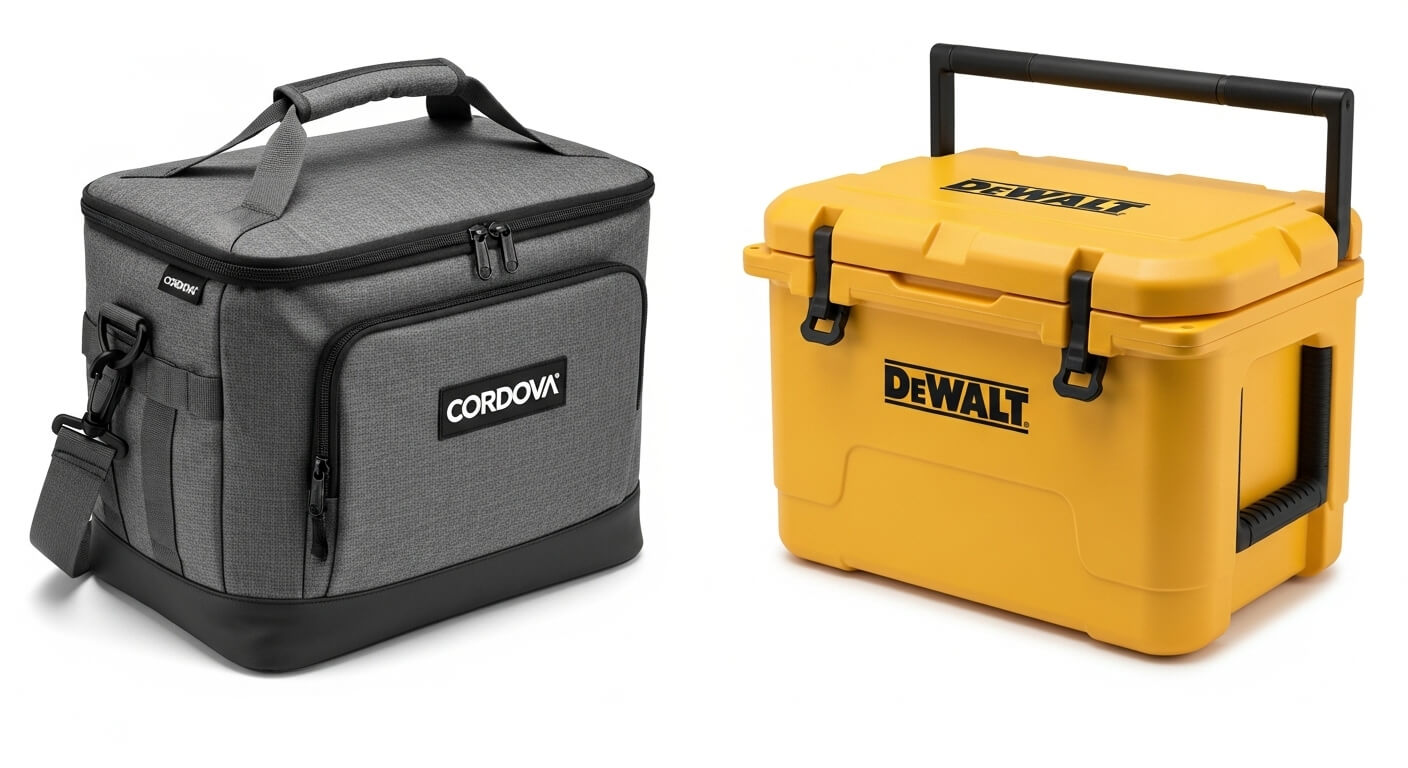
Cordova soft coolers and DeWalt coolers serve different segments within the rugged outdoor cooler market. Cordova delivers commercial-grade construction, maximum soft cooler performance, and longevity, justifying premium pricing for serious users. DeWalt provides jobsite-tough reliability and solid performance at accessible mid-range prices, appealing to professionals and recreational users alike.
The Cordova excels in pure construction quality, ice retention, and waterproof integrity. The 840-denier fabric, RF-welded seams, and military-grade components create coolers that should outlast multiple cheaper alternatives while performing better throughout their lifespan. For users needing maximum reliability or operating in harsh conditions, Cordova represents genuine long-term value despite the steep initial investment.
DeWalt optimizes the value-performance balance, delivering adequate durability and respectable ice retention at prices roughly half of Cordova’s. The brand recognition, widespread availability, and practical features make DeWalt coolers smart choices for users not requiring absolute maximum capability but wanting better-than-budget performance.
For commercial use, extreme conditions, or frequent deployment (15+ times annually), Cordova’s premium construction justifies the investment through superior performance and extended lifespan. The per-use cost becomes reasonable when accounting for years of reliable service.
For recreational use, jobsite applications, or moderate frequency (8-15 times annually), DeWalt delivers excellent value. The coolers perform their core functions well without the premium investment required for maximum capability.
Neither choice is universally superior—the right decision depends on usage intensity, environmental demands, budget constraints, and performance requirements. Match cooler capabilities to actual needs rather than buying maximum performance for situations where adequate suffices or choosing budget options for applications requiring premium durability.