
Choosing the right cooler can make or break a camping trip. While traditional hard-sided coolers dominated for decades, modern campers now face a choice between wheeled coolers that roll like luggage and backpack coolers that distribute weight across your shoulders. Each design philosophy addresses different camping scenarios and physical demands. This comprehensive guide examines both options to help you select the ideal cooling solution for your outdoor adventures.
Understanding the Design
Wheeled Coolers: Rolling Convenience
Wheeled coolers apply luggage design principles to outdoor cooling. Most feature two large wheels, a telescoping handle, and a rigid body that protects contents while rolling across various terrain. The fundamental advantage is removing weight from your body entirely, letting wheels and leverage do the work.
Modern wheeled coolers range from soft-sided models with basic insulation to hard-sided rotomolded units built like wheeled fortresses. Capacity typically spans 30 to 75 quarts, with larger models designed for car camping and smaller versions suitable for day trips or beach outings.
The best wheeled coolers incorporate all-terrain wheels measuring 4 to 8 inches in diameter. These larger wheels navigate sand, gravel, and grass more effectively than small caster wheels. Premium models include ball-bearing axles for smooth rolling and reinforced wheel wells that prevent failure under heavy loads.
Handle systems vary from basic telescoping designs to sophisticated ergonomic handles with multiple grip positions. The handle height adjustment accommodates users of different statures, preventing the awkward bent-over posture that causes back strain. Some models include secondary handles for lifting into vehicles or over obstacles.
Backpack Coolers: Portable Freedom
Backpack coolers prioritize mobility over maximum capacity. By distributing weight across both shoulders and often incorporating hip belts, they allow hands-free transport across terrain where wheels fail. The soft-sided construction collapses when empty, solving storage challenges that plague rigid coolers.
Capacity ranges from 20 to 40 cans, with most models landing in the 24-30 can range. This limitation reflects biomechanics rather than design preference—carrying more weight than about 25-30 pounds becomes uncomfortable regardless of how well the pack is designed.
Insulation technology in quality backpack coolers rivals soft-sided wheeled coolers. Multiple layers of closed-cell foam combined with heat-reflective liners maintain cold for 12 to 24 hours. The soft construction requires careful packing with ice on top to prevent crushing soft items, but the flexibility allows the pack to fit into tight spaces.
Comfort features separate premium backpack coolers from budget options. Padded shoulder straps, breathable back panels, sternum straps, and load-lifter straps transform a simple insulated bag into a genuine backpack designed for distance. The best models feel like hiking packs that happen to keep things cold rather than coolers with straps attached.
Terrain and Access Considerations
Where Wheels Excel
Wheeled coolers dominate in developed camping environments. Established campgrounds with paved or gravel roads, parking areas adjacent to campsites, and relatively flat terrain allow wheels to perform optimally. The cooler rolls from your vehicle to your picnic table with minimal effort regardless of weight.
Beach camping scenarios favor wheeled coolers when you can drive or park nearby. Rolling across packed sand works reasonably well with large wheels, though soft dry sand remains challenging. Many beachgoers appreciate leaving the wheeled cooler as a stationary base rather than carrying it around.
Tailgating and festival camping represent ideal wheeled cooler territory. Parking lot events, outdoor concerts, and sporting events typically offer hard surfaces perfect for rolling. The cooler doubles as a mobile seat or table while providing easy access to cold beverages throughout the event.
RV camping and car camping at sites with vehicle access make wheeled coolers the logical choice. When you can park within 50 feet of your camping spot, rolling a 60-quart cooler loaded with a weekend’s worth of food and drinks beats any carrying alternative.
Where Backpacks Dominate
Backcountry camping requires backpack coolers by necessity. Any scenario involving hiking to your campsite eliminates wheeled options. Even a quarter-mile hike on a maintained trail becomes tedious dragging a wheeled cooler, while a proper backpack cooler carries comfortably for miles.
Music festivals and crowded events where you’ll move frequently favor backpack coolers. The hands-free design allows you to navigate crowds, dance, and move through security while keeping your cold items accessible. You maintain full mobility rather than being tethered to a cooler you must pull.
Kayaking, canoeing, and paddle sports often work better with backpack coolers. The soft-sided design fits into hatches and storage areas more easily than rigid coolers. You can carry the pack from your vehicle to the launch site, then secure it in your watercraft without the bulk of hard-sided alternatives.
Urban adventures like outdoor concerts in parks, picnics requiring walks from parking, or bike camping all benefit from backpack coolers. Any time you’ll travel beyond where wheels work effectively or need both hands free, the backpack design provides superior versatility.
The Terrain Reality
The harsh truth about wheeled coolers is that wheels only work on surfaces humans have improved. Natural terrain—dirt trails, rocky ground, forest floors, or thick grass—quickly reveals the limitations. Even gravel roads become frustrating when pulling a heavy cooler that constantly snags or tips.
Stairs and curbs present obstacles that require lifting the entire cooler, temporarily eliminating the wheeled advantage. If your route from vehicle to campsite includes steps, uneven ground, or obstacles, the wheels become dead weight you must lift repeatedly.
Backpack coolers perform consistently across all terrain but with a strict weight limit. You can hike comfortably with 20-25 pounds of cooler, ice, and contents. Exceeding this threshold leads to shoulder pain, back strain, and an unpleasant experience regardless of pack quality.
Capacity and Ice Retention
Wheeled Cooler Capacity Advantages
Wheeled coolers win decisively on capacity. A typical 60-quart wheeled cooler holds 85 cans plus ice, enough to keep a family fed and hydrated for a long weekend. The rigid construction protects delicate items and maintains organization even when fully packed.
The larger volume allows more strategic packing with separate sections for frozen items, refrigerated food, and beverages. Many wheeled coolers include dividers or baskets that keep items organized and accessible. You can dedicate one section to lunch items while keeping dinner frozen until needed.
The capacity advantage extends to ice retention. More insulation volume and thicker walls in hard-sided wheeled coolers can maintain ice for 3-5 days under typical camping conditions. The rigid construction prevents compression that reduces insulation effectiveness in soft-sided coolers.
However, the large capacity tempts overpacking. A fully loaded 60-quart cooler can weigh 80-100 pounds, becoming difficult to lift into vehicles even with two people. The weight also limits terrain versatility and increases the physical effort required whenever you can’t roll it.
Backpack Cooler Practical Limits
Backpack coolers max out around 30-40 cans, with comfortable carrying capacity limited to about 24 cans plus ice. This serves one to two people for a day trip or overnight excursion. Longer trips require careful planning and may necessitate daily ice resupply or frozen ice packs.
The soft-sided construction means fragile items need protection. Chips, bread, and delicate snacks require rigid containers to prevent crushing. Strategic packing with heavier items at the bottom and ice on top helps, but you sacrifice the careless loading possible with hard-sided coolers.
Ice retention typically spans 12-24 hours in quality backpack coolers, less than half what wheeled hard-sided coolers achieve. The thinner insulation and smaller ice mass mean you’ll need fresh ice daily for multi-day trips. Some backpack coolers use leak-proof liners that allow adding ice multiple times without dealing with meltwater.
The capacity limitation actually benefits some users by preventing overpacking. You’ll pack only essentials rather than accumulating unnecessary items. This discipline often results in lighter overall loads compared to “bringing everything just in case” with a large wheeled cooler.
Ease of Transport and Physical Demands
Rolling vs. Carrying Effort
Wheeled coolers eliminate weight from your body when conditions allow rolling. On smooth surfaces, even a 70-pound cooler rolls with minimal effort. The mechanical advantage of wheels and leverage means a child can pull a load that would challenge an adult to carry.
However, any obstacle that stops the wheels instantly converts your wheeled cooler into an awkward, heavy box. Lifting a fully loaded cooler over a curb or up stairs strains your back and shoulders. The rigid shape and weight distribution aren’t optimized for carrying, making short portages more difficult than equivalent weight in a backpack.
The telescoping handle puts your arm at an awkward angle when pulling, and prolonged rolling can cause forearm and shoulder fatigue. Some users report that extended periods pulling wheeled coolers create arm and shoulder discomfort similar to carrying heavy luggage through airports.
Backpack Ergonomics
Quality backpack coolers distribute weight effectively across shoulders, back, and hips when properly adjusted. The biomechanical efficiency of backpacking allows comfortable transport of 20-25 pounds for considerable distances. Proper fit matters enormously—a well-adjusted pack feels manageable while a poor fit causes pain within minutes.
The hands-free nature provides balance and safety advantages on uneven terrain. You maintain natural arm swing and balance rather than being pulled sideways by a wheeled cooler. Navigating obstacles, climbing over rocks, or balancing on logs remains possible with a backpack cooler.
However, backpack coolers provide no relief from weight. Whether walking 100 feet or one mile, you carry the full load continuously. Heat buildup between your back and the cooler creates discomfort in warm weather. Most backpack coolers include ventilated back panels, but you’ll still sweat more than when rolling a cooler.
The weight limit is absolute. Attempting to carry 40+ pounds in a backpack cooler for any distance results in shoulder pain, back strain, and potential injury. The design works beautifully within its weight envelope but fails painfully when overloaded.
Durability and Longevity
Hard-Sided Wheeled Cooler Durability
Hard-sided wheeled coolers built from rotomolded plastic can last decades with proper care. The seamless construction eliminates weak points where wear occurs. Quality models withstand being run over by vehicles, dropped from truck beds, and dragged over rough surfaces.
The wheels represent the primary failure point. Cheap wheels with plastic bushings fail quickly under heavy loads or rough terrain. Premium coolers with ball-bearing wheels and robust axles last longer but eventually require replacement. Wheel availability and cost vary by brand—some manufacturers offer easy replacement while others make repairs difficult or expensive.
Handles, particularly telescoping mechanisms, experience significant stress and eventually wear. Locking mechanisms lose their grip, and handles develop play that makes them wobble. Quality brands warranty these components, but out-of-warranty repairs can be expensive or impossible depending on design.
The drain plugs, latches, and gaskets require occasional replacement as they wear from use and sun exposure. These components typically remain available as replacement parts for name-brand coolers but finding parts for off-brand models proves challenging.
Soft-Sided Backpack Cooler Durability
Backpack coolers wear differently than hard-sided models. The fabric exterior resists catastrophic failure but gradually degrades from abrasion, UV exposure, and repeated flexing. Seams and zippers experience the most stress and tend to fail first in budget models.
Premium backpack coolers use marine-grade fabrics, reinforced stitching, and heavy-duty zippers designed for thousands of cycles. These materials significantly extend lifespan. A quality backpack cooler can last 5-7 years of regular use, while budget models may fail within one or two seasons.
The insulation compresses over time, reducing effectiveness. This degradation happens gradually, so ice retention slowly decreases over years. Unlike hard-sided coolers where insulation remains stable, soft-sided insulation performance diminishes with age.
Straps and buckles wear from repeated adjustment and UV exposure. Replacing straps is usually possible and relatively inexpensive. The leak-proof liner in many backpack coolers can develop pinhole leaks that allow water to seep into the insulation, reducing effectiveness until replaced.
Storage and Versatility
Wheeled Cooler Storage Challenges
Rigid wheeled coolers occupy substantial space whether full or empty. A 60-quart cooler measures approximately 25″ x 18″ x 18″ and maintains these dimensions permanently. Finding storage space in garages, closets, or sheds becomes challenging, especially if you own multiple coolers for different purposes.
The fixed size means you can’t compress the cooler for off-season storage. It occupies the same garage space year-round. Some users resort to storing wheeled coolers outside under tarps, which works but exposes them to weather and can degrade components faster.
In vehicles, wheeled coolers take up significant cargo space. The rigid shape doesn’t conform to available space, and the wheels add height that prevents stacking items on top. Securing them during transport requires straps or cargo nets to prevent sliding.
However, the rigid construction doubles as furniture during camping. The cooler serves as a seat, table, or workstation. This versatility partially justifies the bulk—you’re transporting a cooler and a piece of functional furniture.
Backpack Cooler Flexibility
Backpack coolers collapse when empty, reducing to a fraction of their loaded size. This compressibility solves storage problems—the empty pack hangs on a hook or folds into a storage bin. For people with limited storage space, this advantage proves significant.
The soft-sided design conforms to available space in vehicles. You can squeeze a backpack cooler into odd-shaped gaps, under seats, or between other gear. This flexibility improves packing efficiency and allows you to bring the cooler even when cargo space is limited.
Many backpack coolers convert to shoulder bags or remove the backpack straps entirely, serving multiple functions. You might use it as a backpack for hiking, a shoulder bag for beach days, or a simple cooler bag for grocery shopping. This versatility increases the value proposition.
However, the soft sides offer no structural benefits beyond cooling. You can’t sit on a backpack cooler or use it as a table. The collapse that benefits storage means the cooler provides no furniture-like functionality at camp.
Price and Value Analysis
Wheeled Cooler Investment
Quality wheeled coolers span a wide price range. Soft-sided wheeled coolers start around $50-$80 and offer decent performance for casual use. Mid-range hard-sided wheeled models cost $150-$250 and provide good ice retention with durable construction. Premium rotomolded wheeled coolers exceed $300 and deliver exceptional performance with lifetime warranties.
The price correlates strongly with durability and ice retention. Budget wheeled coolers often fail within a few years as wheels break, handles snap, or insulation compresses. Premium models last indefinitely with basic maintenance, making them better long-term investments despite higher upfront costs.
Replacement parts availability affects long-term value. Brands offering replacement wheels, handles, and gaskets extend cooler lifespan significantly. Off-brand coolers often become disposable when any component fails since replacement parts don’t exist.
The large capacity means one wheeled cooler can serve all your camping needs, potentially eliminating the need for multiple smaller coolers. This consolidation can reduce total spending on cooling equipment.
Backpack Cooler Economics
Backpack coolers range from $40 to $200 depending on quality and features. Budget models around $40-$60 work for occasional day trips but lack durability for regular use. Mid-range options at $80-$120 balance performance and cost effectively. Premium backpack coolers at $150-$200 incorporate hiking-grade materials and suspension systems.
The investment level should match usage intensity. Occasional users buying premium backpack coolers often regret the expense, while serious hikers find budget models frustrating. Matching quality to usage frequency optimizes value.
Backpack coolers typically don’t require replacement parts beyond occasional zipper repairs. When the cooler reaches end-of-life, you usually replace the entire unit rather than repairing components. This makes the initial purchase decision more critical since you’re unlikely to extend lifespan through repairs.
Many people own both a backpack cooler for hiking trips and a wheeled or traditional cooler for car camping, doubling the total investment. The specialized nature means backpack coolers don’t replace other coolers but supplement them for specific uses.
User Experiences and Preferences
Wheeled Cooler User Feedback
Users love wheeled coolers for family camping and group outings. Parents particularly appreciate being able to roll substantial amounts of food and drinks rather than carrying them. The capacity supports longer trips without resupply, and the convenience makes camping more enjoyable.
Common complaints focus on terrain limitations. Many users report buying wheeled coolers expecting to roll them everywhere, only to discover they work exclusively on improved surfaces. The reality of lifting wheeled coolers over obstacles disappoints users who expected universal rolling capability.
Wheel durability generates frequent criticism in budget models. Users report wheels breaking or axles bending after minimal use, especially when pulling over rough ground. This failure mode often occurs after warranty expiration, leaving owners with expensive coolers that no longer roll.
The storage bulk bothers apartment dwellers and people with limited garage space. Several users mention leaving wheeled coolers at a family cabin or storage unit because keeping them at home proves impractical.
Backpack Cooler User Feedback
Backpack cooler enthusiasts praise the mobility and versatility. Festival-goers, day hikers, and beach visitors appreciate keeping hands free while transporting cold items. The backpack format integrates seamlessly into active lifestyles where traditional coolers feel cumbersome.
The capacity limitation frustrates some users who initially underestimate how much they want to bring. Learning to pack efficiently and prioritize essentials becomes necessary. Some users end up buying larger backpack coolers than initially planned, only to find them uncomfortable when fully loaded.
Ice retention meets or exceeds expectations for most users, though multi-day camping requires creative solutions like bringing frozen ice packs that gradually thaw. Users camping near stores often prefer daily ice resupply to attempting extended ice retention.
The collapsible storage receives universal praise. Users in urban apartments or small homes appreciate that the cooler doesn’t monopolize storage space nine months per year. This factor alone convinces some buyers to choose backpack over wheeled despite preferring other aspects of wheeled coolers.
Specific Use Case Recommendations
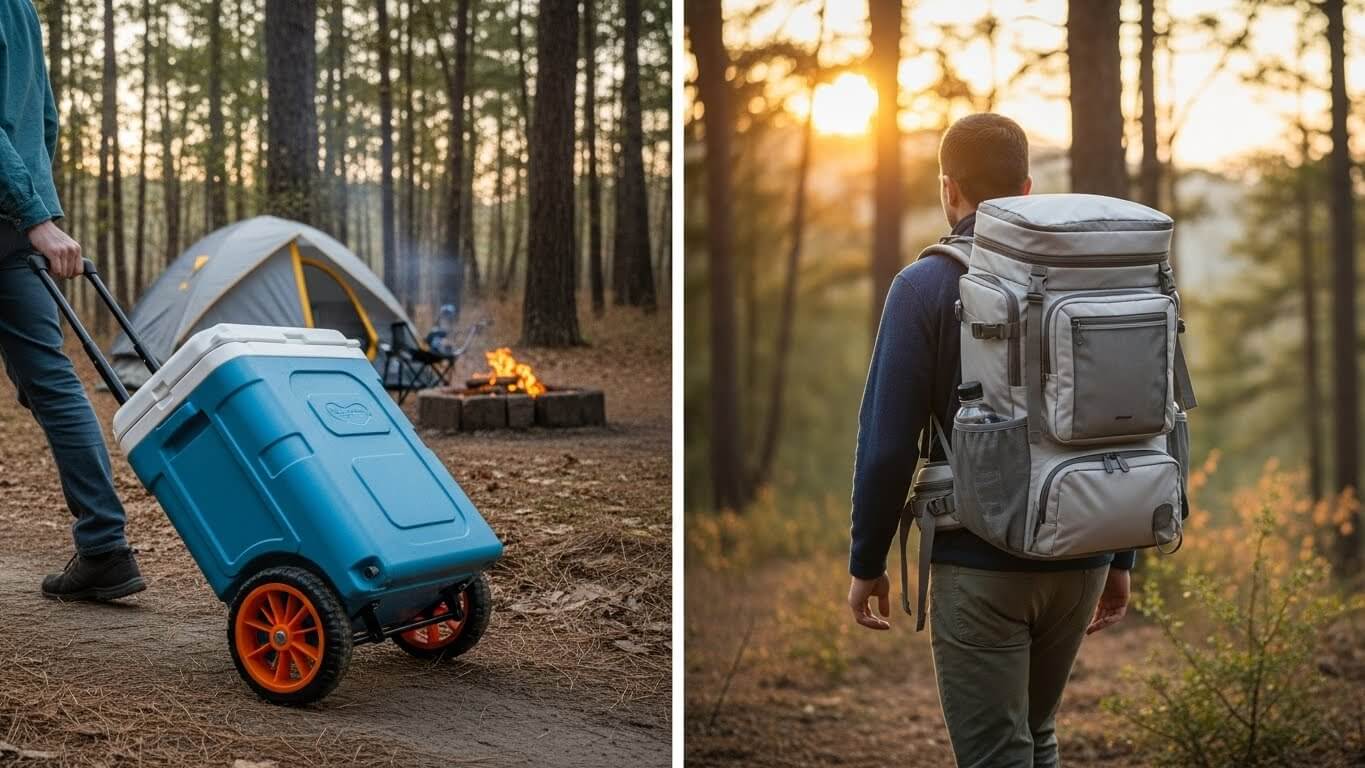
Best for Family Car Camping: Wheeled Cooler
Families camping at established campgrounds benefit most from wheeled coolers. The large capacity accommodates everyone’s food and drinks for long weekends. Rolling from the parking area to your campsite beats carrying, especially with kids and other gear to manage.
Choose a hard-sided wheeled cooler in the 60-70 quart range. The size handles family needs without becoming unmanageable when full. Prioritize models with large wheels (6+ inches) and quality handles that adjust to your height.
Best for Solo Backcountry Camping: Backpack Cooler
Solo hikers camping beyond vehicle access require backpack coolers. The hands-free design maintains mobility on trails while providing cold food and drinks at camp. Pack strategically with frozen items that thaw to refrigerated temperature by mealtime.
Select a backpack cooler with genuine hiking pack features including padded straps, hip belt, and sternum strap. The comfort features justify the higher cost when carrying distance exceeds half a mile.
Best for Beach Days: Either, Depending on Access
Beach access determines the ideal choice. If you can park within 100 feet of your spot on hard sand, wheeled coolers roll easily and provide maximum capacity for all-day beach gatherings. The cooler doubles as a seat and table on the beach.
If accessing the beach requires walking across soft sand, climbing stairs, or hiking trails, backpack coolers prove superior. The hands-free design allows carrying beach chairs, umbrellas, and toys while the cooler rides on your back.
Best for Tailgating: Wheeled Cooler
Parking lot events favor wheeled coolers overwhelmingly. The hard surface allows effortless rolling, capacity supports group needs, and the rigid cooler serves as seating or a serving surface. Premium ice retention means you can load the cooler the night before and maintain cold throughout the event.
Choose a cooler with a wide body that provides stable seating. The premium investment makes sense if you tailgate regularly since one quality cooler lasts for decades of game days.
Best for Kayak Camping: Backpack Cooler
Watercraft camping demands soft-sided backpack coolers. The flexible design fits into kayak hatches and canoe storage areas. You can strap the pack to the deck if necessary. The portage from vehicle to launch site and from water to campsite benefits from backpack carrying.
Select a fully waterproof backpack cooler with welded seams rather than stitched construction. This protects against both interior leaks and exterior water intrusion during inevitable splashing.
Product Recommendations
Best Wheeled Cooler Overall: Yeti Tundra Haul
The Yeti Tundra Haul combines rotomolded durability with thoughtful wheel design. The wide-set wheels provide stability, and the solid construction withstands years of abuse. At approximately $400 for 55 quarts, it’s expensive but delivers professional-grade performance. The ice retention exceeds five days, and the never-flat wheels eliminate the most common failure point.
Best Budget Wheeled Cooler: Coleman Xtreme Wheeled Cooler
For casual campers, the Coleman Xtreme wheeled cooler provides reasonable performance at budget pricing around $70 for 50 quarts. The ice retention approaches three days, adequate for weekend trips. The wheels are small but functional on smooth surfaces. Don’t expect multi-year durability, but for occasional use, the value is compelling.
Best Backpack Cooler Overall: RTIC Backpack Cooler
The RTIC backpack cooler delivers premium performance at mid-range pricing around $140. The 30-can capacity suits day trips and overnight camping. The leak-proof liner, padded straps, and multiple pockets create genuine hiking pack functionality. Ice retention exceeds 24 hours consistently, and the build quality suggests years of reliable service.
Best Budget Backpack Cooler: Arctic Zone Titan Deep Freeze Backpack
At approximately $60, the Arctic Zone Titan provides excellent value. The 24-can capacity works for day trips, and the insulation maintains cold for 16+ hours. The straps lack premium padding but remain comfortable for moderate distances. The collapsible design stores easily between uses.
Best Premium Backpack Cooler: Yeti Hopper M30
The Yeti Hopper M30 represents backpack cooler excellence at $325. The magnetic closure, leak-proof construction, and hiking-grade shoulder straps justify the premium. Ice retention approaches 36 hours in ideal conditions. The durability ensures this cooler lasts many seasons, though the price limits appeal to serious users who’ll maximize the investment.
Frequently Asked Questions
Can I use a wheeled cooler for hiking if I pull it behind me?
This approach fails quickly on natural terrain. Wheels designed for smooth surfaces catch on roots, rocks, and uneven ground. The cooler tips repeatedly, and you’ll end up carrying it more than rolling it. Even “all-terrain” wheels work only on improved surfaces like gravel roads. For any genuine hiking, backpack coolers remain the only practical option.
How much weight can I comfortably carry in a backpack cooler?
Most people comfortably carry 20-25 pounds in a well-designed backpack cooler for distances up to a few miles. Exceeding 30 pounds causes shoulder and back pain for extended carrying. The exact comfortable weight varies by individual fitness, pack quality, and distance traveled. Test loading your pack at home and walking around the neighborhood before committing to a long hike with a full load.
Will a wheeled cooler damage my lawn or campsite?
Wheeled coolers can create ruts in soft ground or wet grass, particularly when fully loaded. The concentrated weight on two wheels causes more damage than foot traffic. Most campgrounds prohibit wheeling coolers across designated vegetation areas. On your property, avoid rolling heavy coolers across lawns after rain or irrigation when soil is soft.
Can backpack coolers keep food frozen for camping?
Backpack coolers can maintain frozen items if you start with completely frozen food, use frozen gel packs rather than ice, minimize opening, and keep the pack in shade. However, expect frozen items to soften to refrigerated temperature within 12-18 hours. For true frozen storage beyond one day, hard-sided coolers with superior insulation perform better. Backpack coolers excel at keeping things refrigerator-cold rather than frozen.
Are wheeled coolers allowed on airplanes?
Hard-sided wheeled coolers generally don’t fit carry-on size restrictions and must be checked as luggage. Airlines treat them as standard checked bags subject to size and weight limits. Empty coolers check easily, but loaded coolers often exceed weight limits and may incur overweight fees. Soft-sided wheeled coolers sometimes qualify as checked bags if within size requirements. Backpack coolers typically meet carry-on size limits when empty but security may require inspection.
Do backpack coolers work in winter for keeping things warm?
The insulation that keeps things cold also maintains heat. Backpack coolers work reasonably well for transporting hot food to winter picnics or tailgates. Preheat the interior with hot water, add hot food in sealed containers, and the insulation maintains temperature for several hours. However, specialized hot food carriers with better heat retention work more effectively for extended periods.
Can I replace wheels on my wheeled cooler when they break?
Replacement wheel availability varies by brand. Major manufacturers like Yeti, Pelican, and Coleman offer replacement wheels as separate parts. Many budget brands don’t provide replacement parts, making the cooler disposable when wheels fail. Before purchasing, check whether replacement wheels are available and note the cost. Some replacement wheel sets cost $40-$60, nearly as much as a budget cooler.
Which type works better for keeping medications cold?
For temperature-sensitive medications requiring consistent cooling, hard-sided wheeled coolers provide more reliable performance with better ice retention and protection from temperature fluctuations. However, if you need to carry medications while hiking or traveling where wheels don’t work, quality backpack coolers with frozen gel packs maintain appropriate temperatures for 12-24 hours. For critical medications, consider dedicated medical coolers with temperature monitoring rather than general-purpose camping coolers.
Conclusion
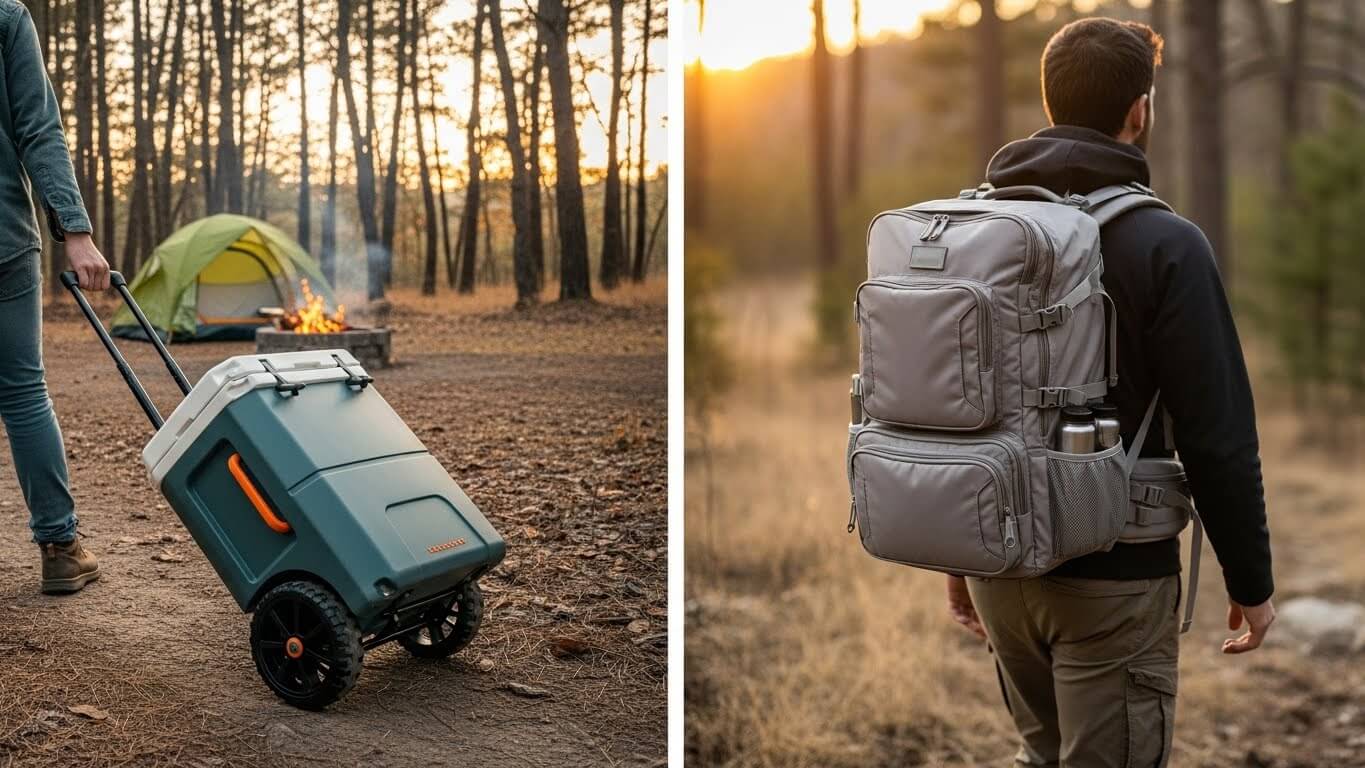
The choice between wheeled and backpack coolers ultimately depends on your specific camping style and access conditions. Wheeled coolers excel when you can park near your camping spot, need maximum capacity for group or family outings, and prioritize extended ice retention. They transform heavy loads into manageable rolling tasks on suitable surfaces, making car camping and tailgating significantly more convenient.
Backpack coolers dominate when terrain prevents wheeling, you need hands-free mobility, or storage space is limited. They enable backcountry camping, facilitate active outdoor pursuits, and provide versatility that rigid coolers cannot match. The trade-off in capacity and ice retention proves worthwhile when mobility matters most.
Many outdoor enthusiasts eventually own both types, using each for appropriate situations. A wheeled cooler serves family camping and tailgating while a backpack cooler handles day hikes and festivals. This dual approach maximizes the benefits of each design without compromising on the situations where one type clearly outperforms the other.
Consider your most frequent camping scenarios when making your decision. If 80% of your trips involve parking near your campsite, invest in a quality wheeled cooler. If you regularly hike to remote locations or navigate terrain where wheels fail, prioritize a premium backpack cooler. The right choice enhances your outdoor experience by eliminating the frustration of fighting inappropriate equipment.
Remember that no single cooler optimally serves all purposes. Rather than seeking the perfect universal solution, select the cooler that best matches your primary use case and accept that some situations may require alternative approaches. The investment in appropriate cooling equipment pays dividends through years of comfortable, convenient camping adventures.