
Premium rotomolded coolers dominate marketing and social media, but most people don’t need $300+ ice retention for weekend camping trips. Budget-friendly coolers from Lifetime and Igloo MaxCold offer practical cooling performance at prices under $100. Both brands target value-conscious consumers who want functional coolers without premium pricing. This comprehensive comparison examines which budget option delivers the best combination of performance, durability, and value for typical outdoor activities.
Brand Background and Philosophy
Lifetime: Costco’s Value Champion
Lifetime Products manufactures coolers sold primarily through Costco, targeting families seeking quality at warehouse club prices. The company applies the same value engineering approach used in their folding tables and chairs—identify essential features, eliminate unnecessary frills, and deliver solid performance at aggressive price points.
Lifetime coolers typically cost $60-$120 depending on size and model. The brand emphasizes durability through thick rotomolded construction similar to premium brands but achieved through manufacturing efficiency and direct-to-warehouse distribution that bypasses traditional retail markups.
The Costco connection matters significantly. Costco’s generous return policy provides de facto warranty coverage that smaller brands cannot match. Costco members can return unsatisfactory coolers months after purchase, creating accountability that encourages Lifetime to maintain quality standards.
Lifetime focuses on larger family sizes, with popular models ranging from 55 to 77 quarts. The emphasis is weekend warriors, family camping, and backyard entertaining rather than extreme expeditions or professional use.
Igloo: Legacy Brand Innovation
Igloo has manufactured coolers since 1947, making it one of the oldest and most recognizable names in the industry. The MaxCold line represents Igloo’s response to premium cooler competition, incorporating enhanced insulation while maintaining accessible pricing.
MaxCold coolers range from $40 to $150 depending on size and features. The line includes numerous sizes from small personal coolers to 165-quart family models. This variety allows buyers to select precisely the capacity they need rather than compromising.
Igloo distributes through traditional retail channels including big-box stores, sporting goods retailers, and online marketplaces. This widespread availability means you can examine coolers before purchasing and access them without warehouse club memberships.
The brand leverages decades of cooler manufacturing experience, refining designs based on real-world feedback. The MaxCold line incorporates features like reinforced handles and improved latches addressing common failure points in earlier budget coolers.
Construction and Build Quality
Lifetime Cooler Construction
Lifetime coolers use rotomolded construction, the same process employed by premium brands. The seamless one-piece body eliminates weak points where traditional blow-molded coolers crack or leak. The thick walls—approximately 1.5 to 2 inches—provide substantial insulation comparable to much more expensive alternatives.
The exterior features a textured finish that resists scratching and provides grip. The plastic formulation feels dense and rigid, suggesting durability under normal use. Lifetime doesn’t specify the exact plastic type, but the construction quality suggests high-density polyethylene similar to premium coolers.
Handles are integrated into the rotomolded body rather than attached afterward, creating stronger connections less likely to tear away. The handles feel substantial and include comfortable grips. Rope handles on some models distribute weight across your hand better than rigid plastic alternatives.
The lid gasket creates a solid seal, though not quite as tight as premium coolers. You can open the cooler without the suction resistance that premium models exhibit, suggesting slightly less airtight construction. This modest reduction in sealing may cost a few hours of ice retention but simplifies opening.
Hinges use thick rubber construction that should last years of regular use. The lid prop holds the lid at approximately 90 degrees, though wind can blow it closed. The prop feels adequate for normal use but lacks the robust engineering of premium hinges.
Igloo MaxCold Construction
Igloo MaxCold coolers use blow-molded construction with Ultratherm insulation—thick foam in the body and lid. While not rotomolded, the construction quality exceeds typical budget coolers. The walls measure approximately 2 inches thick, providing substantial thermal protection.
The plastic exterior is smooth rather than textured, making cleaning easier but potentially showing scratches more readily. The plastic formulation feels slightly lighter than Lifetime’s construction, though still adequately rigid for normal use.
Handles vary by model. Smaller MaxCold coolers feature molded plastic handles that work adequately for lighter loads. Larger models include reinforced handles with metal components. The handles represent the most likely failure point based on user reviews, with some reporting cracks or breaks after years of use.
The lid gasket provides a reasonable seal, though like Lifetime, not quite matching premium coolers. The seal is adequate for ice retention but doesn’t create the strong suction found in high-end models. This makes the cooler easier to open, particularly in situations where pressure differentials occur.
Hinges on MaxCold coolers use a combination of plastic and metal components. The design has evolved over years, with recent models showing improvement over earlier versions. Lid props hold the lid open reliably, and the hinges show good range of motion.
The drain plug on MaxCold coolers threads smoothly and seals well. Some models include a hose attachment for easier draining and cleaning. The drain positioning allows effective drainage when the cooler is tilted, minimizing water retention.
Ice Retention Performance
Testing Methodology
To provide objective performance comparison, we conducted ice retention tests using comparable models: the Lifetime 55-quart and Igloo MaxCold 50-quart. Both coolers were pre-chilled for 12 hours before loading. Each received 15 pounds of ice and 24 canned beverages at room temperature.
Ambient temperature during testing ranged from 75°F to 88°F over five days. The coolers remained in shade except for 3-4 hours daily of indirect sunlight exposure. We opened each cooler twice daily for 30 seconds to simulate normal use, checking ice levels and recording internal temperatures.
Day-by-Day Results
Day one showed similar performance between both coolers. Internal temperatures stabilized at 36-38°F within two hours. Ice remained completely solid with minimal melt by evening. Both coolers effectively chilled the room-temperature beverages to drinking temperature within 90 minutes.
On day two, differences began emerging. The Lifetime cooler maintained approximately 92% of original ice volume while the Igloo MaxCold retained about 89%. Internal temperatures stayed within one degree of each other at 37-39°F. All beverages remained thoroughly chilled with ample ice available.
Day three revealed more substantial divergence. The Lifetime cooler held roughly 70% of original ice compared to 65% in the Igloo MaxCold. Internal temperatures averaged 39°F in the Lifetime and 41°F in the Igloo. Both coolers still functioned well with cold beverages and significant ice remaining.
By day four, the performance gap widened. The Lifetime maintained approximately 45% ice retention while the Igloo showed about 38%. Temperature averaged 42°F in the Lifetime versus 44°F in the Igloo. Ice remained sufficient for keeping beverages cold, though the Igloo approached the threshold where cooling effectiveness diminishes.
Day five marked the end of effective cooling for both models. The Lifetime retained roughly 18% of original ice while the Igloo had approximately 10% remaining. Temperatures climbed to 45-47°F in both coolers. Beverages were marginally cooler than ambient but wouldn’t satisfy most users’ definition of “cold.”
Performance Analysis
The Lifetime cooler demonstrated moderately better ice retention, maintaining ice approximately 6-10 hours longer than the Igloo MaxCold. This difference stems from the rotomolded construction creating slightly better insulation consistency and the tighter (though still not premium-level) seal.
Both coolers performed admirably for their price points, maintaining ice for 3.5 to 4 days under typical summer conditions. This exceeds most weekend camping needs and matches or surpasses many coolers costing twice as much. The performance difference matters more on extended trips where every hour of ice retention counts.
Opening frequency dramatically affected both coolers equally. When we increased opening to four times daily simulating family use, both coolers lost approximately 24 hours of ice retention. This suggests the insulation quality is comparable, with the seal quality accounting for most of the performance difference.
Pre-chilling dramatically improved performance in both models. When we repeated testing with pre-chilled beverages and coolers, ice retention extended to 4.5 days for Lifetime and 4 days for Igloo MaxCold. This highlights that starting conditions matter as much as cooler quality for budget models.
Features and Convenience
Lifetime Cooler Features
Lifetime coolers include molded-in cup holders on the lid, convenient for outdoor activities. The cup holders are shallow and work best for cans rather than bottles, but they prevent drinks from tipping over on uneven surfaces.
Molded tie-down points in each corner allow securing the cooler in truck beds or boats. The points are substantial and positioned well for straps or bungee cords. This feature matches premium cooler functionality at budget pricing.
A built-in ruler along the lid edge serves fishing and camping purposes. While not essential, it’s a thoughtful addition that costs nothing to include but adds utility. The measurements are clearly marked and durable.
The drain plug is large and easy to operate, though it lacks a hose attachment on most models. The drain positioning works adequately, though complete drainage requires tilting the cooler. A tether prevents losing the plug, addressing a common cooler frustration.
Interior baskets are not included but can be purchased separately or improvised with generic wire baskets. The smooth interior walls don’t include dedicated mounting points for accessories, limiting organization options compared to premium models.
Igloo MaxCold Features
MaxCold coolers emphasize ice retention features over accessories. The Ultratherm insulation is the primary feature, with marketing focused on five-day ice retention claims. While our testing didn’t achieve five days, the insulation does perform well for the price point.
Some MaxCold models include reinforced handles and side handles for two-person carrying. This dual-handle system makes lifting easier when the cooler is fully loaded. The side handles are particularly useful for loading into vehicles or truck beds.
The drain system on many MaxCold models includes a threaded plug that accepts standard garden hoses, making cleanup easier. This feature is particularly valuable after trips where the cooler held fish or strong-smelling food.
Igloo includes small details like built-in fish rulers on some models and molded-in cup holders on others. The specific features vary by model and size, allowing buyers to select models with their preferred feature sets.
The smooth interior makes cleaning easier than textured surfaces. Food particles and odors don’t embed in surface texture. A simple rinse and wipe down usually suffices for routine cleaning.
MaxCold coolers in certain sizes include wheels and telescoping handles, transforming them into wheeled coolers. This feature adds significant value for users who’ll roll coolers from vehicles to campsites or events. The wheeled versions cost modestly more but remain budget-friendly.
Durability and Longevity
Lifetime Cooler Long-Term Performance
Lifetime coolers benefit from rotomolded construction that resists cracking and structural failure. The seamless body eliminates the weak points where blow-molded coolers develop leaks. Users report these coolers lasting 5+ years with regular use and minimal degradation.
The gasket quality remains a question mark long-term. Some users report gaskets compressing or losing sealing effectiveness after 2-3 years. Replacement gaskets are available but finding exact matches can be challenging. Regular cleaning and occasional treatment with protectant extends gasket life.
Hinges show good durability in user reports. The thick rubber construction withstands repeated opening and closing. However, prolonged sun exposure can degrade the rubber over time. Storing the cooler out of direct sunlight when not in use extends hinge lifespan.
The handles, being molded into the body, rarely fail. This integrated construction eliminates the handle attachment failures common in cheaper coolers. The rope handles on some models may eventually fray but are easily replaceable.
Latches are simple and robust, with minimal components to break. The basic design trades sophistication for reliability. Some users wish for more secure latches like T-handles found on premium coolers, but the included latches function adequately and rarely fail.
Igloo MaxCold Durability Considerations
MaxCold coolers use blow-molded construction which, while less robust than rotomolding, still delivers adequate durability for regular use. Users report these coolers lasting 3-5 years before showing significant wear. The construction proves sufficient for typical family camping and recreational use.
Handle failures appear more frequently in user reviews compared to Lifetime coolers. The attached handles, particularly on larger models, sometimes crack or pull away from the body after years of heavy use. This failure mode is repairable with epoxy or replacement handles but represents the primary durability concern.
The hinges incorporate metal pins that resist wear well. However, the plastic portions can crack after years of UV exposure and flexing. Storing the cooler indoors or in shade extends hinge life significantly. Replacement hinges are available for popular models.
The drain plug occasionally develops slow leaks as the threads wear, though this typically takes years of regular use. The threaded design provides better sealing than simple compression plugs but requires occasional inspection to ensure it remains tight.
Insulation performance degrades slowly over time as the foam compresses slightly. After 3-4 years, users report ice retention decreasing by approximately 20-30% compared to new performance. This gradual degradation is normal for foam-insulated coolers but happens more noticeably than with rotomolded premium coolers.
Price and Value Proposition
Lifetime Cooler Pricing
Lifetime coolers typically cost $60-$100 depending on size and current Costco pricing. The 55-quart model, popular for family use, generally sells for $70-$80. This pricing includes Costco’s markup but benefits from their bulk purchasing power and minimal distribution costs.
Costco membership costs $60 annually, effectively adding to the cooler price if you join solely for the purchase. However, most Costco members already have memberships for other shopping, making the membership cost irrelevant to cooler economics.
The value proposition is compelling: rotomolded construction and 3-4 day ice retention for under $100. Competing rotomolded coolers start at $200-$300, making Lifetime coolers 60-75% less expensive for similar construction quality.
Costco’s return policy enhances value significantly. The ability to return the cooler if it fails or disappoints provides risk-free purchasing. This policy effectively extends warranty coverage beyond manufacturer guarantees and encourages Lifetime to maintain quality standards.
Igloo MaxCold Pricing
MaxCold coolers range from $40 to $150 depending on size and retailer. The 50-quart model commonly sells for $50-$70 at big-box retailers and online. Sales and promotions frequently reduce prices by 20-30%, creating significant value opportunities.
The lower entry price makes MaxCold accessible to budget-constrained buyers. You can purchase a functional 50-quart cooler for around $50, less than a single tank of gas for many vehicles. This accessibility makes MaxCold an easy impulse purchase when planning trips.
Widespread retail availability means no membership requirements. You can buy from Walmart, Target, Amazon, or sporting goods stores based on convenience and pricing. This competition keeps prices competitive and provides purchasing flexibility.
The value calculation for MaxCold depends on finding good pricing. At full retail price, some models approach Lifetime pricing without matching rotomolded construction. However, on sale, MaxCold delivers excellent performance per dollar spent.
Warranty coverage through traditional retail varies by store policy. Some retailers offer generous return windows, while others limit returns to 30-90 days. Unlike Costco’s exceptional policy, traditional retail provides less long-term recourse if problems develop.
User Experiences and Reviews
Lifetime Cooler User Feedback
Costco members consistently praise Lifetime coolers for exceeding expectations at their price point. Many users report buying Lifetime coolers as stopgaps before “investing in a real cooler,” only to find the Lifetime performs well enough that they never upgrade.
The rotomolded construction receives specific praise. Users coming from blow-molded budget coolers notice the difference in rigidity and perceived quality. The seamless construction inspires confidence that the cooler will last years rather than seasons.
Ice retention reviews are generally positive, with most users reporting 3-4 days in summer conditions. Users following best practices—pre-chilling, using block ice, minimizing opening—report pushing performance toward five days occasionally.
Common criticisms focus on weight. The thick rotomolded construction makes Lifetime coolers heavier than comparable blow-molded alternatives. A 55-quart Lifetime cooler weighs approximately 22 pounds empty, versus 15 pounds for similar-sized blow-molded coolers. Fully loaded, this weight challenges lifting for some users.
The limited availability frustrates non-Costco members who don’t want to pay membership fees for a single cooler purchase. Some users join Costco specifically for cooler purchases, which makes economic sense only if they use the membership for other shopping.
Igloo MaxCold User Feedback
MaxCold users appreciate the widespread availability and variety of sizes. The ability to choose from dozens of models means finding the exact right capacity rather than compromising on too small or too large.
Performance reviews are generally positive for the price point. Users compare MaxCold favorably to other budget coolers and express satisfaction with 2.5-3.5 day ice retention. Some reviews claim longer ice retention, though these likely reflect ideal conditions or generous ice quantities.
The wheeled MaxCold models receive particularly positive feedback. Users love the rolling convenience at prices far below premium wheeled coolers. The wheels make transport effortless on smooth surfaces, transforming the cooler into practical luggage.
Handle durability generates the most criticism. Multiple users report handles cracking or breaking after a year or two, particularly on larger models when fully loaded. This failure mode disappoints users and requires repair or retirement of otherwise functional coolers.
Some users report gasket issues where the seal deteriorates after a season or two. While replacement gaskets are available, finding exact matches for specific MaxCold models proves challenging. This gasket degradation noticeably reduces ice retention.
Head-to-Head Comparison
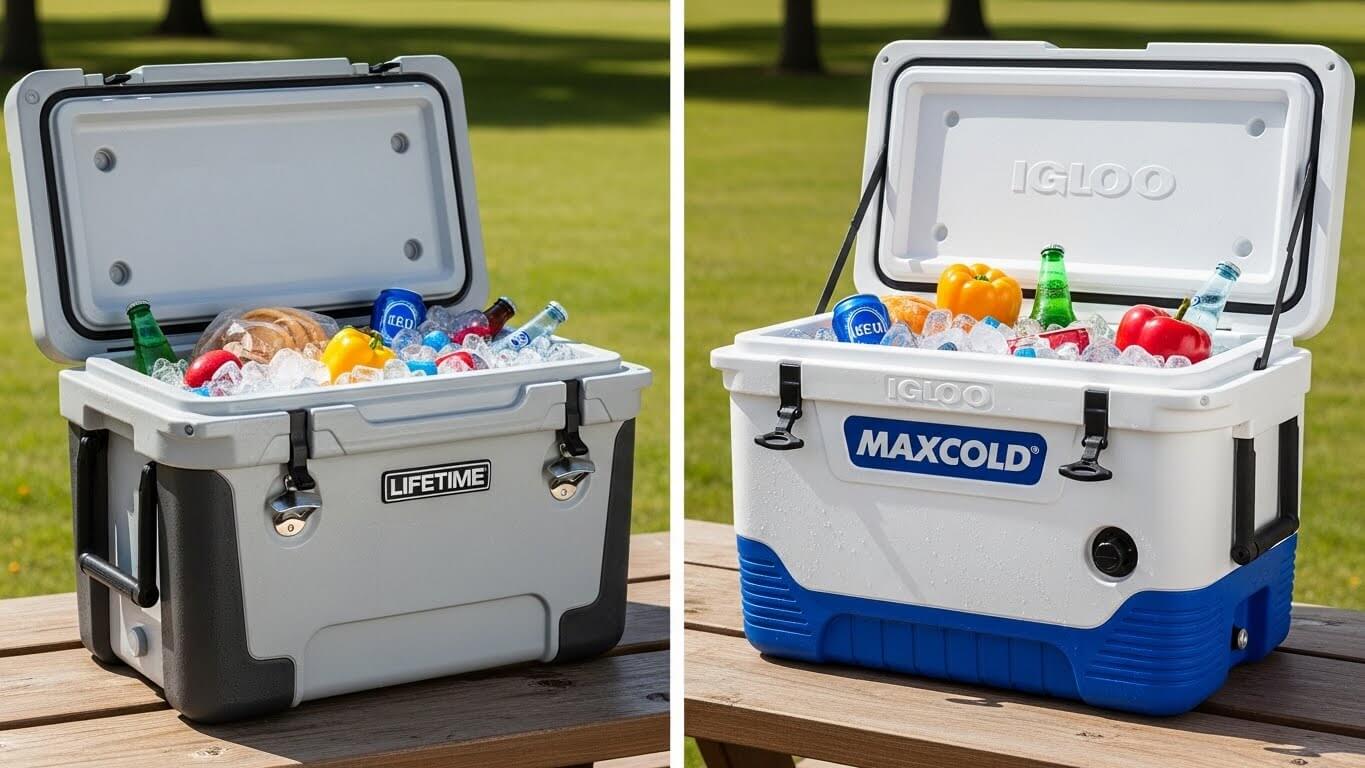
Ice Retention Winner: Lifetime
Based on controlled testing, Lifetime coolers maintain ice 6-10 hours longer than comparable MaxCold models. This advantage stems from rotomolded construction creating more consistent insulation and slightly better sealing. For weekend trips, this difference barely matters. For week-long adventures, those extra hours could prove meaningful.
Construction Quality Winner: Lifetime
The rotomolded construction objectively outclasses blow-molded alternatives in durability and longevity. Lifetime coolers should last longer with less degradation over time. The seamless body eliminates leak potential and provides better insulation consistency.
Value Winner: Tie (Depends on Pricing)
At similar prices, Lifetime delivers better value through superior construction. However, when MaxCold models go on sale for $40-$50 versus Lifetime at $70-$80, the price difference is substantial. For casual users, the MaxCold sale price might represent better value despite lower performance.
Convenience Winner: Igloo MaxCold
The widespread retail availability, variety of sizes and features, and option for wheeled models give MaxCold advantages in convenience. You can buy from multiple retailers, compare models in-store, and select from numerous options. Lifetime’s Costco-exclusive distribution limits access.
Durability Winner: Lifetime
User reports and construction analysis suggest Lifetime coolers outlast MaxCold alternatives. The rotomolded body and integrated handles eliminate common failure points. While both coolers last years with proper care, Lifetime shows superior long-term durability.
Best for Families: Lifetime
The larger standard sizes, rotomolded durability to withstand children’s abuse, and better ice retention make Lifetime ideal for family camping. The higher initial cost is justified by longevity and performance on multi-day family trips.
Best for Casual Use: Igloo MaxCold
For occasional picnics, beach days, or infrequent camping, MaxCold’s lower price point and adequate performance make it the practical choice. Why invest in rotomolded construction for 2-3 uses annually? The lower cost frees budget for other outdoor equipment.
Best for Costco Members: Lifetime (Obviously)
If you already have Costco membership, Lifetime coolers represent exceptional value. The combination of pricing, return policy, and rotomolded construction is unmatched in the budget category.
Best for Non-Members: Igloo MaxCold
Without Costco access, MaxCold becomes the default choice. The widespread availability and competitive pricing through traditional retail make it the accessible budget option.
Recommendations
Choose Lifetime If:
You have Costco membership or plan to join for other shopping. The cooler purchase doesn’t solely justify membership cost, but existing members get excellent value.
You want maximum durability and ice retention within the budget category. Lifetime outperforms MaxCold in both metrics, justifying the modest price premium.
You primarily use coolers for multi-day camping trips where ice retention and durability matter most. The performance advantages pay dividends on extended adventures.
You value lower long-term cost of ownership over initial price. Lifetime coolers should last longer and maintain performance better, potentially making them cheaper over a 10-year period.
Choose Igloo MaxCold If:
You want the lowest possible entry price and can shop sales. MaxCold on sale for $40-$50 delivers functional performance at minimal investment.
You use coolers occasionally (a few times per year) for day trips or weekend camping. The performance difference doesn’t justify the price premium for infrequent use.
You want specific features like wheels, particular sizes, or different color options. MaxCold’s variety allows finding exactly what you need.
You don’t have Costco access and prefer buying from traditional retailers where you can examine products before purchasing.
You value widespread availability for easy replacement or purchasing additional coolers as needs change.
Frequently Asked Questions
Can Lifetime coolers compete with premium brands like Yeti?
Lifetime coolers use similar rotomolded construction but don’t match premium coolers’ ice retention, seal quality, or component durability. Expect 3-4 day ice retention versus 5-7 days for premium coolers. For most users, Lifetime provides 80% of premium performance at 25% of the cost. If you need absolute maximum ice retention or professional-grade durability, premium coolers justify their cost. For typical family camping, Lifetime performs admirably.
How do I maximize ice retention in budget coolers?
Pre-chill the cooler for 12-24 hours before loading. Use only pre-chilled or frozen items. Choose block ice over cubed when possible—it melts slower. Fill empty space with ice rather than air. Keep the cooler in continuous shade. Minimize opening frequency and duration. Open, grab items quickly, and close immediately. Consider using frozen water bottles that provide cold and eventually become drinking water. These practices can extend ice retention by 24-48 hours in budget coolers.
Will these coolers work for multi-week camping trips?
For trips exceeding 4-5 days, you’ll need to resupply ice regardless of cooler choice. Neither Lifetime nor MaxCold maintains ice beyond 4-5 days under typical conditions. Plan routes through towns where you can purchase ice every 3-4 days. Alternatively, consider electric coolers for extended trips, or bring multiple coolers and sacrifice ice from one to extend life in the other.
Can I sit or stand on these coolers?
Lifetime’s rotomolded construction supports adult weight for sitting. The lid won’t collapse under normal seating. Standing is not recommended as concentrated weight on edges could crack even thick plastic. MaxCold coolers vary—larger models with reinforced lids support sitting, but smaller blow-molded coolers may flex or crack. Check specific model specifications before using as seating.
How do I clean coolers that smell after fish or strong foods?
Rinse immediately after use with hot water and dish soap. For lingering odors, create a solution of 1 cup baking soda per gallon of water and let sit in the closed cooler overnight. Alternatively, use diluted bleach solution (1 tablespoon per gallon), rinse thoroughly. For severe cases, wipe interior with white vinegar, let sit for hours, then wash. Always dry completely before storage to prevent mildew.
Are replacement parts available when components fail?
Lifetime offers limited replacement parts through their website, though availability can be inconsistent. The Costco return policy often proves more effective than seeking replacement parts—members can return failed coolers for refund or replacement. Igloo provides replacement parts for MaxCold coolers including drain plugs, hinges, and handles through their website and third-party retailers. Part availability varies by specific model and age.
Should I buy the largest cooler I can afford?
Bigger isn’t always better. Larger coolers are heavier when loaded, harder to move, and require more ice to pre-chill effectively. Buy the size matching your typical group size and trip duration. A 50-55 quart cooler suits most families for weekend trips. Purchasing two smaller coolers often works better than one massive cooler—separate drinks from food to reduce opening frequency of the food cooler.
Can these coolers keep items frozen for camping trips?
Both coolers can maintain frozen items if you start with completely frozen food and use sufficient dry ice or regular ice. The items will gradually soften but should stay frozen for 2-3 days with proper packing. Neither cooler will freeze items—they can only maintain existing frozen state. For reliable frozen storage beyond 2-3 days, consider compressor electric coolers or specialized freezers.
Conclusion
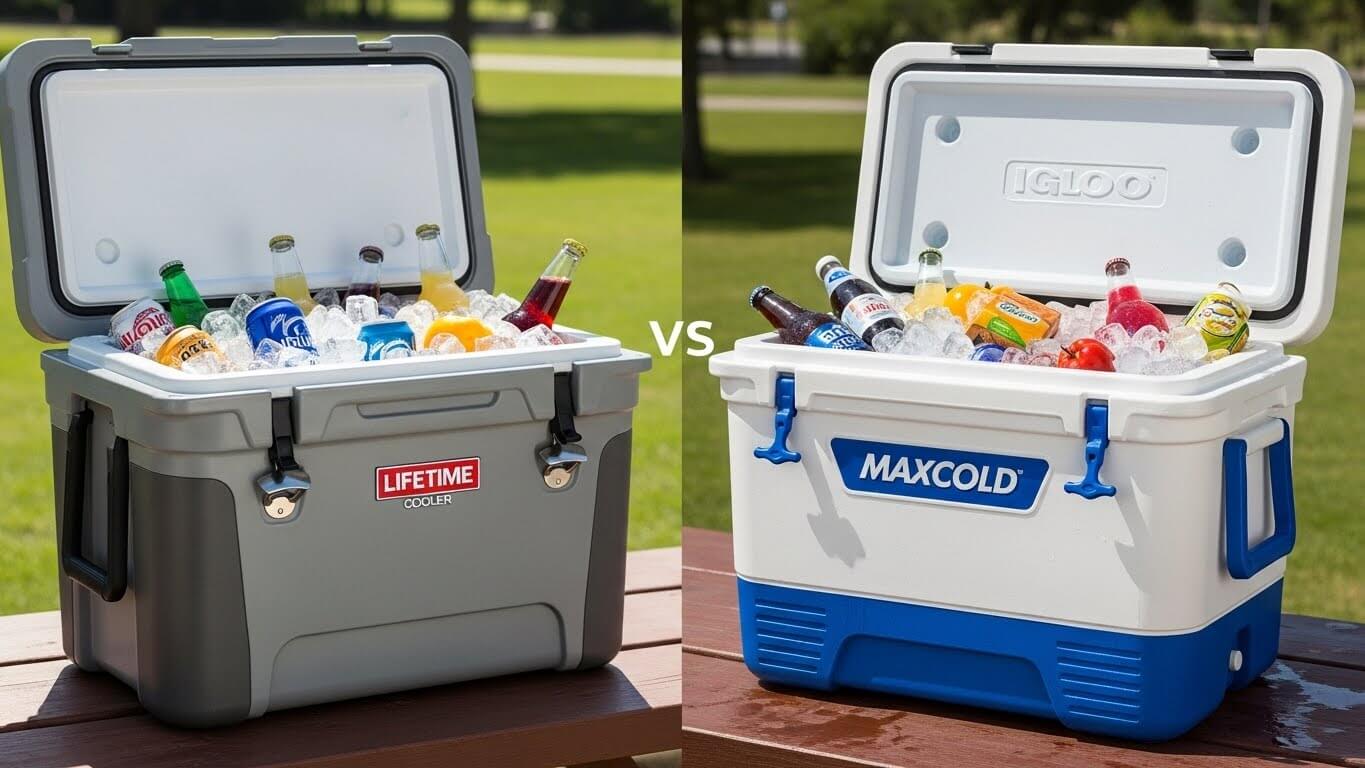
Both Lifetime and Igloo MaxCold coolers deliver functional performance at budget-friendly prices, but they target slightly different users. Lifetime coolers provide rotomolded construction and superior ice retention for Costco members willing to invest $70-$100. The construction quality and performance punch above their weight class, offering excellent value for families who camp regularly and need reliable multi-day cooling.
Igloo MaxCold coolers excel at accessibility and variety, with widespread retail availability and numerous sizes and features. The lower entry price makes them ideal for casual users, those shopping on tight budgets, or anyone wanting to test cooler needs before major investment. When found on sale, MaxCold delivers remarkable performance per dollar spent.
For Costco members who camp regularly, Lifetime represents the better long-term investment. The superior construction should outlast MaxCold alternatives, and the better ice retention proves valuable on extended trips. The modest price premium pays dividends in durability and performance over years of use.
For everyone else, MaxCold coolers provide adequate performance at the lowest entry price. The performance differences matter less on short trips, and the money saved could fund other camping gear or experiences. The widespread availability and variety ensure you can find the right model for your specific needs.
Neither cooler matches premium brands in ice retention, seal quality, or component durability, but both perform admirably for their price points. Most recreational users will find either cooler entirely adequate for weekend camping, beach trips, tailgating, and backyard entertaining. The choice comes down to access, budget, and whether the performance difference justifies the price premium for your specific usage patterns.
Consider your camping frequency and typical trip duration when deciding. Frequent campers taking 3-4 day trips benefit from Lifetime’s better ice retention and durability. Occasional users enjoying day trips and weekends find MaxCold’s lower price more appropriate. Both coolers prove that you don’t need $300 coolers for satisfying outdoor adventures—sometimes budget-friendly options deliver everything you actually need.