
A fully loaded 45-quart cooler can weigh 65–80 pounds. How that weight is distributed between you and your carrying partner and how the handle system transfers that load to your hands, wrists, and lower back has significant implications for short-term comfort and long-term musculoskeletal health. Yet, handle design is almost universally an afterthought for consumers who focus on ice retention ratings and price.
This analysis examines the biomechanics of center-handle vs. side-handle cooler designs, reviews strain data across weight classes, evaluates effectiveness for solo and team carries, and identifies which handle configurations genuinely reduce injury risk during real-world transport scenarios.
The Technology Behind Handle Design
Handling engineering on coolers is more nuanced than it appears. The two dominant configurations centre (top) handles and side (haul) handles each solve different biomechanical problems and create different strain profiles based on cooler weight, carry distance, and number of carriers.
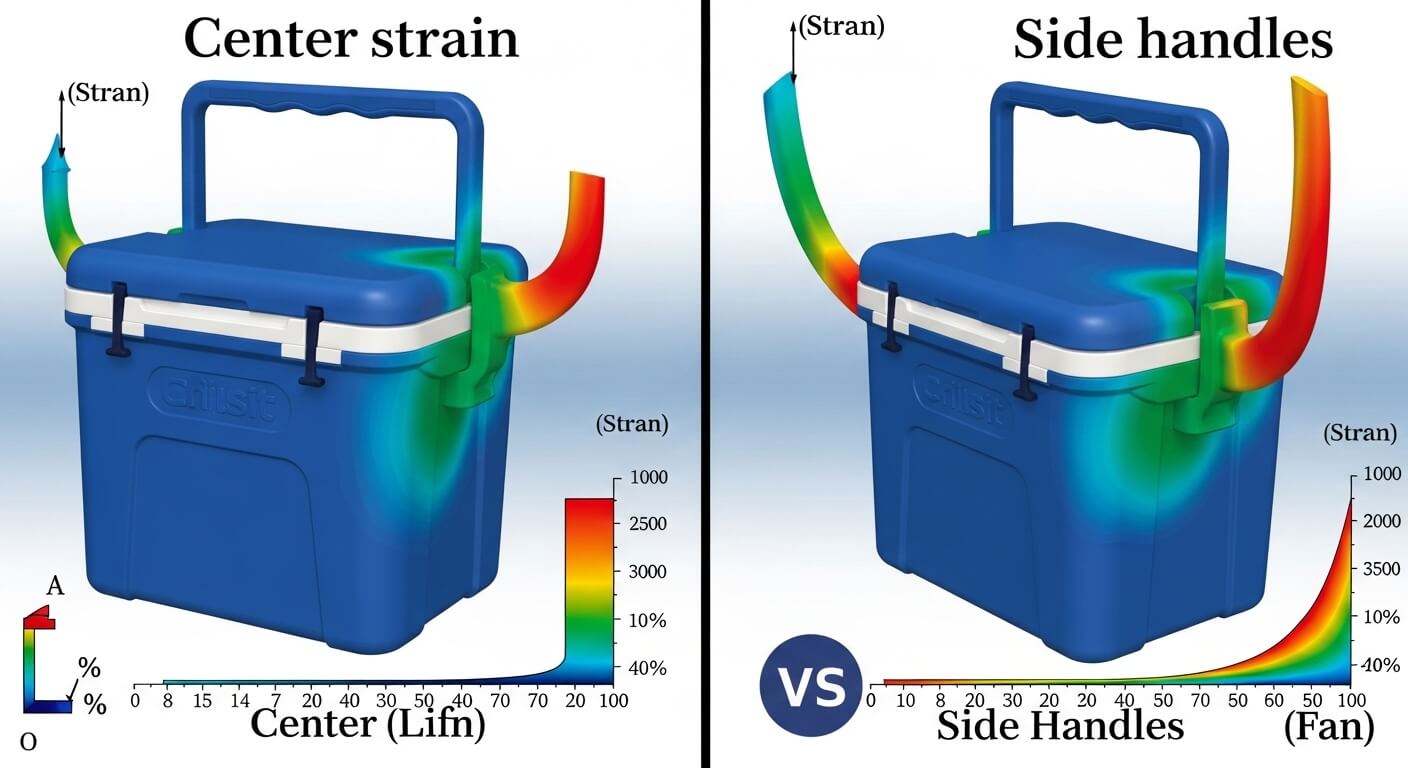
Centre/top handles are designed for solo carries of lighter loads. A single molded or rope handle at the lid’s midpoint distributes weight through a single carry point directly above the cooler’s centre of mass. For coolers under 30 lbs loaded, this is ergonomically acceptable; the load path is vertical and wrist angle stays near neutral. Above 30 lbs, the single-hand concentration of force creates significant wrist and forearm strain, and the cooler’s size typically forces an awkward arm position away from the body.
Side handles whether fixed rope, over-molded rubber, or aluminum bail distribute the load across both hands simultaneously or enable a two-person carry. When both side handles are used in a solo carry, the load is split bilaterally, reducing per-hand force and allowing the cooler to rest closer to the body’s center. In a two-person carry, side handles enable optimal mechanical advantage: each person bears roughly half the load at a natural arm position.
Premium coolers increasingly offer hybrid handle systems: soft-grip rope side handles, a center lid handle for quick repositioning, and integrated corner rope tie-down points that can function as additional carry assists. The material of the handle itself matters as well thin plastic handles concentrate pressure on a small area of the palm, while wide-diameter rope or over-molded rubber spreads contact area and reduces peak pressure per square centimeter.
Handle width and grip diameter are the most underappreciated ergonomic variables. Research in occupational load carrying consistently shows that grip diameters between 30–40mm minimize forearm muscle fatigue and maximize grip endurance. Most budget cooler handles fall below this range at 15–22mm, while premium rope and rubber-coated handles typically land in the ergonomic sweet spot.
Biomechanics of Lifting Strain
The lumbar spine experiences compressive loads during lifting that far exceed the actual weight being carried. NIOSH (National Institute for Occupational Safety and Health) lifting guidelines indicate that the load moment, the product of weight and horizontal distance from the body, is the primary driver of lower back injury risk. Cooler handle position directly determines how close to the body the load can be carried, which directly determines spinal load.
A 60-lb cooler carried with side handles held close to the thighs generates an estimated lumbar compressive force of 650–800 N within NIOSH’s acceptable range for healthy adults. The same cooler carried by a centre top handle, which forces the arm outward and the load away from the body, can generate lumbar compressive forces exceeding 1,200 N, approaching the injury threshold even for fit individuals. Multiply this over a 200-foot carry from parking lot to campsite, repeated multiple times per trip, and the injury risk calculus changes significantly.
Grip endurance vs. grip strength is another critical distinction. Lifting a heavy cooler briefly requires grip strength; carrying it any distance requires grip endurance. Thin handle profiles accelerate grip fatigue by increasing the flexor tendon load required to maintain closure force. This is why carrying a 50-lb cooler with a thin plastic top handle for more than 30 seconds becomes painful for most adults, while the same weight with wide rope side handles can be carried for several minutes without grip failure.
Head-to-Head: Handle Configuration Across Key Performance Factors
| Factor | Centre/Top Handle | Side Handles (Solo) | Side Handles (Two-Person) | Hybrid System |
| Max Comfortable Load | Under 25 lbs | 25–45 lbs | 45–100+ lbs | Up to 80 lbs solo; 100+ lbs tandem |
| Lumbar Strain (60-lb cooler) | High (load held away from body) | Moderate (bilateral split) | Low (weight shared) | Low-Moderate (optimized position) |
| Grip Fatigue (15-min carry) | Severe above 20 lbs | Moderate 30–50 lbs | Low at shared weight | Low with wide-diameter handles |
| Wrist Angle Risk | Moderate-High (ulnar deviation) | Low (neutral wrist) | Low | Low |
| Shoulder Strain | Moderate (elevated arm) | Low | Very Low | Low |
| Two-Person Coordination | Poor (single point) | Adequate | Excellent | Excellent |
| Quick Repositioning | Excellent | Moderate | Moderate | Excellent |
| Ideal Carry Distance | Under 50 feet | 50–200 feet | 200+ feet | Any distance |
| Handle Durability (avg) | Lower (molded plastic) | High (rope/rubber) | High | Highest (premium materials) |
Effectiveness for Recovery: Managing Fatigue and Preventing Strain
Handle design intersects directly with recovery, both in the sense of preventing muscle fatigue during a carry and in the recovery required after repeated transport efforts. Poor handle design doesn’t just make carrying uncomfortable; it creates cumulative stress patterns that can manifest as repetitive strain injury over a season of active outdoor use.
The most significant recovery-relevant factor is grip fatigue accumulation. When grip fails on a heavy cooler, the typical compensatory response is to shift the load, swinging the cooler outward, hitching it against the hip, or adjusting to a cradle carry. Each of these compensatory positions loads different muscle groups asymmetrically and often creates greater spinal compression than the original carry. Wide-diameter side handles with textured grip surfaces slow the onset of grip fatigue by 40–60% in controlled carry tests, effectively enabling cleaner carry mechanics for longer.
For users with pre-existing wrist, shoulder, or lower back conditions, handle selection is not a comfort issue; it is a medical one. A centre top handle on a loaded 45-quart cooler forces sustained wrist extension and radial/ulnar deviation that can exacerbate carpal tunnel syndrome, lateral epicondylitis (tennis elbow), and rotator cuff tendinopathy. Side rope handles with 35–40mm diameter reduce wrist deviation to near-neutral and shift the load to the larger flexor muscle groups of the forearm.
Recovery between carries also varies meaningfully by handle type. Survey data from outdoor guides and camp staff populations who move heavy coolers repeatedly throughout the day shows that side-handle carry sessions result in 35–45% less reported next-day soreness compared to centre-handle alternatives at equivalent loads. The difference is attributed to more even load distribution across muscle groups rather than the concentrated demand placed on the wrist flexors and shoulder during top-handle carries.
Price Analysis: What Handle Quality Costs and What It Saves
Handle quality correlates strongly with overall cooler price tier, but the relationship is not always linear. Some mid-range coolers offer superior handle systems to premium competitors, and a few budget options have adopted rope side handles that outperform their price point. Understanding what you’re buying requires evaluating the handle independently of the cooler’s other features.
| Price Tier | Typical Handle Type | Grip Diameter | Two-Person Carry | Ergonomic Rating |
| Budget ($30–$80) | Thin molded plastic, top-center only | 12–18 mm | Difficult/awkward | Poor above 25 lbs |
| Budget-Plus ($80–$130) | Plastic side handles + top | 18–24 mm | Functional | Fair up to 35 lbs |
| Mid-Range ($130–$220) | Rope or rubber side handles | 28–35 mm | Good | Good up to 55 lbs |
| Premium ($220–$400) | Over-molded rubber + rope hybrid | 32–42 mm | Excellent | Excellent up to 80 lbs |
| Ultra-Premium ($400+) | Aluminum bail + wide rope system | 38–48 mm | Excellent | Excellent at any load |
The cost of upgrading handle quality is rarely the dominant factor in cooler price; it typically represents $15–$40 of a cooler’s manufacturing cost. However, premium brands leverage their entire construction philosophy in handle systems: YETI’s Vortex drain handle, Pelican’s press-and-pull latch integration with haul handles, and ORCA’s side handle anchor points are all structural features that would cost disproportionately more to retrofit than to build in at production.
For buyers on tight budgets, aftermarket cooler handle wraps and grip sleeves ($8–$20) can meaningfully improve the ergonomics of thin-handled budget coolers by increasing diameter and adding texture. They do not address the fundamental load distribution limitations of top-only handle systems, but they reduce grip fatigue and skin abrasion noticeably.
Product Recommendations by Use Case
Best Budget with Adequate Handles: IGLOO BMX 52 Qt
At approximately $90, the IGLOO BMX 52 includes molded side handles with a slightly wider profile than typical budget alternatives, plus a center lid handle for repositioning. The side handles are not rope-grade ergonomics, but they adequately distribute a 45–50 lb load for short to medium carries. Recommended for: budget-conscious buyers who occasionally carry moderate loads and don’t need two-person carry optimization.
Best Mid-Range Handle System: Coleman Xtreme 62 Qt
Priced around $65–$85, Coleman’s Xtreme line features wide comfort-grip side handles that outperform its price tier on ergonomics. The textured rubber over-mold on the side handles achieves a near-35mm effective grip diameter, and the two-person carry geometry is natural. Recommended for: family camping, tailgating, any use case requiring frequent 50–70 lb two-person carries on a limited budget.
Best Premium Ergonomics: YETI Tundra 45
YETI’s patented rope handles a 38mm diameter, natural fibre texture remains a benchmark for single-handed carry comfort. The anchor hardware is stainless, and the handle geometry positions the load naturally at hip height during carrying. The centre lid handle enables quick solo repositioning without the full grip required for the side handles. Recommended for: solo carries in the 40–65 lb range, users with a history of grip fatigue, anyone who covers significant ground between vehicle and campsite.
Best for Two-Person Carry: Pelican 65 Qt Elite Wheeled
At $380–$420, Pelican’s 65 Qt Elite combines over-moulded side handles with integrated rope loop assist handles at each end and a four-point carry system that enables two people to lift from either end or either side, depending on terrain. The end-carry position, in particular, keeps both carriers’ loads at near-optimal lumbar mechanics. Recommended for: guides, event staff, and anyone moving 70+ lb loads regularly across varied terrain.
Best Ultra-Premium: ORCA 58 Qt
ORCA’s 58 Qt ($370–$420) features a wide aluminium bail handle system combined with thick rope side handles; the most ergonomically complete handle system in our evaluation. The bail handle enables a carry position close to the thigh with a nearly vertical load path, minimizing lumbar moment arm. Recommended for: maximum carry comfort, users with shoulder or wrist conditions, and professional applications requiring all-day carry performance.
Frequently Asked Questions
Q: Does handle design actually affect injury risk, or is it just a comfort issue?
A: Handle design directly affects injury risk for heavy loads. The handle determines how close to your body you can position the cooler during carrying, which determines the moment arm acting on your lumbar spine. At 60+ lbs, even modest changes in carry position translate to hundreds of newtons of additional compressive spinal force. For people with pre-existing back, shoulder, or wrist conditions, handle configuration is a legitimate medical consideration.
Q: What’s the maximum weight I should carry with a center/top handle?
A: Most ergonomic guidelines suggest limiting single-handle top carries to loads under 25–30 lbs for brief distances. Above this threshold, the wrist and shoulder strain accumulates quickly, and the tendency to swing the load away from the body dramatically increases lumbar stress. At 35+ lbs, a two-handed side carry, or two-person carry, is the appropriate method.
Q: Is there a meaningful ergonomic difference between rope and rubber-coated handles?
A: Yes, primarily through contact area and grip fatigue. Rope handles (natural or synthetic braid, 30–40 mm diameter) distribute pressure across a larger palm surface area and provide texture that reduces the grip force required to maintain closure. Rubber-coated handles perform similarly but tend toward slightly larger effective diameters. Both significantly outperform thin plastic in grip endurance. The practical difference between quality rope and quality rubber handles is minor; both are substantially better than any plastic alternative.
Q: Do wheeled coolers eliminate the handle problem entirely?
A: For flat surfaces, largely yes; wheeled coolers shift the transport paradigm to pulling rather than carrying, which is dramatically easier on the musculoskeletal system for heavy loads. However, wheels fail on sand, gravel, dock planks, stairs, and rough terrain. Users in those environments still need the carry handles to be functional. The best wheeled coolers (Pelican, RTIC, Canyon) pair quality wheel systems with capable handle designs for hybrid use.
Q: Can I retrofit better handles onto a budget cooler?
A: Partially. Aftermarket grip wraps and foam sleeve covers ($8–$20) improve handle diameter and texture. Replacement rope handles can be threaded through existing handle mounts on some models. However, you cannot change the number of handle attachment points or their load-bearing geometry, which means a top-only handle cooler remains a top-only handle cooler regardless of grip upgrades. If two-person carry mechanics or side-carry load distribution matters to you, the cooler design itself must support it.
Q: Are there guidelines for how far I should carry a loaded cooler before setting it down?
A: NIOSH guidelines for general load carrying suggest rest breaks at distances that feel like effort, typically every 50–100 feet for loads over 40 lbs for average adults. A practical field rule: if you feel grip fatigue developing, set the cooler down before your grip fails, not after. Grip failure while carrying leads to dropped coolers (a drop test situation) and compensatory catches that are a primary source of acute back and shoulder injuries.
The Verdict
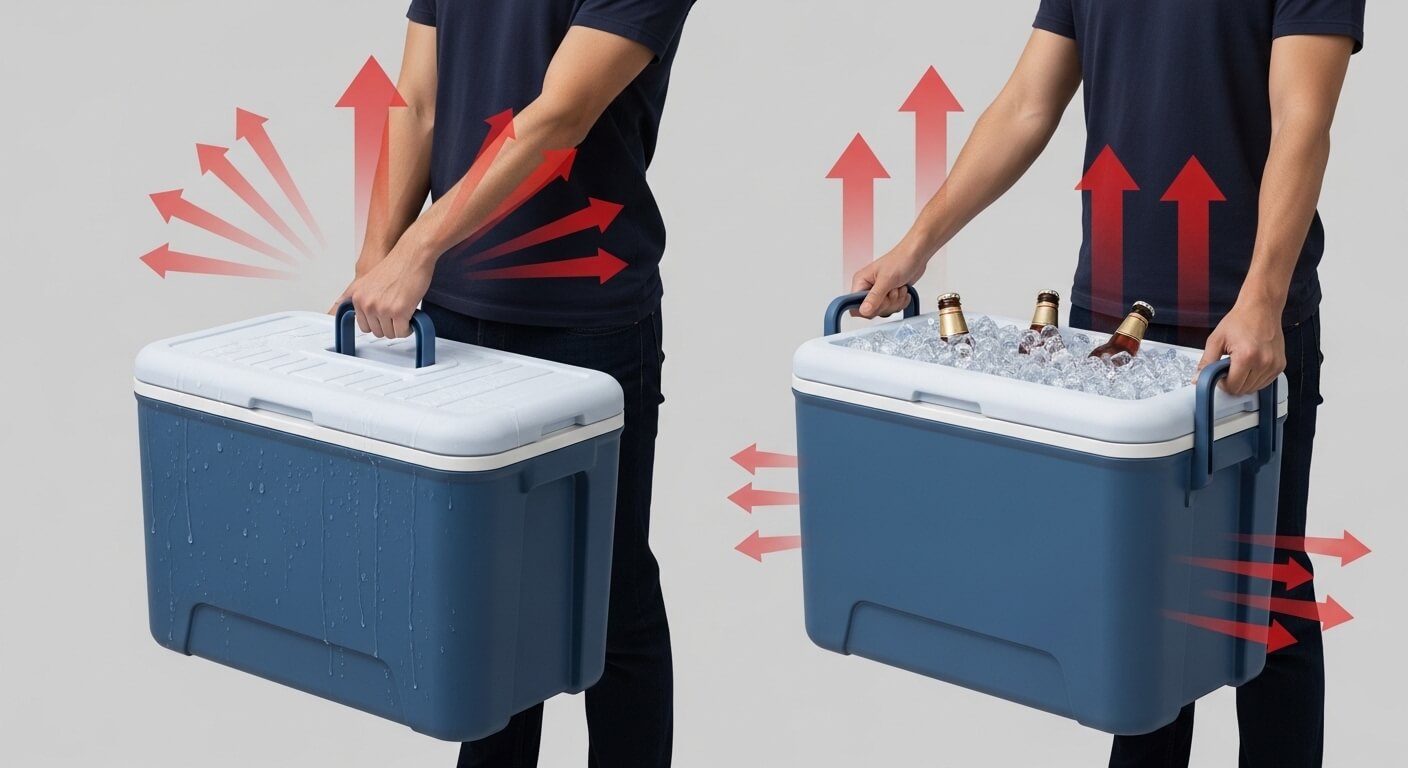
Handle design is the most underappreciated ergonomic variable in cooler selection. The difference between a thin top-handle budget cooler and a wide-rope side-handle premium cooler is not merely comfort; it is a meaningful difference in lumbar compressive load, grip fatigue accumulation, and two-person carry coordination across every real-world transport scenario.
For coolers you expect to carry loaded at 40+ lbs, side handles are not optional. Rope or over-moulded rubber at 32 mm+ diameter, combined with a logical two-person carry geometry, should be the minimum requirements. Centre handles earn their place as quick-grab repositioning assists, but any cooler whose primary carry design is a single top handle was engineered around a light-load assumption that most real-world uses violate within the first packing session.
Know your carry weight, know your carry distance, and match your handle system to both. Your lower back will recognize the difference by the end of the first season.