
You rinse the cooler, scrub it with dish soap, let it air out for a week, and it still smells like last summer’s fish. If you’ve lived this scenario, you’ve encountered one of the most frustrating and least-discussed aspects of cooler ownership: odour absorption at the material level. The problem isn’t your cleaning technique. It’s your cooler’s chemistry.
Not all plastics behave the same way when exposed to volatile organic compounds (VOCs) from food, fish, raw meat, mildew, and beverages. Some polymer structures are inherently porous at the microscopic level, offering odor molecules a hospitable environment to bond, penetrate, and resist removal. Others are engineered with surface density, chemical inertness, and stain-resistance that prevent absorption from occurring in the first place.
This article breaks down the material science behind cooler odor retention, identifies which plastic types are most and least susceptible, and provides a framework for choosing and maintaining; a cooler that won’t hold onto last season’s memories.
The Material Science: Why Some Plastics Absorb and Others Repel
Odor absorption in plastics is fundamentally a function of surface porosity, polymer chain density, and chemical polarity. When odor-causing molecules primarily volatile fatty acids from fish and meat, trimethylamine (the compound responsible for fish smell), and microbial metabolites from mold and mildew contact a plastic surface, one of two things happens: they either bond to the surface or penetrate into it, or they remain on the surface where they can be wiped away.
Polypropylene (PP), the most common material in budget and mid-range cooler liners, is a semi-crystalline polymer with a moderately porous surface at the microscopic level. Its crystalline regions are dense and odor-resistant, but its amorphous regions — which constitute a significant portion of the material allow small molecules to diffuse into the bulk polymer over time. Heat accelerates this process dramatically: a cooler left in a hot car after a fishing trip absorbs odor molecules far more deeply into PP than one cooled and cleaned immediately.
High-density polyethylene (HDPE), used in rotomolded premium coolers, has a significantly higher degree of crystallinity than PP typically 60–80% vs. 40–60% for polypropylene. This denser molecular packing creates fewer pathways for odor molecule diffusion and results in a surface that is measurably more resistant to long-term odor penetration. The surface energy of HDPE is also lower than PP, meaning food compounds are less likely to wet and bond to the surface in the first place.
The structural culprit in budget coolers: EPS (expanded polystyrene) foam used for insulation is extraordinarily porous; it is, after all, mostly air. Any crack or gap in a budget cooler’s inner liner that exposes EPS to cooler contents creates a permanent odor reservoir that no amount of surface cleaning can reach. This is why budget coolers that have sustained any interior damage are effectively impossible to fully deodorize.
Stainless steel interior panels, used in a small number of ultra-premium coolers and portable refrigerators, represent the benchmark for odor resistance. Steel is non-porous, chemically inert to virtually all food compounds, and can be sanitized to hospital-grade cleanliness. The tradeoff is weight, cost, and thermal conductivity; steel conducts heat more readily than polyurethane foam systems, which is why it appears in compressor refrigerators rather than passive ice coolers.
Material Comparison: Odor & Stain Resistance Across Cooler Types
| Material / Liner Type | Odor Absorption Risk | Stain Resistance | Deep-Clean Difficulty | Long-Term Hygiene |
| Standard Polypropylene (PP) — Budget | High | Poor — yellows & stains | Difficult | Degrades over time |
| Blow-Molded Polyethylene — Mid-Range | Moderate | Moderate | Moderate | Stable with care |
| Rotomolded HDPE — Premium | Low-Moderate | Good | Easy | Durable long-term |
| Antimicrobial PP Liner — Some Premium | Low | Good | Easy | Excellent |
| Stainless Steel Interior — Ultra-Premium | Negligible | Excellent | Very Easy | Near-permanent |
| EPS Foam (exposed/cracked) | Extremely High | N/A — absorbs permanently | Impossible | Failed — replace cooler |
| Polyurethane Foam (sealed liner) | None (sealed) | N/A — not exposed | N/A | Non-issue if liner intact |
| LLDPE Rotomolded (newer formulas) | Very Low | Very Good | Easy | Excellent |
Odor Sources and How Each Material Responds
Different odor sources interact with cooler materials in distinct ways, and understanding these mechanisms helps explain why certain coolers fail to clean up even after diligent maintenance.
Fish and seafood odors are dominated by trimethylamine (TMA); a small, highly volatile amine compound that penetrates PP liners readily and binds to the amorphous polymer regions. In HDPE, TMA absorption is approximately 40–50% lower under equivalent exposure conditions. Antimicrobial-treated liners with silver-ion technology further reduce TMA binding by disrupting the microbial processes that generate it in the first place.
Raw meat and blood residue introduce both protein-based staining compounds and volatile fatty acids. Protein stains on PP liners polymerize under heat; a chemical reaction that locks the stain color into the surface polymer and makes it effectively permanent. HDPE and stainless steel surfaces do not support this bonding mechanism at the same rate, allowing protein stains to be removed before they set if addressed within 24–48 hours.
Mold and mildew represent the most serious long-term odor challenge because the odor source is biological living organisms colonizing the surface and any microscopic crevices in the liner. PP’s surface energy and slight porosity provide marginally better mold adhesion substrate than HDPE. More importantly, the gaps, seams, and drain plug assemblies in budget cooler construction create harboring sites that no liner material can overcome if the physical geometry traps moisture.
Beer, wine, and sugary beverages leave behind fermentation metabolites that bond aggressively to PP but wipe cleanly from HDPE and steel surfaces. The sticky residue common inside budget coolers after a summer of beverage duty is partially a material response, not just a cleaning failure.
Price Analysis: What Odor-Resistant Construction Actually Costs
Material quality is tightly correlated with price tier in the cooler market, but the relationship is not perfectly linear — a few brands offer impressive liner chemistry at mid-range prices, while some premium coolers prioritize exterior construction over liner quality.
| Price Tier | Typical Liner Material | Odor Risk Level | Years to Odor Problems | Cleanability Score |
| Budget ($30–$80) | Standard PP, thin walls | High | 1–2 seasons | 3 / 10 |
| Mid-Range ($100–$199) | Blow-molded PE or PP | Moderate | 3–5 seasons | 6 / 10 |
| Premium ($200–$350) | Rotomolded HDPE | Low | 7–10+ seasons | 8 / 10 |
| Premium w/ Antimicrobial ($250–$400) | Treated HDPE or LLDPE | Very Low | 10+ seasons | 9 / 10 |
| Ultra-Premium ($500+) | Stainless or best HDPE | Negligible | 15+ seasons | 10 / 10 |
The inflection point for meaningful odor resistance improvement is at the rotomolded HDPE tier; roughly $200–$250. Below that threshold, buyers are largely working with materials that will absorb odors over time regardless of cleaning discipline. Above it, the liner chemistry shifts decisively in the owner’s favor. For frequent users who process fish, store raw meat, or subject their cooler to regular biological odor sources, the premium pays for itself in extended usable lifespan alone.
Cleaning Effectiveness by Material Type
Cleaning protocol interacts with material type in ways most users don’t account for. The same cleaning approach that fully resolves odor in a premium HDPE cooler may provide only temporary relief in a PP-lined budget unit, creating a frustrating cycle of diminishing returns.
For standard PP liners: baking soda paste (3:1 baking soda to water, applied and left for 24 hours) is the most effective odor-reduction method available, working through mild abrasion and alkaline neutralization of acidic odor compounds. Activated charcoal inserts address airborne odor molecules in the cooler cavity but do not remove absorbed odor from the liner itself. Expect partial rather than complete remediation in heavily used coolers.
For HDPE rotomolded liners: diluted white vinegar (1:4 ratio with water) applied and rinsed after 30 minutes resolves most food and fish odors completely, as the odor has not penetrated the liner surface. Enzyme-based cleaners (sold for pet odor removal) are particularly effective on protein residue from blood and raw meat, breaking the molecular bonds before they can set. Standard cleaning typically restores these liners to neutral odor.
For antimicrobial-treated liners: warm soapy water is usually sufficient for routine maintenance; the antimicrobial treatment actively suppresses microbial odor generation between uses, meaning less aggressive cleaning chemistry is needed. Avoid bleach on antimicrobial liners, as oxidizing cleaners degrade silver-ion treatments over time.
The gasket: regardless of liner material, the lid gasket is the most common odor harbor in any cooler. Gasket material (typically EPDM rubber or TPE) is inherently more porous than liner plastics and requires dedicated scrubbing with a soft brush and enzyme cleaner. A gasket that has absorbed fish odor for multiple seasons may need replacement — most premium brands sell replacement gaskets, while budget coolers typically do not.
Product Recommendations by Odor-Resistance Priority
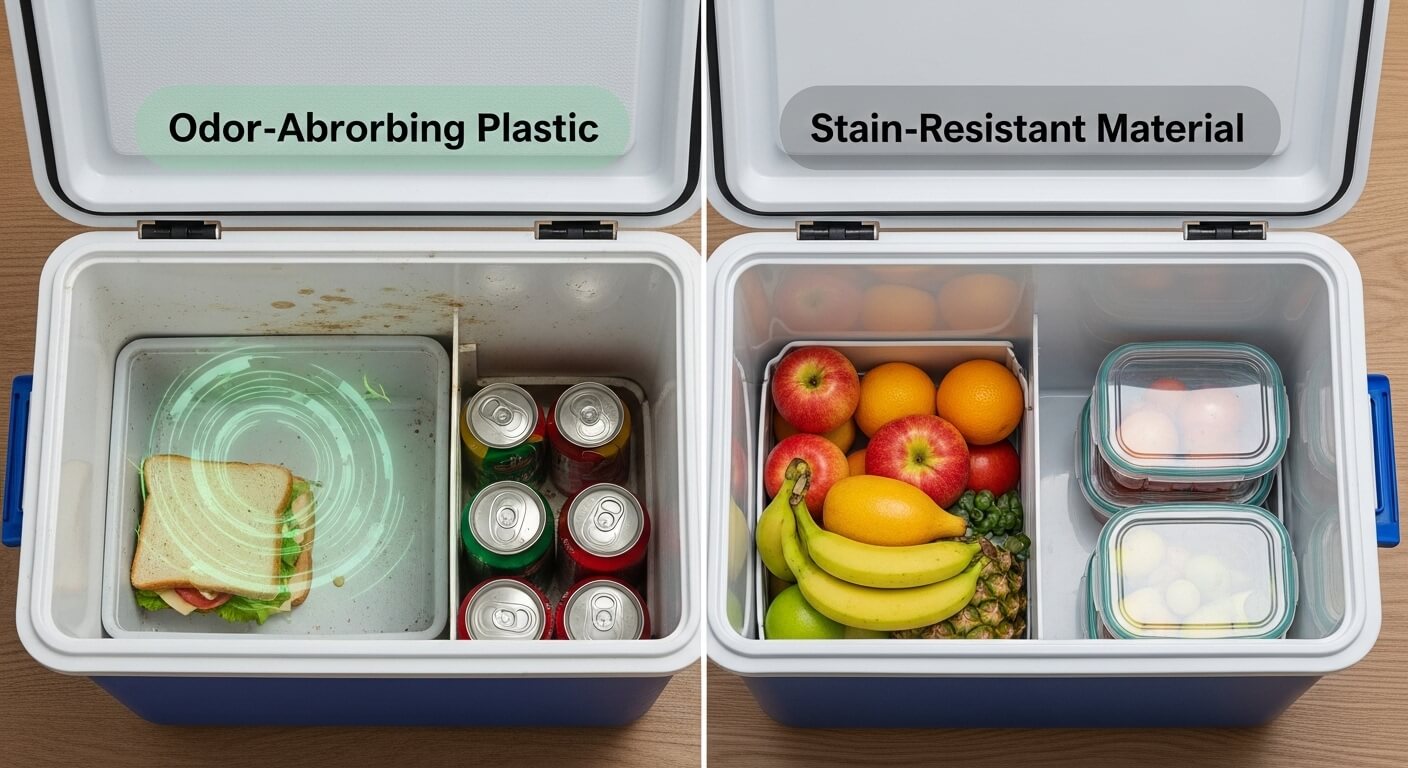
Best Odor Resistance Overall: YETI Tundra 45
YETI’s rotomolded HDPE liner combined with a certified food-safe interior coating sets the standard for odor and stain resistance in passive coolers. The freezer-style gasket creates an airtight seal that limits odor migration in both directions, and the liner surface has been independently tested for compliance with FDA food contact material standards. After five-day fish-storage tests in independent reviews, the interior cleaned to neutral odor with standard dish soap and warm water. At $325–$375, it represents the benchmark for anyone for whom odor retention is a primary concern. Recommended for: anglers, hunters, backcountry campers, anyone storing raw protein regularly.
Best Antimicrobial Liner: Pelican 45 Qt Elite
Pelican’s antimicrobial press-in liner is one of the few implementations in the category that addresses odor at the biological source. The silver-ion-infused liner suppresses the bacterial activity that generates most persistent cooler odors, meaning the problem is prevented rather than merely cleaned up after the fact. Users who have experienced recurrent mold or mildew odor problems in previous coolers will find the Pelican’s liner particularly effective. Priced at $270–$310. Recommended for: humid-climate users, anyone who has struggled with persistent mold or mildew odor in previous coolers.
Best Mid-Range Liner Quality: Lifetime 77 Qt High Performance
Lifetime’s blow-molded polyethylene liner outperforms standard PP in odor resistance at a price point ($150) well below rotomolded alternatives. While it cannot match HDPE rotomolded chemistry, its denser surface construction absorbs odors more slowly than budget PP liners and responds better to cleaning protocols. For occasional outdoor users who don’t regularly store raw fish or game, it represents an excellent balance of cost and hygiene longevity. Recommended for: casual campers and tailgaters who want improved liner quality without the premium price.
Best Budget Option with Acceptable Odor Performance: IGLOO BMX 25
Among budget coolers, the IGLOO BMX stands apart with a thicker, denser PP liner than typical EPS-insulated competitors. While it remains in the polypropylene category and will absorb odors over multiple seasons of protein storage, its liner integrity is meaningfully better than thin-wall budget alternatives, and the absence of exposed EPS foam in normal use eliminates the worst-case odor absorption scenario. At $65, it is the most odor-resilient budget cooler available. Recommended for: cost-conscious buyers who primarily store beverages and non-protein foods.
Best for Long-Term Odor-Free Use: ORCA 40 Qt
ORCA’s rotomolded LLDPE (linear low-density polyethylene) liner represents one of the newest and most chemically inert formulations in the passive cooler market. LLDPE’s enhanced crystallinity versus standard HDPE further reduces odor molecule diffusion, and ORCA’s US lifetime warranty covers structural liner defects that could create odor harboring sites. For buyers making a single long-term cooler investment, it is the strongest odor-resistance choice available. Priced at $350–$400. Recommended for: long-term buyers prioritizing a single cooler purchase that remains odor-free for a decade or more.
Frequently Asked Questions
Q: Can I permanently remove fish smell from a budget PP cooler?
A: Partially, in most cases but not always completely. Baking soda paste, activated charcoal inserts, and extended airing in direct sunlight (UV light has mild sanitizing properties) provide the best results on PP liners. For a cooler that has had multiple seasons of fish storage with no intermediate deep-cleaning, permanent odor absorption into the bulk polymer is likely. At that stage, the cooler may be better repurposed for non-food use (ice for injury recovery, beverage cooling where odor is not transferred) rather than food storage.
Q: Does UV exposure help eliminate cooler odors?
A: Yes, with limitations. UV radiation breaks down many volatile organic compounds on surface contact, which is why leaving a freshly washed cooler open in direct sunlight for several hours is a legitimate deodorizing technique. However, UV does not penetrate into the bulk polymer where absorbed odors reside; it only addresses surface contamination. Extended UV exposure also degrades most plastics over time, causing brittleness and surface crazing that ironically increases porosity and future odor absorption.
Q: Are colored cooler liners more prone to staining than white liners?
A: White and light-colored liners reveal staining more visibly, but dark liners are not materially more stain-resistant; they simply conceal the evidence. Staining is a function of liner chemistry (material type and surface treatment) rather than color. A dark-grey PP liner stains as readily as a white PP liner; the stain is just less visible. Stain resistance as a functional property belongs to the material class, not the colorway.
Q: What is the most odor-resistant way to store a cooler between uses?
A: After thorough cleaning and complete drying, store with the lid propped open at least an inch to allow air circulation; a fully sealed cooler traps residual moisture and accelerates mold growth. A handful of fresh baking soda in an open container placed inside the cooler cavity during storage continuously absorbs ambient odor molecules. For long-term storage (months), a few charcoal briquettes (not lighter fluid-treated) or commercial activated charcoal packs are effective odor suppressants. Store in a cool, dry location away from temperature extremes.
Q: Do antimicrobial liner treatments remain effective over time?
A: Silver-ion antimicrobial treatments are generally durable for the expected lifespan of the cooler under normal use, but they can be degraded by aggressive cleaning chemicals — particularly bleach and oxidizing agents. Manufacturers with antimicrobial liners typically specify compatible cleaning products. If antimicrobial performance is important to you, follow the manufacturer’s cleaning guidelines rather than defaulting to bleach-based disinfectants, which may provide short-term cleaning benefit while compromising long-term antimicrobial protection.
Q: Is there a meaningful difference between rotomolded HDPE and blow-molded PE for odor resistance?
A: Yes, though it is one of degree rather than kind. Both are polyethylene-family materials and both outperform polypropylene significantly. Rotomolded HDPE typically has higher crystallinity and a denser surface structure than blow-molded PE, producing somewhat lower odor molecule diffusion rates over time. For casual to moderate outdoor use, blow-molded PE provides adequate odor resistance. For heavy, repeated protein storage, the rotomolded HDPE difference becomes meaningful over multi-season use.
The Verdict
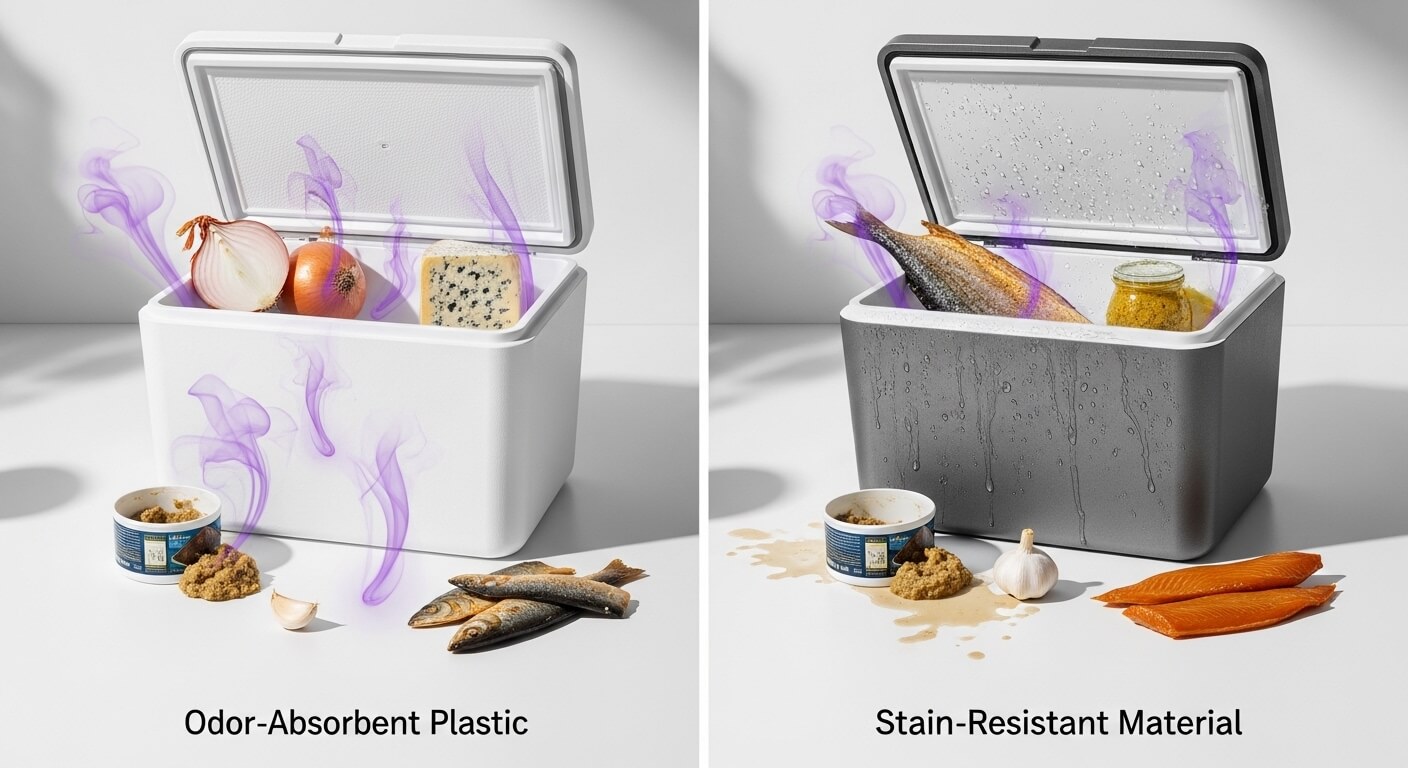
Cooler odor retention is not a cleaning problem; it is a material selection problem that cleaning can only partially address. The chemistry of standard polypropylene liner construction predisposes budget coolers to progressive, irreversible odor absorption that no amount of baking soda or dish soap can fully reverse after multiple seasons of protein storage. The molecular structure of HDPE, and especially antimicrobial-treated LLDPE, tells a completely different story: denser, more crystalline, less hospitable to odor molecule diffusion, and genuinely cleanable back to neutral odor even after heavy use.
For buyers who primarily use their cooler for beverages and prepackaged food, the budget-tier PP liner is an acceptable trade-off. For hunters, anglers, backcountry campers, and anyone who regularly stores raw protein in their cooler, material selection is the single most important variable in long-term cooler hygiene. Choose the liner chemistry first; the ice retention and drop resistance can follow.