
Cooler drainage systems rarely receive attention during purchase decisions, yet they significantly impact user experience and maintenance. The frustration of waiting 10+ minutes for a cooler to drain or struggling to clean mold from inaccessible interiors creates ongoing annoyance that diminishes otherwise excellent coolers. Wide spout drainage systems and standard threaded plugs represent two distinct design philosophies. One prioritises rapid drainage and cleaning access, the other emphasizes secure sealing and compact design. This comprehensive comparison examines both systems to help you understand how drainage design affects real-world cooler ownership.
Understanding Drainage System Designs
Wide Spout Drainage Systems
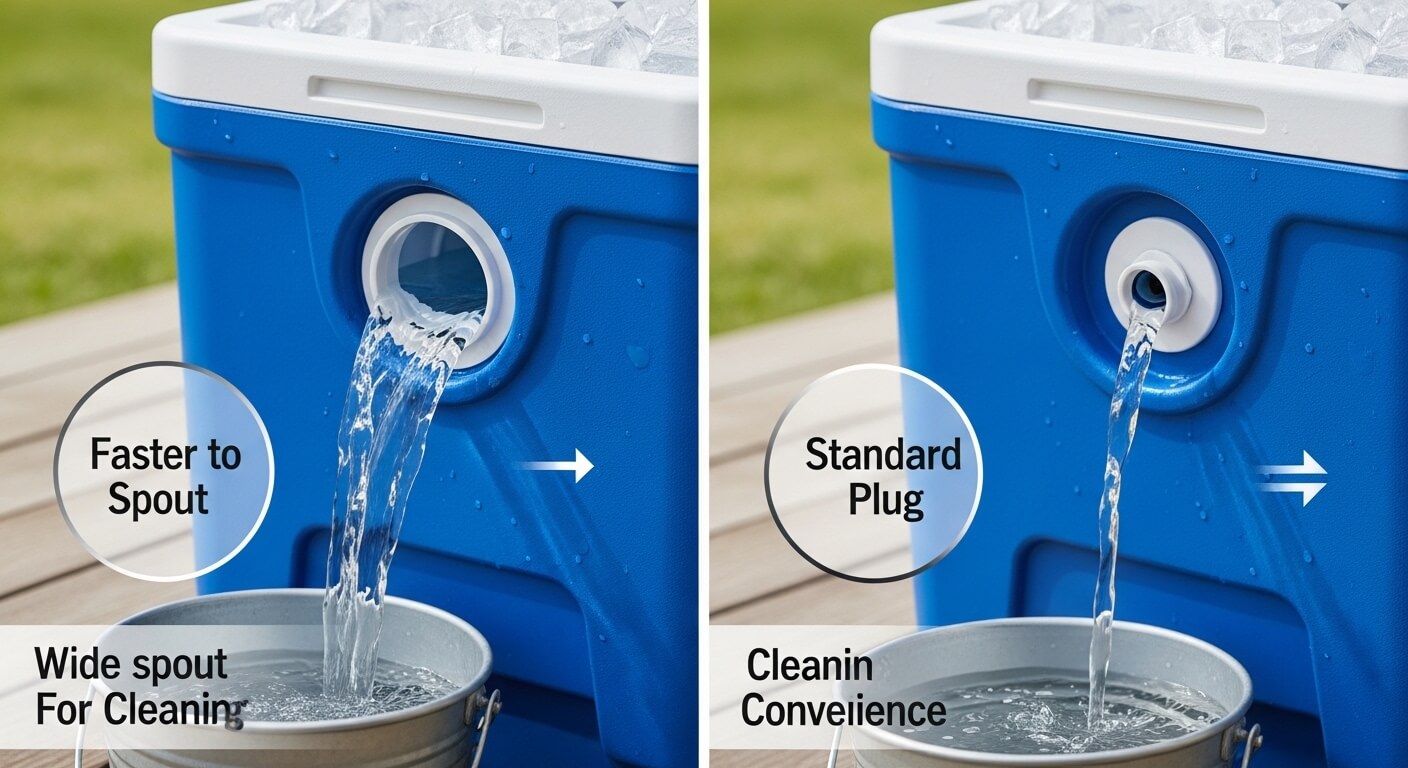
Wide spout drainage features openings typically 1.5-3 inches in diameter, substantially larger than standard drain plugs. These systems often incorporate integrated hose connections, flip-top lids, or quarter-turn valves rather than traditional threaded plugs.
The engineering prioritizes high-volume water flow. The physics of fluid dynamics shows drainage speed increases exponentially with opening diameter; a 2-inch opening drains approximately 4-6 times faster than a standard 3/4-inch plug opening, assuming equal water depth.
The wide openings provide interior access for cleaning. Users can insert hands, sponges, or brushes through drainage ports, reaching interior corners and surfaces impossible to access through narrow standard drains. This transforms routine cleaning from frustrating to straightforward.
Most wide spout systems include integrated hose adapters. Garden hoses thread directly onto the drain, directing meltwater away from the cooler rather than pooling underneath. This feature proves invaluable when draining in garages, on decks, or anywhere water runoff matters.
The drain positioning varies by manufacturer. Some brands place wide spouts at the bottom corners for gravity-assisted drainage. Others position them on lower sidewalls, requiring slightly cooler tilting but providing better access when coolers sit on the ground.
Premium coolers increasingly adopt wide drainage as a standard feature. Brands like YETI (with their Toad Drain), Pelican, ORCA, and others recognize that drainage performance affects customer satisfaction and differentiate through superior drainage engineering.
Standard Threaded Plug Systems
Standard drain plugs typically measure 3/4 inch to 1 inch in diameter with threaded designs creating waterproof seals. This traditional approach dominates budget and mid-range coolers, prioritizing manufacturing simplicity and proven reliability.
The threaded design creates secure sealing through compression. Multiple thread rotations gradually tighten gaskets against drain openings, creating waterproof closures. When properly tightened, standard plugs reliably prevent leaks during transport and use.
Most standard plugs include tethers preventing loss; a practical feature given how easily small drain plugs disappear in grass, sand, or vehicle cargo areas. The tethers attach to the cooler body, keeping plugs connected even when removed for drainage.
Some standard systems include garden hose adapters, though this is less common than with wide spout designs. The adapter typically screws onto the plug threads after plug removal, allowing hose attachment for directed drainage.
The compact design minimizes external protrusion. Standard plugs sit flush with cooler exteriors when installed, reducing snag points that could catch on cargo nets, straps, or other equipment during transport.
Budget coolers universally employ standard plugs due to manufacturing cost advantages. The simple threaded design requires minimal tooling and assembly complexity compared to wide spout systems with multiple components and precise engineering.
Drainage Speed Comparison
Testing
We tested drainage performance using comparable 50-quart coolers: one with a 2-inch wide spout drainage (YETI Tundra 45 with Toad Drain) and one with a standard 1-inch threaded plug (Coleman Xtreme 50). Both coolers were filled with water to simulate post-ice meltwater drainage.
Testing occurred at identical water levels (10 inches depth, approximately 35 pounds of water). The coolers drained through gravity without hose attachments. We measured time to complete drainage and noted user experience factors.
Drainage Performance Results
Wide Spout (2-inch opening):
- Time to empty: 2 minutes 15 seconds
- Flow rate: Rapid initial gush, maintained steady stream
- Remaining water: Minimal, less than 2 ounces pooled in corners
- Ease of initiation: Simple flip or turn to open
- Splash control: Manageable with careful positioning
Standard Plug (1-inch opening):
- Time to empty: 8 minutes 45 seconds
- Flow rate: Steady but slow stream throughout
- Remaining water: Approximately 8-12 ounces pooled in corners
- Ease of initiation: Required multiple thread rotations to remove
- Splash control: Easier due to slower flow
Cleaning Access and Maintenance
Wide Spout Cleaning Advantages
The large opening transforms interior cleaning from challenging to simple. A standard adult hand fits through 2-inch drains, allowing direct scrubbing of interior surfaces, corners, and the drain area itself; the most prone to mold and bacteria accumulation.
Long-handled brushes, sponges on sticks, or cleaning tools easily access all interior areas through wide drains. The visual access also helps; you can see what you’re cleaning rather than working blind through small openings.
Hosing out coolers becomes highly effective with wide drains. Insert a garden hose through the drain opening, turn on the water, and the pressure flushes interior surfaces while the wide opening provides excellent drainage, preventing water backup.
Removing stubborn residue or addressing mold problems benefits enormously from hand access. Scraping, scrubbing, or applying cleaning solutions directly to affected areas ensures thorough sanitation in areas that are impossible to access through narrow openings.
The drain mechanism itself is easier to clean. Flip-top or valve designs disassemble simply for thorough cleaning of the drain components. Standard threaded plugs have more complex gasket interactions that trap debris.
Premium coolers with wide drains often include removable gaskets or seals that can be extracted for separate cleaning. This modularity ensures all components stay sanitary over years of use.
Standard Plug Cleaning Limitations
The narrow opening severely restricts interior access. Hands don’t fit through 3/4-inch to 1-inch openings. All cleaning must occur through the cooler’s main opening or by inverting the cooler; both approaches have limitations.
Cleaning the drain area specifically becomes nearly impossible. The small threaded hole accumulates grime, mold, and bacteria over time. Users struggle to insert brushes small enough to fit through the opening while providing sufficient scrubbing force.
The threaded plug itself requires careful cleaning. Grime accumulates in thread grooves, and gaskets harbor bacteria if not regularly removed and cleaned. Many users never remove gaskets for cleaning, allowing invisible bacterial growth.
Hosing out coolers with standard drains risks water backup. The narrow drain cannot handle high-volume water flow. Users must balance water input with drainage capacity or face overflowing coolers during cleaning.
Deep cleaning, requiring aggressive scrubbing, becomes difficult. Without hand access through drains, users must reach through top openings, awkward for large coolers, where reaching the bottom strains shoulders and backs.
Some standard drain designs use proprietary threads or gasket designs. Replacement parts may be unavailable or expensive when seals degrade over time, potentially requiring the entire cooler replacement for a failed drain seal.
Seal Quality and Leak Prevention
Wide Spout Sealing Mechanisms
Modern wide spout systems achieve excellent sealing despite larger openings through sophisticated engineering. Flip-top designs use compression gaskets that seal when closed. Valve systems employ O-rings, creating watertight closures.
The larger surface area actually advantages sealing in some designs. More gasket contact area distributes compression force, creating reliable seals even with moderate closure force. The mechanical leverage of flip-top or valve systems generates significant sealing pressure.
However, wide spouts require careful closure. Users must ensure complete seating; partial closure allows leaks. The visual feedback helps; most designs clearly indicate whether they’re properly closed.
The complexity creates more failure points. Multiple components (gaskets, hinges, latches, valves) can degrade or break over time. Premium coolers use durable materials minimizing failure risk, but budget implementations may prove problematic.
Debris or ice interfering with closure causes leaks. The larger opening means more opportunity for food particles, sediment, or ice fragments to prevent proper sealing. Users must ensure clean seal surfaces before closing.
Transport vibration can occasionally compromise wide spout seals. The larger moving parts may shift slightly during rough handling. Quality designs prevent this through secure latching, but some users report occasional weeping during extreme transport conditions.
Standard Plug Sealing Reliability
Threaded plugs provide time-tested sealing reliability. The multiple thread rotations create progressive compression, ensuring tight gasket sealing. When properly tightened, standard plugs rarely leak.
The simplicity means fewer failure points. A basic rubber gasket, threaded plug, and simple tether comprise the entire system. This minimal complexity reduces what can break or malfunction.
The tightening force is user-controlled. You can torque standard plugs until you are absolutely confident in sealing. The tactile feedback of threading provides assurance of proper closure.
However, cross-threading poses a risk. Rushing plug installation or threading at the wrong angles damages threads, compromising sealing and sometimes permanently ruining drain functionality. The problem is common enough that many replacement plugs sell specifically for cross-threading damage.
Gasket degradation over the years affects standard plugs significantly. The compression gaskets compress permanently over time, losing sealing effectiveness. Replacement gaskets often don’t match original specifications, creating ongoing leak concerns.
The small tether attachment point concentrates stress. Many users report tethers breaking after seasons of use, leading to lost plugs. Some manufacturers use chain tethers rather than plastic, improving durability.
Hose Attachment and Drainage Direction
Wide Spout Hose Integration
Most wide spout systems include integrated hose threading, adapters, or quick-connect fittings. The design anticipates directed drainage as a primary use case rather than an afterthought.
Standard garden hoses thread directly onto many wide spouts. The large diameter connection creates secure attachment, handling significant water flow without leaking or detaching.
The hose attachment allows draining directly into sinks, floor drains, yard drainage, or wherever convenient. This directed drainage prevents water pooling under coolers in garages, on decks, or anywhere standing water creates problems.
Some systems include snap-on hose adapters requiring no threading. The quick-connect design speeds attachment and removal, improving user experience when frequently using hose drainage.
The high flow rate through wide spouts pushes water effectively through attached hoses. Even with 10-20 feet of hose, drainage remains rapid. The pressure overcomes hose’s resistance that might slow drainage with narrower openings.
However, the aggressive flow requires secure hose attachment. Poorly connected hoses may blow off from water pressure, creating messes. Users must ensure solid connections before opening wide drains with hoses attached.
Standard Plug Hose Adaptation
Standard plugs sometimes accommodate hose attachment through screw-on adapters. The adapter threads onto the drain opening after plug removal, providing a hose connection.
The narrow opening limits the flow rate through the attached hoses. Even with the hose direction, drainage remains slow due to the bottleneck of the small drain opening. The time savings of directed drainage are minimal.
Some adapters leak at the thread connections. Achieving watertight seals between the adapter and drain requires proper tightening and compatible threads. Mismatched threads cause drips or complete disconnection.
Not all standard plugs include hose adapter capability. Many budget coolers lack the threaded exteriors needed for adapter attachment. Users wanting hose drainage with these models must improvise or accept direct drainage.
The adapters represent additional accessories to purchase, track, and potentially lose. Many users never bother with hose drainage due to the extra equipment and setup hassle.
Cost Implications and Value
Wide Spout Cost Factors
Wide drainage systems add manufacturing complexity and cost. The additional engineering, more complex molds, and extra components typically add $15-$40 to cooler retail prices compared to standard drains.
The cost premium is most noticeable in budget coolers. Adding wide drainage to a $60 cooler represents a 25-40% price increase, significant enough that budget brands universally stick with standard plugs.
In premium coolers, wide drainage becomes an expected standard feature rather than an upcharge. The $300-$400 cooler price already includes sophisticated drainage. Buyers at this level expect and demand superior drainage systems.
Replacement parts for wide spout systems cost more than standard plug replacement. A replacement Toad Drain or similar component might cost $30-$50 versus $5-$15 for standard plugs and gaskets.
However, the improved functionality and reduced maintenance hassle provide value justifying the premium for serious cooler users. Time savings across dozens of uses and easier maintenance add up to meaningful quality-of-life improvements.
Standard Plug Economics
Standard drainage adds minimal cost to coolers. The simple design, low-cost materials, and straightforward assembly keep manufacturing expenses low, passing savings to consumers.
Replacement parts are inexpensive and widely available. Generic drain plugs cost $5-$10 and often fit multiple cooler brands. The interchangeability reduces long-term ownership costs.
The simplicity reduces repair costs. Users can replace failed plugs or gaskets themselves with basic tools and no specialized knowledge. Wide spout systems may require professional repair or replacement.
For occasional cooler users who drain and clean infrequently, the cost premium of wide drainage isn’t justified. Standard plugs perform adequately for people using coolers 5-10 times annually.
Making Your Decision
Choose Wide Spout Drainage If:
You use coolers frequently (15+ times annually). The convenience and time savings justify the cost premium when drainage occurs regularly.
Cleaning and maintenance matter to you. The hand access for thorough cleaning prevents the bacteria and mold buildup that shortens the lifespan of the cooler and creates health concerns.
You drain in locations where water direction matters. The integrated hose capability directs water appropriately in garages, on decks, or anywhere standing water causes problems.
Time efficiency is valuable. The 6-8 minute drainage time savings per use add up to hours annually for frequent users.
You’re buying premium coolers anyway. If spending $300+ on a cooler, the wide drainage system should be included and expected as a standard feature.
You struggle with grip strength or dexterity. The flip-top or valve mechanisms are easier to operate than threading tight drain plugs.
Choose Standard Plug Drainage If:
Budget is the primary concern. The $30-$60 saved by accepting standard drainage might be better allocated to other camping or outdoor equipment.
You use coolers occasionally (5-10 times annually). The convenience premium isn’t justified when drainage occurs infrequently.
You prefer minimal external protrusions. The low-profile design appeals if you stack coolers or worry about snags during transport.
Simplicity and proven reliability matter. The time-tested threaded plug design has no complex mechanisms to fail or require maintenance.
You’re buying budget or mid-range coolers. Wide drainage systems on sub-$150 coolers are rare and may compromise other features to meet price points.
Replacement part availability concerns you. Generic standard plugs fit many coolers, ensuring you can always find replacements locally or online.
Frequently Asked Questions
Can I retrofit wide drainage onto a cooler with standard plugs?
Technically possible but impractical. Cutting larger drain holes compromises the cooler structure and insulation. The modification requires precise cutting, sealing, and mechanism installation beyond most users’ capabilities. Replacement coolers with factory-installed wide drainage make more sense than attempting retrofits.
How do I prevent mold in standard drain coolers?
Thoroughly dry coolers before storage; prop lids open for 24-48 hours after washing. Store with lids slightly open to maintain airflow. Monthly off-season cleaning with a diluted bleach solution prevents growth. Consider desiccant packs inside stored coolers to absorb residual moisture.
Will wide spout drains leak more than standard plugs?
Not if properly closed and maintained. Quality wide spout systems seal reliably when users follow closure procedures. The perception of leak risk stems from novelty rather than actual higher failure rates. Both systems leak when improperly sealed or when sealing components degrade.
Can standard drains be cleaned well enough for food safety?
Yes, with diligence. Long, thin bottle brushes reach through standard drains. Regular cleaning with hot soapy water and periodic sanitizing with bleach solution maintain food safety. However, the effort required is significantly greater than wide drain cleaning.
Do wide drainage systems reduce cooler insulation effectiveness?
Minimal impact. The drain mechanism creates a small thermal bridge, but quality coolers engineer the drain area to minimize heat transfer. The insulation around drains is typically reinforced. Real-world ice retention differences between comparable coolers with different drain types are negligible.
How long do wide spout drain mechanisms last?
Quality systems last the cooler’s lifetime, 10-20+ years with proper care. Budget implementations may fail within 2-5 years due to inferior materials or engineering. The mechanism’s durability generally matches overall cooler quality. Premium coolers include replacement part availability, extending functional lifespan.
What’s the best way to drain coolers on boats or in vehicles?
Wide spout systems with hose attachments excel for these scenarios. Run hoses overboard on boats or out of vehicle doors, allowing drainage without water accumulation in living/cargo spaces. Standard drains work with careful bucket positioning or extensive towelling to manage slow, steady water release.
Can I leave either drain type open during use for continuous drainage?
Not recommended. Open drains during use allow warm air infiltration, dramatically reducing ice retention. The insulation works only with closed systems. Drain coolers only when ready to remove contents and clean, not during active use.
Conclusion

Wide spout drainage systems and standard threaded plugs represent fundamentally different approaches to cooler drainage and maintenance. Wide spouts prioritise user convenience, rapid drainage, and cleaning access through larger openings and sophisticated mechanisms. Standard plugs emphasize cost efficiency, proven reliability, and minimal design complexity through traditional threaded designs.
Wide spout drainage delivers measurable benefits: 3-4x faster drainage, superior cleaning access, and integrated hose capability. These advantages justify cost premiums for frequent cooler users who drain and clean regularly. The time savings accumulate across seasons, and the cleaning convenience prevents maintenance-related cooler deterioration. For users spending $200+ on premium coolers, wide drainage should be expected standard equipment.
Standard plugs remain entirely adequate for occasional users, budget-conscious buyers, and those prioritising simplicity. The proven reliability, minimal cost, and universal replacement part availability serve casual campers well. For users draining coolers 5-10 times annually, the convenience premium of wide drainage doesn’t justify the cost difference.
The decision ultimately depends on cooler usage frequency and personal priorities. Frequent users (15+ annual uses) gain meaningful benefit from wide drainage that justifies premium pricing. Occasional users find standard drains entirely sufficient for limited needs. The drainage system quality should align with overall cooler quality and intended usage—premium coolers deserve premium drainage, budget coolers work fine with standard drains.
Consider your actual usage patterns honestly. If you drain and clean coolers after every use and use them frequently, wide drainage transforms frustrating maintenance into quick, simple tasks. If coolers sit in storage most of the year and get used sporadically, standard drainage works fine. Choose the drainage system matching how you actually use coolers rather than aspirational usage that may not materialize.