
RV life brings unparalleled freedom; the open road, changing landscapes, and the ability to explore on your own terms. But maintaining food safety and keeping beverages cold in a mobile home presents unique challenges. Traditional RV refrigerators are expensive, built-in fixtures, while ice coolers require constant replenishment and create messy meltwater.
Portable electric coolers have emerged as versatile solutions for RVers, offering refrigeration without ice, installation flexibility, and the ability to supplement or replace built-in fridges. Two distinct technologies dominate the portable electric cooler market: thermoelectric coolers using the Peltier effect to transfer heat, and compressor coolers operating like miniature refrigerators with actual cooling compressors. Both promise convenient refrigeration powered by your RV’s 12V system, but they work in fundamentally
different ways and deliver dramatically different performance. Which technology better serves RV life? Does the lower-cost thermoelectric option provide adequate cooling for your travels, or does compressor technology’s superior performance justify its significantly higher price?
In this comprehensive guide, we’ll examine how each technology works, compare their effectiveness across various RV scenarios, evaluate practical considerations for mobile use, and help you determine which electric cooler type best fits your RV lifestyle, travel patterns, climate considerations, and budget.
Understanding RV Cooling Challenges
Why RV Refrigeration is Different
RV refrigeration faces challenges beyond home refrigerators. Extreme temperature variations occur as RVs travel through different climates and sit in direct sun without climate control when parked. Ambient temperatures inside parked RVs can exceed 120°F, creating massive thermal loads. Limited power supply from batteries or generators constrains energy consumption—efficiency matters far more than in homes with unlimited grid power.
Space constraints demand compact solutions that maximize storage in minimal footprint. Vibration and movement during travel stress components not designed for mobile applications. Varying elevations affect cooling performance as air pressure changes. The need for multi-power capability (12V DC, 110V AC, sometimes propane) adds complexity.
These unique conditions mean not all cooling technologies work equally well in RV environments. Some excel despite challenges while others struggle or fail completely.
Traditional RV Refrigerator Options
Built-in absorption refrigerators using propane/electric operation have been RV standards for decades. They work at any angle, handle vibration well, and run on multiple fuel sources. However, they’re inefficient, expensive ($800-$2,000+), require professional installation, and limited by fixed location.
Built-in compressor RV refrigerators offer better efficiency and cooling performance but cost $1,000-$3,000+ installed. They require significant electrical power and permanent installation. Both options represent major investments and limit flexibility.
Portable electric coolers provide alternatives or supplements to built-in units, offering flexibility, lower cost, portability between vehicles, and ability to add refrigeration without modification. Understanding the two main portable cooler technologies helps RVers make informed decisions.
Thermoelectric Coolers: Budget-Friendly Technology
How Thermoelectric Coolers Work
Thermoelectric coolers use the Peltier effect—when electrical current passes through junctions of two different conductors, one junction cools while the other heats. Thermoelectric modules contain semiconductors arranged to create temperature differential when powered.
The process involves electrical current flowing through Peltier plates, one side absorbing heat from the cooler interior, and the other side releasing heat via heat sink and fan to the exterior. No refrigerant, compressor, or moving parts except fans exist. The solid-state technology is simple, reliable in terms of mechanical failure, and relatively inexpensive to manufacture.
The cooling capacity depends on the temperature differential between inside and outside—thermoelectric coolers typically cool 40-45°F below ambient temperature. In 80°F weather, the interior might reach 35-40°F. In 100°F heat, the best you’ll achieve is 55-60°F; not truly refrigeration temperatures.
Advantages of Thermoelectric Technology
Thermoelectric coolers offer several compelling benefits for RVers. Lower cost represents the primary advantage—quality thermoelectric coolers cost $100-$300 versus $400-$1,200 for comparable compressor models. The price difference allows budget-conscious RVers to add refrigeration capability affordably.
Lighter weight results from simpler construction without heavy compressors—thermoelectric units weigh 15-25 pounds versus 30-50 pounds for compressor coolers. Quieter operation with only fan noise rather than compressor cycling makes them less disruptive in small RV spaces. The solid-state design has no compressor to fail, potentially offering better long-term reliability despite lower cooling performance.
Dual-function capability allows many models to heat as well as cool, useful for keeping food warm during travel. Lower power consumption at startup avoids the surge current that compressors require. Some users find thermoelectric sufficient for their needs, particularly in moderate climates or for non-critical cooling like beverages.
Limitations and Drawbacks
Thermoelectric coolers have significant limitations for RV use. Temperature-dependent cooling means performance degrades dramatically in hot weather, when you need refrigeration most. A thermoelectric cooler might maintain 40°F inside your air-conditioned RV but struggle to stay below 70°F when parked in 95°F sun.
Cannot reach freezing temperatures for most models—they cool below ambient but rarely achieve true refrigeration (below 40°F) in warm conditions. Poor insulation compared to compressor coolers allows faster heat gain. Performance varies with climate—excellent in cool/moderate weather, inadequate in hot climates or summer travel.
Higher power consumption relative to cooling achieved means inefficient battery use. Constant fan operation drains power even when the desired temperature is reached. The coolers struggle to recover temperature quickly after opening and cannot handle high thermal loads from adding warm items.
Limited capacity, typically 20-40 quarts, restricts storage. The technology fundamentally cannot match compressor cooling performance in demanding RV conditions.
Pricing and Models
Budget thermoelectric coolers cost $100-$150 for a 20-30 quart capacity with basic cooling capability. Examples include Wagan and Koolatron entry models. Mid-range units run $150-$250 for better insulation, 30-40 quart capacity, and improved Peltier modules. Coleman and Igloo offer popular options.
Premium thermoelectric coolers cost $250-$350 for maximum thermoelectric performance, though still subject to technology’s inherent limitations. Few RVers choose premium thermoelectric when compressor coolers in a similar price range offer dramatically better performance.
Compressor Coolers: Superior Performance
How Compressor Coolers Work
Compressor coolers operate like miniature refrigerators or freezers using true refrigeration technology. A compressor pumps refrigerant through a closed system, compressing it in the condenser (releasing heat), then allowing it to expand in the evaporator (absorbing heat from the interior).
This active refrigeration creates actual cooling independent of ambient temperature. The system can maintain 32-40°F for refrigeration or 0-10°F for freezing regardless of outside conditions. The technology is the same proven method used in home refrigerators, adapted for 12V DC operation and mobile use.
Quality compressor coolers use variable-speed compressors that adjust output based on cooling demand, dramatically improving efficiency. They cycle on and off to maintain temperature rather than running continuously.
Advantages of Compressor Technology
Compressor coolers deliver professional refrigeration in a portable format. True refrigeration capability maintains food-safe temperatures (below 40°F) even in extreme heat. Many models reach freezing temperatures, allowing frozen food storage or ice making, impossible with thermoelectric.
Consistent performance regardless of ambient temperature means reliability in any climate or season. Superior insulation (often 2-3 inches) maintains temperature far longer than thermoelectric units. Efficient operation uses less power overall despite higher peak draw, as compressors cycle off when temperature is reached rather than running constantly.
Fast cooldown quickly reaches the target temperature and recovers after opening. High thermal load capacity handles adding warm items without a significant temperature rise. Larger capacities available (up to 100+ quarts) suit extended travel or family needs. Dual-zone models allow simultaneous refrigeration and freezing in separate compartments.
The technology genuinely functions as a portable refrigerator/freezer rather than just a cooling box.
Limitations and Drawbacks
Despite superior performance, compressor coolers have notable limitations. Significantly higher cost ($400-$1,200) creates substantial investment, 3-5 times thermoelectric prices. Heavier weight (30-50+ pounds) impacts portability and placement options.
More complex technology means more potential failure points: compressors, electronics, and refrigerant systems can malfunction. Higher startup current (surge when compressor starts) can stress smaller battery systems, though modern variable-speed compressors minimize this. Compressor noise when cycling, while reduced in quality models, exceeds thermoelectric fan noise.
More expensive repairs when components fail, often requiring professional service. Some models are sensitive to extreme angles, though most handle typical RV travel angles without issue.
Pricing and Models
Budget compressor coolers cost $400-$600 for 40-50 quart capacity with basic compressor refrigeration. Brands like Alpicool and BougeRV offer entry-level options with adequate performance. Mid-range units run $600-$900 for quality compressors, better insulation, 50-75 quart capacity, and improved build quality. Dometic, ARB, and Iceco make popular mid-range models.
Premium compressor coolers cost $900-$1,500+ for maximum efficiency, dual-zone capability, advanced features (app control, WiFi), and commercial-grade construction. The Dometic CFX3 series and ARB Zero represent top-tier options.
Head-to-Head Comparison
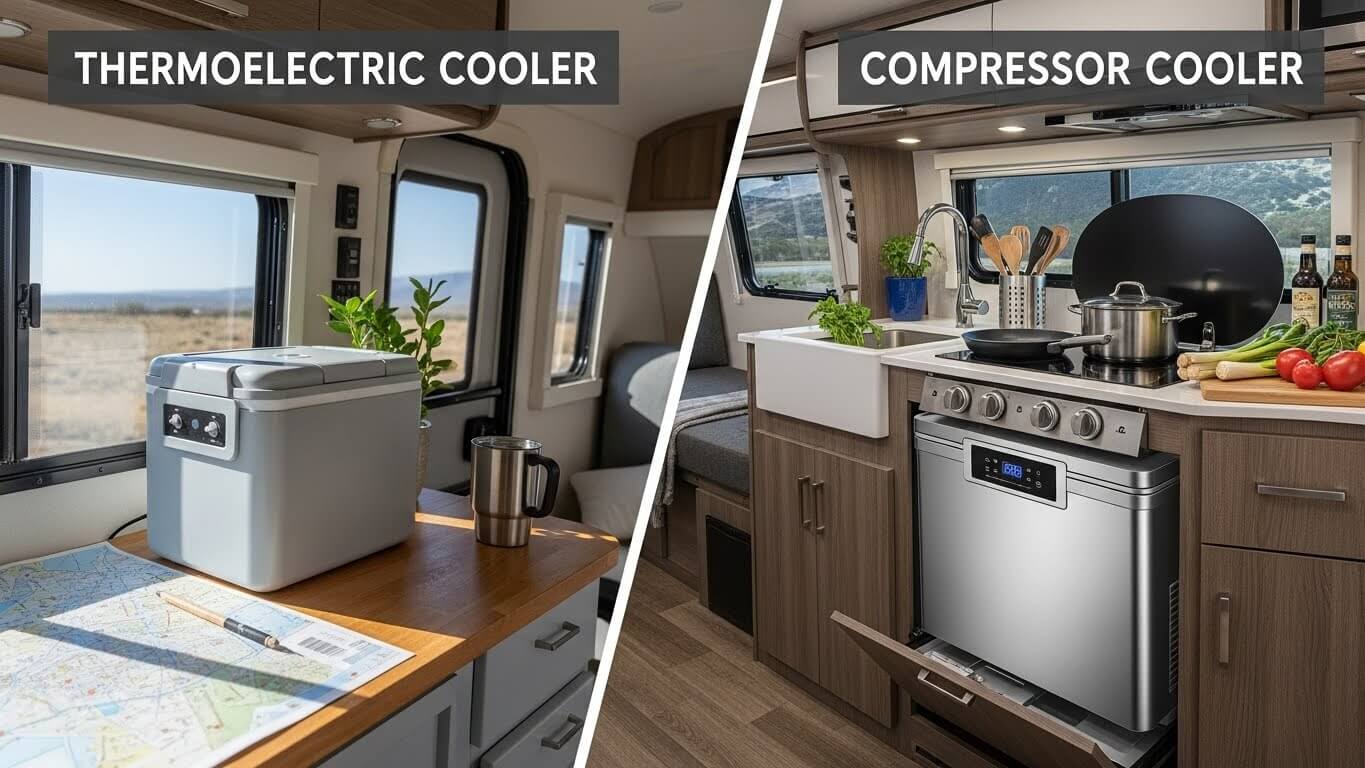
Cooling Performance and Temperature Control
Winner: Compressor Coolers (overwhelmingly)
Compressor technology provides actual refrigeration, maintaining food-safe temperatures regardless of conditions. Thermoelectric coolers fundamentally cannot match this performance, struggling or failing entirely in hot weather when cooling matters most.
For RV use where ambient temperatures vary dramatically, and reliable refrigeration is essential, compressor coolers provide the only truly dependable solution. The performance gap is not modest—it’s the difference between reliable refrigeration and a device that may keep things “cooler than outside” without actually refrigerating.
Energy Efficiency
Winner: Compressor Coolers (for actual refrigeration)
Despite higher peak power draw, quality compressor coolers use less total energy because they cycle off when the temperature is reached. Variable-speed compressors in modern units draw just 30-50 watts when running, cycling perhaps 30-50% of the time in moderate conditions.
Thermoelectric coolers operate continuously, drawing 40-60 watts of power. Over 24 hours, a compressor cooler might use 400-600 watt-hours while a thermoelectric unit uses 960-1,440 watt-hours—more than double for inferior cooling.
For battery-powered RV use, compressor efficiency is crucial and superior.
Cost and Initial Investment
Winner: Thermoelectric Coolers (significantly)
At $100-$300 versus $400-$1,200, thermoelectric coolers cost 1/3 to 1/4 as much. For budget-conscious RVers or those wanting to experiment with portable refrigeration, the lower investment reduces risk.
However, the value calculation changes when considering performance—you’re saving money by purchasing something that may not actually meet your refrigeration needs. A $200 thermoelectric cooler that fails to keep food cold in summer is poor value compared to a $600 compressor cooler that reliably refrigerates.
Pure cost favours thermoelectric; practical value often favours the compressor despite a higher price.
Weight and Portability
Winner: Thermoelectric Coolers
Lighter weight (15-25 lbs versus 30-50+ lbs) makes thermoelectric easier to move, load, and position. For users frequently moving coolers between RV, vehicle, and ground use, the weight difference matters.
However, few RVers frequently move their coolers once positioned. For semi-permanent RV installation, the weight difference becomes less significant.
Reliability and Durability
Winner: Mixed
Thermoelectric solid-state design eliminates compressor failure potential—fewer moving parts theoretically mean better reliability. However, cheap thermoelectric units often have poor quality control and fail due to fan failures, Peltier module degradation, or electrical issues.
Quality compressor coolers from reputable brands (Dometic, ARB) demonstrate excellent long-term reliability despite complexity. The compressors are designed for mobile applications and prove very durable. Premium compressor coolers often outlast budget thermoelectric units.
Quality matters more than technology type for reliability. A quality compressor cooler is more reliable than a cheap thermoelectric unit; a quality thermoelectric unit might match budget compressor reliability.
Versatility and Dual-Purpose Use
Winner: Compressor Coolers
Compressor coolers function as refrigerators, freezers, or both (dual-zone models). They maintain consistent performance year-round in any climate. Some include battery protection features and sophisticated temperature management.
Thermoelectric coolers offer cooling and heating modes but cannot freeze, cannot reliably refrigerate in hot weather, and provide limited versatility in extreme conditions. The heating function rarely proves valuable in RV contexts.
For comprehensive versatility, compressor wins decisively.
Noise Level
Winner: Thermoelectric Coolers (slightly)
Constant fan noise from thermoelectric units is generally quieter than compressor cycling noise. However, modern compressor coolers have become remarkably quiet, with premium models barely audible when cycling.
The difference is modest in quality models and matters less in RV environments with existing background noise from generators, road noise, or ventilation fans.
Real-World RV Scenarios
Weekend Warriors and Occasional RVers
For users taking weekend trips in moderate weather, thermoelectric coolers can work adequately. If ambient temperatures stay below 85°F, you’re mainly storing beverages and non-perishable items, and you don’t need freezing capability, a thermoelectric cooler saves significant money while providing adequate cooling.
However, one hot weekend or unexpected temperature spike can spoil food, negating all savings. Many weekend RVers ultimately upgrade to compressor after disappointing thermoelectric performance.
Full-Time RVers and Extended Travel
Full-timers need reliable refrigeration through all seasons and climates. Compressor coolers are essentially mandatory—thermoelectric performance is too inconsistent and unreliable for daily food storage. The investment in quality compressor refrigeration becomes critical infrastructure.
Full-timers often supplement built-in RV fridges with compressor coolers for extra capacity, beverage storage, or freezer space. The consistent performance and efficiency justify the investment through daily use.
Hot Climate RV Travel
RVing in Arizona, Texas, Florida, or desert Southwest during summer creates extreme conditions. Ambient temps exceeding 100°F render thermoelectric coolers nearly useless—they might maintain 60-70°F interior, completely inadequate for food safety.
Compressor coolers maintain proper refrigeration even in 120°F parked RV interiors. For hot climate travel, compressor technology is non-negotiable for safe food storage.
Off-Grid and Boondocking
Off-grid camping prioritizes power efficiency and battery conservation. Compressor coolers’ superior efficiency (400-600 watt-hours daily) versus thermoelectric constant draw (960-1,440 watt-hours daily) makes significant difference in battery longevity.
For boondockers relying on solar and battery systems, compressor coolers provide better refrigeration while using less precious battery capacity—the efficiency advantage is crucial for extended off-grid stays.
Supplemental to Built-In Refrigerators
Many RVers use portable coolers to supplement built-in fridges for extra capacity during extended trips or group travel. For this application, if the built-in fridge handles critical refrigeration, thermoelectric supplements can work for beverages and less-critical items.
However, most RVers find that once they invest in a portable cooler, compressor performance makes it worth upgrading to compressor technology for maximum versatility and performance.
Power Consumption and Battery Impact
Understanding RV Power Systems
RVs typically run on 12V DC battery systems (one or more deep-cycle batteries), 110V AC from shore power or generators, and sometimes propane. Portable coolers should operate efficiently on 12V DC to avoid depleting batteries during boondocking or between charging.
A typical RV house battery bank provides 100-200 amp-hours usable capacity (at 12V, this is 1,200-2,400 watt-hours). Daily power consumption must balance against battery capacity and recharging capability (solar, alternator, generator).
Thermoelectric Power Consumption
Typical thermoelectric coolers draw 4-5 amps continuously at 12V (48-60 watts). Over 24 hours: 96-120 amp-hours or 1,152-1,440 watt-hours. This represents 50-100% of a modest battery bank’s capacity; unsustainable without daily recharging.
In hot weather, thermoelectric coolers run constantly at maximum power, providing minimal cooling while draining significant battery. The poor efficiency makes them problematic for battery-powered operation.
Compressor Cooler Power Consumption
Quality compressor coolers draw 3-5 amps when the compressor runs (36-60 watts), but cycle on/off. Duty cycle might be 30-50% depending on insulation, ambient temperature, and interior temperature setting. Daily consumption: approximately 400-600 watt-hours in typical conditions.
This represents 20-40% of battery capacity—manageable with solar charging or alternator charging during driving. Modern variable-speed compressors further reduce consumption by running at lower speeds when light cooling is needed.
The efficiency advantage is dramatic and crucial for RV applications.
Solar Panel Requirements
To support thermoelectric cooler: 200-300 watts of solar panels needed to offset daily consumption while providing battery recharging. To support compressor cooler: 100-200 watts of solar panels adequate for offsetting consumption in sunny conditions.
The reduced power requirement makes compressor coolers more compatible with modest solar setups common in RVs.
Choosing the Right Cooler for Your RV
Assess Your Needs and Travel Patterns
Consider several questions. What climates do you travel in—moderate year-round or hot summers? How often do you RV—weekends, extended trips, or full-time? Do you need freezing capability for frozen foods or ice? What’s your power setup—large battery bank with solar or minimal batteries relying on shore power?
What’s your budget—$200 or $600-$800? Do you boondock frequently or mainly camp with hookups? What size capacity do you need? Are you supplementing built-in fridge or replacing it entirely?
Honest answers guide toward appropriate technology and investment level.
Thermoelectric Makes Sense If…
Limited scenarios favor thermoelectric for RV use. You travel exclusively in moderate climates avoiding summer heat. Your RV trips are brief weekends with shore power access. You mainly store beverages and non-critical items. Your budget absolutely limits you to under $200. You have reliable built-in refrigeration and need only supplemental cooling.
You understand and accept performance limitations in hot weather. Even in these scenarios, many users ultimately wish they’d invested in compressor technology initially.
Compressor is Recommended If…
Most RV scenarios favor compressor coolers. You travel through various climates including hot weather. You need reliable refrigeration for food safety. You want freezing capability. You plan extended trips or full-time RV living. You boondock or camp off-grid frequently.
Battery efficiency matters for your power setup. You want versatility and consistent performance. Your budget allows $400-$800 initial investment. You view the cooler as essential infrastructure worth proper investment.
For serious RVers, compressor coolers represent the right choice despite higher cost.
Best Thermoelectric Coolers for RVs
Wagan 6-Quart 12V Cooler/Warmer ($80-$100)
Ultra-compact option for beverages or medication. Cools 40°F below ambient. Works adequately in air-conditioned RVs or moderate weather. Best for supplemental use or budget experimentation.
Coleman 40-Quart PowerChill ($150-$180)
Decent capacity with improved insulation. Cools ~40°F below ambient. Adequate for moderate climate weekend use. Represents best performance achievable in thermoelectric technology, though still limited by fundamental constraints.
Igloo Iceless 28-Quart ($120-$150)
Mid-size option with reliable performance within thermoelectric limitations. Good build quality for the price. Works well in controlled temperature environments but struggles in heat.
Best Compressor Coolers for RVs
Alpicool C40 ($400-$500)
Budget-friendly entry to compressor refrigeration. 40-quart capacity, reaches -4°F, adequate insulation. Good starting point for price-conscious buyers wanting compressor performance without premium cost.
Dometic CFX3 45 ($750-$900)
Excellent mid-range option with 45-quart capacity, superior insulation, efficient compressor, WiFi app control, and proven reliability. Represents sweet spot of performance, features, and value for most RVers.
ARB Zero 50 ($800-$950)
Robust construction with 50-quart capacity, exceptional insulation, efficient cooling, and proven durability. Slightly more expensive but highly regarded for reliability and performance.
Dometic CFX3 75DZ ($1,200-$1,400)
Premium dual-zone allowing simultaneous refrigeration and freezing. 75-quart total capacity, advanced features, maximum efficiency. Ideal for full-timers or serious RVers wanting ultimate capability.
Frequently Asked Questions
Can thermoelectric coolers work in hot RV interiors?
Performance degrades significantly in heat. In 100°F+ interiors common in parked RVs, thermoelectric coolers might maintain 60-75°F interior—inadequate for food safety. They work better in air-conditioned RVs but still cannot match compressor reliability.
How long do compressor coolers last?
Quality compressor coolers from reputable brands last 5-10+ years with proper care. The compressors are designed for mobile applications and prove very durable. Some users report 10+ years of reliable service.
Can I run these coolers while driving?
Yes, both types work on 12V from your vehicle electrical system. Compressor coolers are ideal for maintaining refrigeration during travel. Ensure proper wiring and fusing for safety.
Do I need a battery monitor with compressor coolers?
Recommended but not required. Battery monitors help track consumption and prevent over-discharge. Compressor coolers often include low-voltage cutoff protecting batteries, but monitors provide better visibility into power usage.
Are compressor coolers worth 3-5x the cost?
For serious RV use, absolutely. The reliable refrigeration, superior efficiency, and consistent performance justify the investment. Budget thermoelectric units that fail to adequately cool provide poor value regardless of low price.
Can these replace my RV’s built-in refrigerator?
High-capacity compressor coolers (60-100+ quarts) can replace or supplement built-in fridges. Many full-timers use large compressor coolers as primary refrigeration, especially if built-in units fail. Dual-zone models provide both fridge and freezer capability.
Conclusion
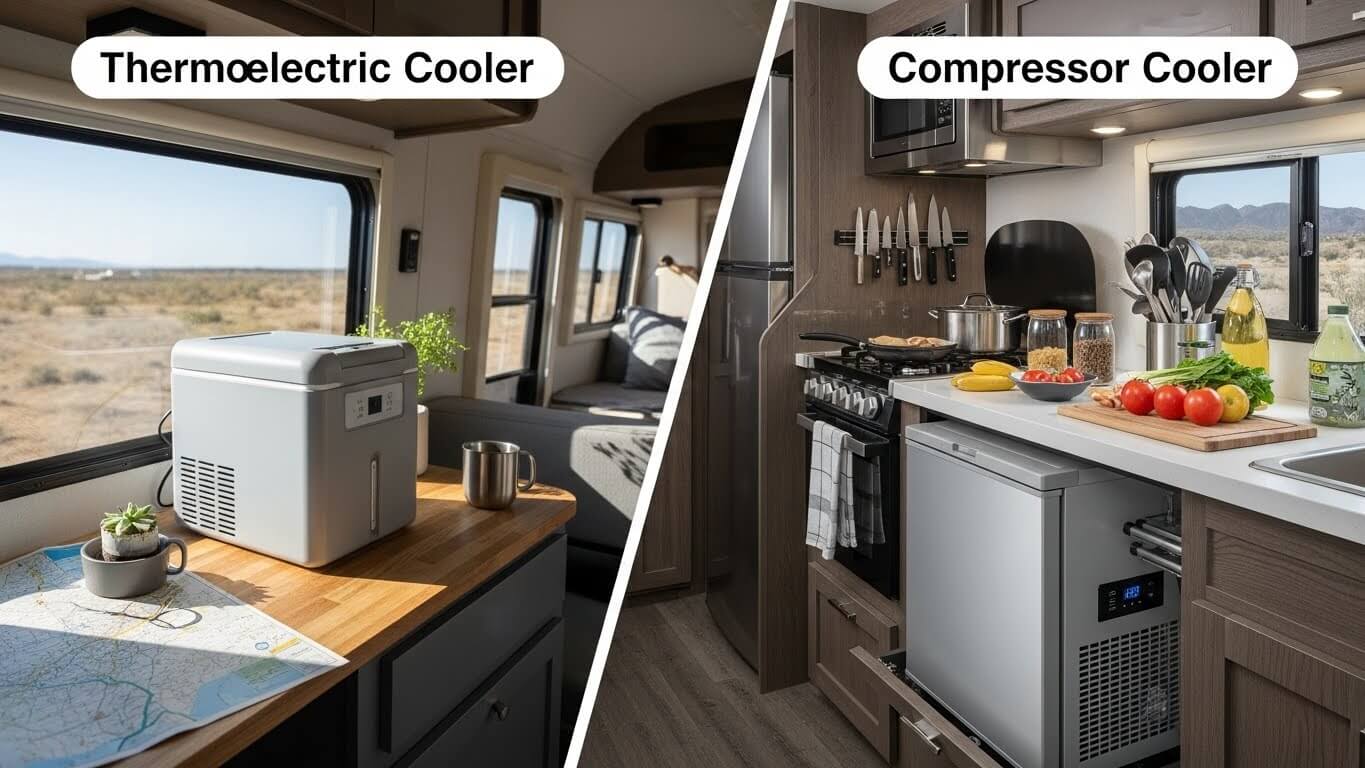
For RV applications, compressor coolers provide vastly superior performance, reliability, and value despite significantly higher initial cost. The technology delivers true refrigeration, maintaining food-safe temperatures in any climate, superior energy efficiency crucial for battery-powered RV systems, freezing capability for frozen foods and ice, and consistent performance through all seasons and conditions. Compressor coolers cost $400-$1,200 but function as genuine portable refrigerators that reliably serve RV refrigeration needs for years.
Thermoelectric coolers offer budget-friendly entry at $100-$300 but suffer from fundamental limitation,s including temperature-dependent cooling that fails in hot weather when needed most, inability to reach true refrigeration temperatures in warm conditions, poor energy efficiency with constant power draw, and performance inadequate for reliable food storage in typical RV conditions. They work only in narrow scenarios—moderate climates, short trips, supplemental use with reliable built-in refrigeration.
For weekend RVers in moderate climates willing to accept limitations, thermoelectric coolers provide minimal-cost experimentation with portable cooling. For serious RVers, extended travelers, full-timers, or anyone traveling through hot climates, compressor coolers represent essential infrastructure worth proper investment. The superior performance, reliability, and efficiency justify the 3-5x price premium through years of dependable service.
The smart approach is saving for a quality compressor cooler rather than settling for inadequate thermoelectric performance. A $600-$800 compressor cooler provides decades of reliable refrigeration supporting comfortable, safe RV living. A $200 thermoelectric cooler that fails during your first hot weather trip wastes money while potentially spoiling food. In RV refrigeration, quality compressor technology isn’t luxury—it’s essential infrastructure ensuring your mobile lifestyle remains comfortable, safe, and enjoyable regardless of where your travels take you.