
Pull the lid off a quality cooler, and you may notice something unexpected: real physical resistance. Not the friction of a tight latch, but a genuine suction-like pull that requires a moment of deliberate force before the seal releases. That is the vacuum seal effect, and it is one of the more elegant indicators of a well-engineered freezer-style gasket doing exactly what it was designed to do.
What most cooler users have never considered is that this effect changes with altitude. Drive your well-sealed YETI from sea level up to a trailhead at 10,000 feet, and the physics inside that cooler have shifted in ways that affect the lid seal, the pressure differential at the gasket, and, more consequentially, the rate at which ice melts once you are there.
This article explains the atmospheric physics behind cooler lid pressure, traces exactly what happens to that pressure differential as altitude increases, examines how different gasket and lid construction types respond to these changes, and addresses the real-world implications for anyone who hauls a cooler into the mountains. It also confronts a common misconception: that high altitude universally compromises cooler performance. The answer, like most things in physics, is more nuanced than the question suggests.
The Vacuum Seal Effect: What It Is and What Creates It
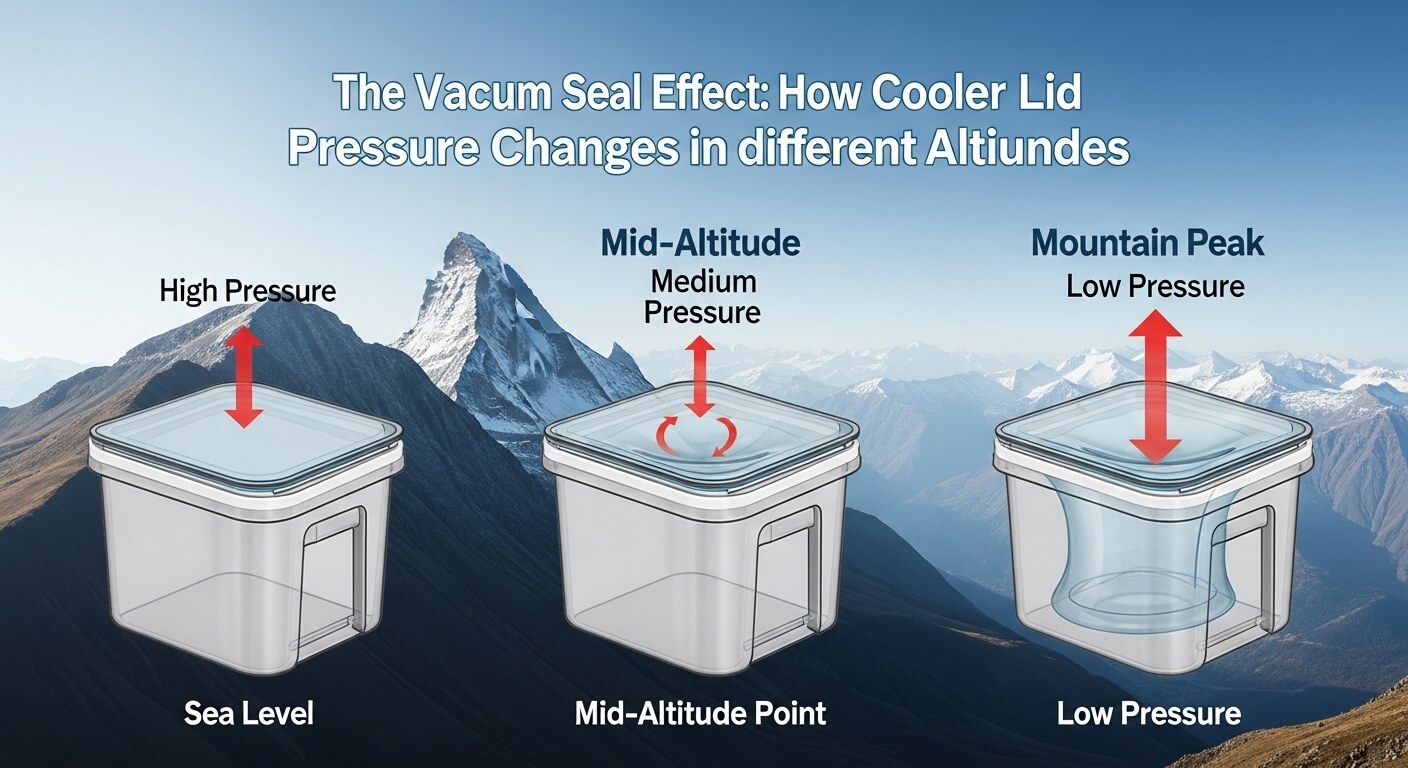
The “vacuum seal” in a premium cooler is not a true vacuum in the engineering sense, as there is no partial pressure removal, no active evacuation of air. It is a pressure differential created by a combination of thermal contraction and gasket geometry that produces a seal with a net inward atmospheric force holding the lid closed.
Budget coolers with flat foam gaskets and minimal lid-to-body contact area generate a smaller pressure differential because air leaks across the seal more readily, allowing interior and exterior pressure to equilibrate. The freezer-style compression gasket used in premium rotomolded coolers; a flexible rubber channel that deforms under closing pressure to create a near-airtight contact perimeter is the engineering feature that makes the pressure differential meaningful. The gasket material, its cross-sectional profile, and the lid’s closing geometry all determine how much of the potential pressure differential is retained versus lost to air infiltration.
How Altitude Changes the Vacuum Seal Dynamic
The relationship between altitude and the cooler vacuum seal effect is more complex than a simple “higher altitude = weaker seal” narrative. What actually happens involves two competing forces that interact differently depending on when the cooler was sealed, how well it was pre-cooled, and the temperature differential between the cooler contents and ambient air at altitude.
Scenario 1 – Cooler sealed at low altitude, transported to high altitude: This is the most common scenario for hikers and campers. When the cooler is sealed at sea level with cold contents and a chilled interior, the air inside is at approximately sea-level pressure minus the thermal contraction differential — roughly 94–97 kPa. Transporting this cooler to 10,000 feet means the exterior pressure drops to about 69.7 kPa. Now the interior pressure (still approximately 94–97 kPa) is actually higher than the exterior pressure. The pressure differential has reversed: instead of the lid being held down by external pressure, the lid is now being pushed outward by internal excess pressure. The vacuum effect disappears entirely, and the lid may flex outward slightly or become easier to open than expected.
Scenario 2 – Cooler sealed at high altitude with cold contents: when the cooler is loaded and sealed at elevation, the interior air starts at the lower ambient pressure of that altitude. As the contents cool the interior air, pressure drops from that already-lower baseline. The thermal contraction differential still exists; cooling interior air still creates lower pressure relative to the sealed starting point but the absolute interior pressure is lower than it would be at sea level. The resulting pressure differential (interior vs. exterior atmospheric) is similar in magnitude to sea-level performance, provided the temperature differential between contents and ambient air is equivalent.
Scenario 3 – The temperature-altitude compound effect: at high altitude, ambient temperatures are typically lower than at sea level for any given climate. Cold ambient air means the temperature differential between cooler contents and environment is smaller, reducing the thermal contraction effect that creates interior pressure drop. This dampens the vacuum seal effect regardless of the altitude pressure dynamics. A cooler loaded with ice at 14,000 feet on a 45°F day develops less interior pressure drop than the same cooler on a 75°F beach day, because the 45°F starting air cools less dramatically before approaching ice temperature.
The net result across these scenarios is that the vacuum seal effect is weakened or reversed for coolers sealed at low altitude and transported to high altitude, and is approximately equivalent (or slightly reduced) for coolers sealed at high altitude. Neither scenario produces a dramatic seal failure in a quality gasket-equipped cooler; the gasket’s mechanical compression seal functions independently of the pressure differential and continues to provide primary sealing function regardless of the pressure direction.
The Real Altitude Impact: Ice Retention and Thermal Performance
The seal pressure dynamics are scientifically interesting, but the question most outdoor users actually care about is simpler: does my cooler keep ice longer, shorter, or about the same at altitude compared to sea level? The answer involves several competing factors that net out to a modest altitude advantage in most practical scenarios.
Factor 1 – Lower ambient temperatures at altitude: the most significant thermal effect of altitude is the lower ambient air temperature. For every 1,000 feet of elevation gain, ambient temperature drops approximately 3.5°F (2°C) on average (the standard environmental lapse rate). At a 10,000-foot trailhead where sea-level temperature would be 75°F, ambient air is approximately 40°F cooler — around 35–40°F. This dramatically reduces the thermal gradient driving heat into the cooler, and ice retention improves substantially as a result. Users consistently report that ice lasts noticeably longer on mountain camping trips than at beach or low-elevation destinations.
Factor 2 – Lower solar radiation absorption at altitude (clear days): at higher elevations, there is less atmosphere to absorb and scatter solar radiation, meaning UV intensity increases with altitude. However, the direct thermal (infrared) heating of a cooler’s exterior from solar radiation depends on the cooler’s surface absorptivity, not UV intensity. A dark-colored cooler shell can still heat significantly from solar exposure at altitude. Users who keep coolers in direct sun at high altitude should not assume the cooler benefits from reduced solar heating — in full sun, solar thermal loading remains a significant heat ingress source regardless of altitude.
Factor 3 – Lower air pressure and reduced convective heat transfer: thinner air at altitude is a slightly less efficient thermal conductor than denser sea-level air. The convective heat transfer coefficient (how efficiently moving air transfers heat into or out of a surface) decreases modestly at altitude — meaning the cooler exterior is marginally less efficiently heated by ambient convection at high altitude than at sea level. This is a secondary effect compared to the temperature differential advantage, but it contributes to the overall altitude performance benefit.
Factor 4 – Water boiling point and food safety implications: while not directly related to the seal pressure effect, altitude significantly lowers the boiling point of water — from 212°F at sea level to approximately 194°F at 10,000 feet. For cooler users carrying meals that need to be fully cooked, this affects cooking times and temperatures. Ice, however, still melts at 32°F regardless of altitude — the melting point of water is essentially pressure-independent within the altitude ranges encountered in outdoor recreation.
Gasket Construction: Which Designs Handle Altitude Changes Best
The pressure reversal that occurs when a sea-level-sealed cooler reaches high altitude puts stress on gasket construction in a way that normal use does not. Instead of atmospheric pressure pressing the lid seal inward, the higher interior pressure presses outward against the gasket. How well a gasket resists this outward pressure — and whether the latch system can hold the lid closed against it — varies significantly by construction type.
Flat foam gaskets (budget coolers): the least effective design for both vacuum seal creation and altitude pressure reversal management. Flat foam gaskets rely primarily on lid latch tension for seal integrity rather than gasket compression geometry. They allow air permeation at lower pressure differentials, which means they rarely develop a strong vacuum seal at sea level — but also that the pressure reversal at altitude is smaller and less consequential, as air equilibrates through the loose seal in both directions. The practical result is mediocre seal performance regardless of altitude.
Compression channel gaskets (premium rotomolded coolers): the freezer-style compression gasket—a flexible rubber channel that compresses to create a near-airtight perimeter seal—creates both the best vacuum seal effect at sea level and the highest internal pressure buildup when transported to altitude. A YETI, Pelican, or ORCA cooler sealed at sea level with well-chilled contents and transported to 12,000 feet can develop meaningful outward pressure on the lid that requires the latches to hold against a few pounds of net outward force. Quality rotomolded cooler latches are engineered to handle this — the T-Rex or equivalent latch systems on premium coolers are rated for significantly more force than the pressure differential generates in practice.
The pressure equalization valve (a niche solution): a small number of specialty coolers and most marine coolers include a pressure equalization valve — a small one-way or bidirectional vent that allows slow pressure equalization between the interior and exterior without compromising thermal seal integrity. These valves prevent both the extreme vacuum suction at sea level (which can make lids impossible to open without significant force) and the outward pressure buildup at altitude. They are uncommon in consumer coolers but represent the most elegant engineering solution to the altitude pressure dynamic.
Cooler Gasket and Seal Quality Across Price Tiers
| Price Tier | Gasket Type | Vacuum Seal Effect | Altitude Pressure Handling | Seal Durability | Example Brands |
| Budget ($30–$80) | Flat foam, minimal contact | Negligible | Air equalization — no pressure buildup | 1–3 years | Generic, Igloo basic |
| Mid-Range ($100–$199) | Improved foam/rubber strip | Mild | Minor pressure differential | 3–5 years | Lifetime, Coleman Xtreme |
| Premium ($200–$350) | Compression channel, EPDM | Pronounced — full vacuum effect | Pressure buildup at altitude — latches hold | 7–10+ years | YETI Tundra, ORCA, Pelican |
| Ultra-Premium ($350+) | Precision compression, dual-wall | Maximum — strongest seal | Maximum buildup — premium latches required | 10+ years | YETI, Igloo BMX Pro |
| Marine / Specialty ($200+) | Compression + equalization valve | Excellent + pressure-safe | Fully managed — valve equalizes | 10+ years | Yeti Marine, ENGEL |
For buyers who regularly travel between significantly different altitudes — coastal residents who frequently camp in the mountains, or high-altitude residents who travel to sea level — the gasket type and latch strength should be conscious purchase considerations. Premium compression gasket coolers will develop more pronounced pressure differentials in either direction than their budget counterparts, but their latch systems are engineered to handle it. The risk scenario to avoid is a premium gasket cooler with a compromised or worn latch — the combination creates the conditions for either a lid that cannot be opened at sea level without extreme force, or a lid that pops open at altitude.
Product Recommendations for Altitude-Variable Users
Best Premium Cooler for Mixed-Altitude Use: YETI Tundra 45
YETI’s Tundra 45 ($325–$375) is the benchmark for compression gasket seal integrity across altitude ranges. Its T-Rex latch system is rated for forces well beyond what altitude pressure differentials generate in practice, and the EPDM rubber compression gasket maintains its sealing geometry through the compression-decompression cycling inherent in altitude-variable use. The cooler’s PermaFrost polyurethane insulation maintains performance at both ends of the altitude range without degradation. Recommended for: users who regularly travel between sea level and high-altitude destinations and need reliable seal integrity throughout.
Best Marine/Pressure-Safe Design: YETI Tundra 35 Marine
The YETI Marine series ($350–$400) includes a self-draining pressure equalization feature designed for marine use that also elegantly solves the altitude pressure differential problem. The valve allows slow pressure equalization in both directions without compromising cold retention, eliminating both the extreme vacuum effect and the altitude pressure reversal. For users who find standard premium cooler lids frustratingly difficult to open or who regularly transport coolers through large altitude changes, the pressure equalization feature transforms the experience. Recommended for: boat owners, altitude-variable users who find lid vacuum resistance annoying, and anyone transporting sealed coolers from sea level to high mountains regularly.
Best High-Altitude Performance Value: ORCA 40 Qt
ORCA’s rotomolded LLDPE construction ($350–$400) provides premium gasket seal quality comparable to YETI with a cooler exterior and latch geometry that several high-altitude users have noted handles the pressure reversal cycle with particular reliability. The cooler’s US-made construction and lifetime warranty provide confidence for serious altitude users. Its superior ice retention at any elevation is the primary recommendation driver — the same qualities that make it excellent at sea level make it exceptional at altitude where ambient thermal advantage compounds the insulation advantage. Recommended for: mountain hunters, alpine campers, and serious outdoor users who want a single premium cooler that performs across all elevation ranges.
Best Mid-Range for Occasional Altitude Use: Lifetime 77 Qt High Performance
For buyers who occasionally camp at altitude but whose primary use is at lower elevations, Lifetime’s $150 blow-molded cooler offers improved seal quality over budget alternatives without the premium gasket’s altitude pressure complications. Its improved foam seal provides moderate vacuum effect at sea level and limited pressure buildup at altitude — a performance ceiling that is also a practical simplicity advantage for casual users who do not want to deal with hard-to-open lids. Recommended for: casual mountain campers, budget-conscious buyers who camp at altitude a few times per year.
Best Budget Option with Minimal Altitude Sensitivity: Coleman Xtreme 5 Series
Coleman’s Xtreme 5 ($50–$70) uses a standard foam gasket that allows sufficient air permeation to prevent meaningful vacuum or altitude pressure buildup in either direction. The seal is not airtight enough to develop the seal quality of premium alternatives, but this also means it is entirely altitude-insensitive — it opens and closes with consistent effort from sea level to 14,000 feet. For budget users who primarily care about ice retention at moderate ambient temperatures and do not need premium gasket performance, the altitude neutrality is a practical benefit. Recommended for: budget users, casual campers at variable elevations, and anyone who finds premium cooler lid vacuum resistance more annoying than impressive.
Frequently Asked Questions
Q: Is the vacuum seal effect a sign of a good cooler or just a quirk of the design?
A: It is both a sign of quality and a direct functional benefit. The vacuum seal effect only occurs in coolers with airtight or near-airtight compression gaskets — the same gaskets that also prevent warm ambient air from infiltrating the cooler and accelerating ice melt. A cooler that develops a strong vacuum seal is demonstrating that its gasket is preventing air exchange between the interior and exterior, which is exactly the property that delivers extended ice retention. The suction resistance you feel when opening the lid is not an inconvenient side effect; it is physical evidence that the seal is working correctly.
Q: Can the pressure difference at altitude damage my cooler’s gasket or structure?
A: Under normal altitude variations encountered in outdoor recreation (sea level to 14,000 feet), pressure differentials are not large enough to damage a quality cooler’s gasket or structural integrity. The maximum pressure differential in the worst case (sea-level sealed, high-altitude opened) is approximately 25–30 kPa — well within the engineering margins of premium rotomolded coolers and their latch systems. Gasket wear from repeated altitude cycling is a concern over years of heavy use (as noted by expedition outfitters), but casual altitude use will not cause measurable gasket degradation. Avoid leaving a tightly sealed premium cooler in a hot car at sea level after returning from altitude — the combination of heat expansion and altitude-differential pressure is the most stressful scenario for lid seal integrity.
Q: Why does my YETI lid feel almost impossible to open after several days of cold use?
A: This is the vacuum seal effect at maximum development, and it is entirely normal. After several days of continuous cold storage, the interior air has fully equilibrated to near-ice temperature, reaching maximum pressure differential below ambient. The gasket has also cold-compressed — the EPDM rubber that forms the seal becomes slightly stiffer at cold temperatures, adding mechanical resistance to the thermal pressure resistance. The technique for opening is to rock the lid slightly rather than pulling straight up — this introduces a small gap at one corner of the seal perimeter that breaks the vacuum locally and allows the rest of the seal to release without requiring full lid-perimeter force all at once.
Q: Does ice actually melt at a different rate at high altitude?
A: Ice melts at 32°F (0°C) regardless of altitude — the melting point of water has essentially no pressure dependence within the range of altitudes encountered in outdoor recreation (ice melts at 32°F whether you are at sea level or at 14,000 feet). What changes is the rate at which heat flows into the cooler from the environment, which is dominated by the temperature differential between the ice and the ambient air. At altitude, cooler ambient temperatures dramatically reduce this heat flow, extending ice retention. The ice is not “more frozen” at altitude — it is simply receiving less heat input per hour due to the lower ambient temperature.
Q: Does the altitude effect matter for dry ice or frozen contents rather than water ice?
A: Dry ice (solid CO2) introduces an additional altitude variable because CO2 sublimates (converts directly from solid to gas) and the sublimation rate is influenced by both temperature and pressure. At altitude, lower atmospheric pressure slightly accelerates CO2 sublimation at any given temperature, meaning dry ice sublimates marginally faster at high altitude than at sea level.
The effect is modest for the altitude ranges in outdoor recreation but becomes more significant at extreme altitude. The larger practical consideration with dry ice at altitude is that the CO2 gas produced by sublimation needs to vent safely — never seal dry ice in an airtight container, which is particularly relevant for premium gasket coolers at altitude where the seal is most effective.
Q: Should I open my cooler when I arrive at a significantly different altitude to release the pressure?
A: For comfort and ease of subsequent openings, yes; briefly opening the cooler when you arrive at your destination altitude allows interior and exterior pressure to equalize passively. This resets the pressure baseline for your new altitude. For cold retention, this is a minor trade-off — the brief opening allows some warm air exchange but the thermal benefit of re-establishing a proper vacuum seal at your new altitude outweighs the momentary cold loss in most practical scenarios. Users who travel frequently between significantly different altitudes with premium gasket coolers find this a useful habit.
The Verdict
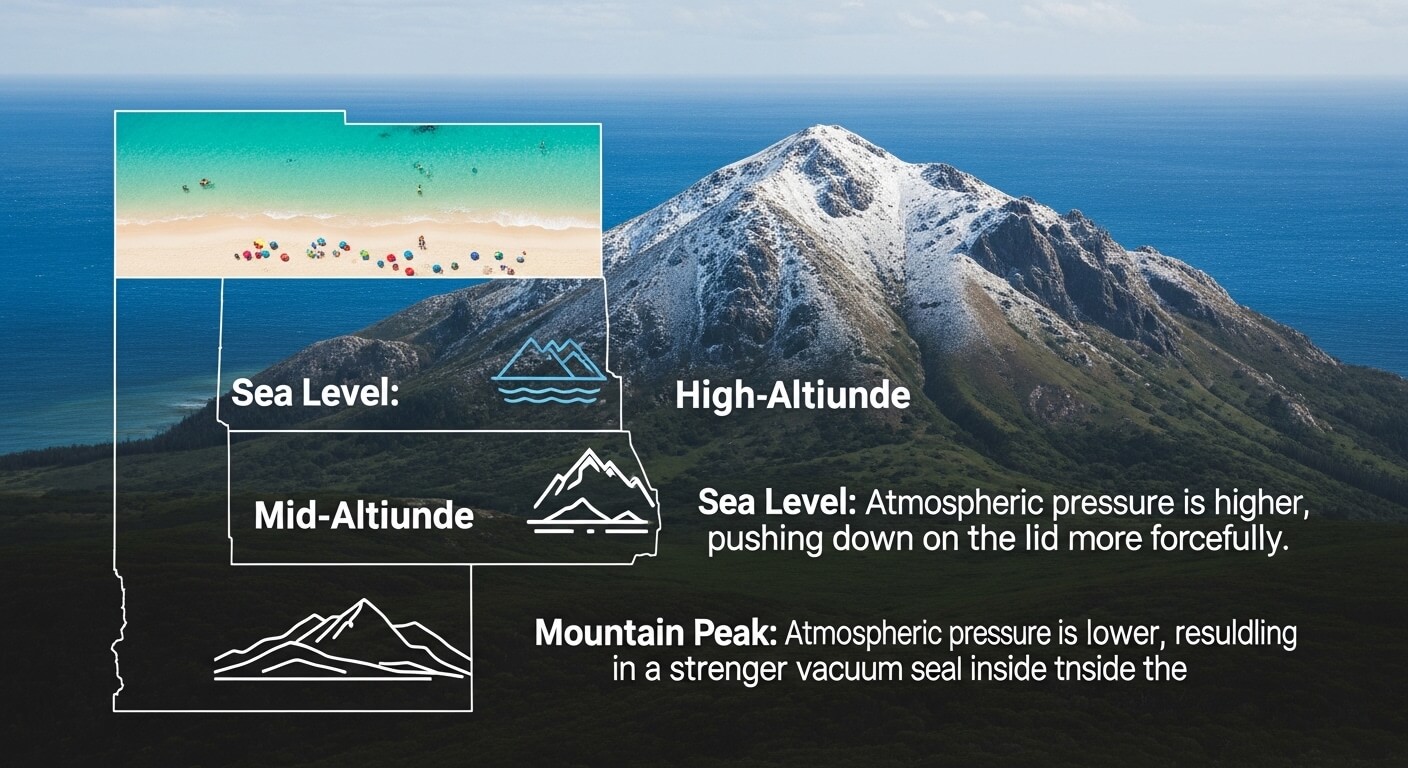
The vacuum seal effect in cooler lids is not marketing language. It is a measurable consequence of the thermodynamic first principle; the ideal gas law expressing itself in a sealed container through a quality compression gasket. At sea level, it is an asset: the suction holding the lid closed is physical evidence of an airtight seal that also delivers the ice retention performance premium coolers are purchased for.
At altitude, the physics gets more interesting. Pressure reversal, reduced thermal gradient, and cold gasket compression interact to change the lid dynamics that most cooler users have never thought to question. The practical summary is reassuring: for users who take quality coolers to high elevation, the thermal performance advantage of lower ambient temperatures significantly outweighs any seal complexity introduced by the altitude pressure dynamics. Your ice lasts longer in the mountains; sometimes dramatically longer. The lid may behave unexpectedly, but it is behaving according to well-understood physics, and knowing the mechanism lets you work with it rather than be confused by it.