
Coolers are only one example of how sustainability is starting to play a significant role in daily purchase decisions. Whether for camping, picnics, or road trips, more people are embracing eco-friendly coolers as a method to lessen environmental impact while still keeping food and drinks fresh. In contrast to conventional standard coolers, which mostly rely on plastics and less environmentally friendly insulation materials, these coolers are made with sustainable materials, energy-efficient cooling, and an emphasis on durability.
Typically, an environmentally friendly cooler uses non-toxic parts, biodegradable insulation, or recycled plastics. Innovative energy-saving features, such as ice-free cooling systems or very effective insulation to prolong ice retention, are also used in some models. In addition to their advantages for the environment, these coolers are frequently lightweight, portable, and useful for outdoor enthusiasts who need convenience without sacrificing their dedication to sustainability.
However, for many years, a regular cooler has been the preferred method of keeping goods cold while traveling. Hard plastics, foam insulation, and basic ice-based cooling technologies are typically used in the construction of these coolers. For short-term use, they are inexpensive, widely accessible, and dependable. However, because of their dependency on ice or electricity for cooling, non-recycled materials, and limited recyclability, their environmental impact tends to be greater.
Your priorities, travel preferences, and environmental principles will determine whether you choose an eco-friendly cooler or a conventional cooler. Both can keep your food and beverages cold, but the environmentally friendly choice lets you reduce your environmental impact without compromising usefulness. Making an informed decision that fits your lifestyle and environmental objectives will be made easier if you are aware of the variations in materials, cost, portability, and cooling efficiency.
The main distinctions between eco-friendly and conventional coolers will be examined in this comparison, taking into account factors like cost, long-term value, convenience, cooling performance, and environmental impact. By the time it’s all over, you’ll know which cooler best suits your needs, keeping your drinks cold and encouraging more environmentally friendly outdoor activities.
What Is An Eco-Friendly Cooler?
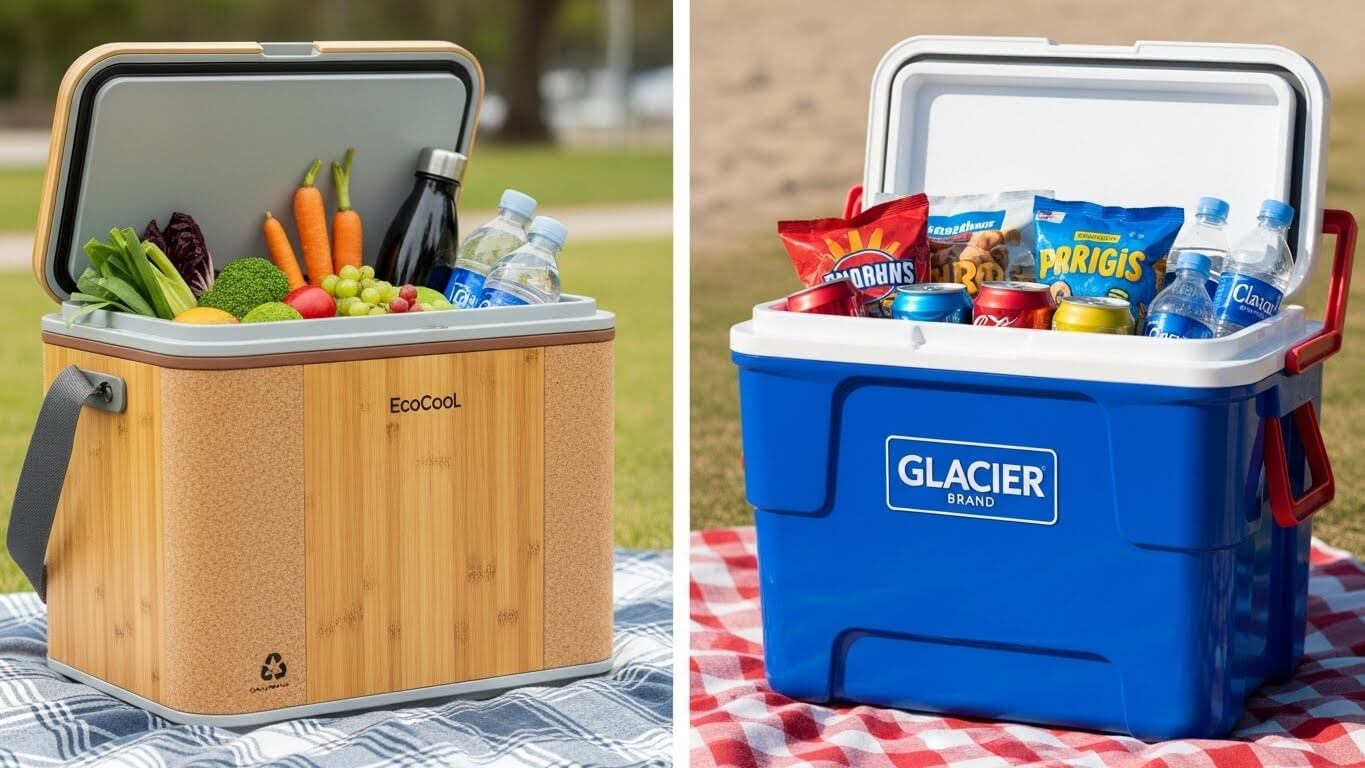
An eco-friendly cooler is made to lessen its impact on the environment while still offering dependable food and drink cooling. Unlike traditional coolers, these units focus on sustainable materials, energy efficiency, and durability, making them a viable alternative for environmentally conscious consumers.
By using recycled plastics, biodegradable insulation, or non-toxic parts, many environmentally friendly coolers lessen their dependency on virgin materials and reduce the amount of garbage that ends up in landfills. Certain models have high-performance insulation that prolongs ice retention or keeps chilly temps longer, reducing the need for ice or energy. Energy-efficient thermoelectric or compressor-based cooling systems, which use less electricity than conventional types, are also found in some cutting-edge environmentally friendly coolers.
These coolers are ideal for camping excursions, picnics, beach excursions, and other outdoor activities because they are usually lightweight and portable. Long-term usage is guaranteed by their sturdy structure, which promotes sustainability and offers a great return on investment. Convenience and eco-friendliness are combined in some designs with features like built-in compartments, ergonomic handles, and detachable lids.
The ability to enjoy cold beverages and fresh food while reducing one’s environmental impact is the primary benefit of an eco-friendly cooler. They are suitable for individuals or families who prioritize sustainability without compromising on functionality, whether for daily use or extended outdoor activities.
An eco-friendly cooler strikes a balance between environmental responsibility, portability, and performance. These coolers provide a contemporary, sustainable substitute for conventional solutions while maintaining the safe chilling of food and beverages by selecting materials and designs that are less detrimental to the environment.
What Is A Standard Cooler?
The conventional method for keeping food and beverages cold on excursions, trips, and outdoor activities is a regular cooler. Because of their dependability, cost, and user-friendliness, these coolers have been used extensively for many years.
Standard coolers are typically constructed from hard polymers and foam insulation, which provide adequate temperature retention for short-term use. The majority of models use ice-based cooling, which keeps the contents cold using loose ice or ice packs. Thermoelectric or basic compressor systems are examples of some contemporary modifications, but they typically lack the eco-friendly or energy-efficient design of sustainable coolers.
These coolers come in a variety of sizes, from small personal units to huge family or tailgating models, and are incredibly accessible and adaptable. They are easy to use: just fill them with ice, add your food and drinks, then cover them. Additionally, a lot of conventional coolers have useful features like cup holders, detachable trays, strong handles, and convenient drain plugs.
A conventional cooler’s primary benefits are its affordability and robustness. Depending on the quality of the ice and the surrounding temperature, they can keep things cold for hours or even a day. They are also generally accessible and simple to clean. However, compared to eco-friendly options, these coolers are less environmentally beneficial because they frequently use non-recycled materials, add to plastic waste, and may need frequent ice replenishment.
In conclusion, a regular cooler is an affordable, useful choice for quick travels and informal gatherings. Although it lacks the energy-efficient features and sustainable materials that characterize eco-friendly coolers, it is dependable and practical. A conventional cooler is still the preferred option for people who value economy and performance over environmental effect.
Efficiency and Cooling Performance
Cooling performance and efficiency are important factors that impact usability and convenience when comparing eco-friendly coolers to conventional coolers. Eco-friendly coolers are made to combine efficient temperature management with sustainability. High-quality insulation composed of recycled or biodegradable materials is a characteristic of several models that helps maintain frigid temperatures for longer.
Energy-efficient thermoelectric or compressor-based systems are another feature of several environmentally friendly coolers that lower power use without sacrificing dependable cooling. This makes them appropriate for day outings, camping, and longer adventures since it enables users to keep food and drinks frozen for longer periods of time without excessively depending on ice or energy.
In contrast, standard coolers mostly rely on ice or simple insulation to keep the temperature frigid. Their cooling effectiveness is largely dependent on the type and quantity of ice utilized, even if they are useful for brief periods of time. While standard thermoelectric coolers provide some powered cooling, they are typically less energy-efficient than environmentally friendly alternatives, particularly when used for lengthy periods of time or in hot weather. Because of this, consumers might have to cope with inconsistent cooling in some parts of the cooler or constantly replace the ice.
Consistency in temperature is another factor. Perishable goods are kept safer for longer thanks to eco-friendly coolers with powered systems or sophisticated insulation that provide more consistent internal temperatures. Standard coolers are more vulnerable to temperature changes, particularly in warm climates or when they are opened frequently.
In conclusion, eco-friendly coolers offer dependable, long-lasting cooling functionality in addition to sustainable materials and energy efficiency. Standard coolers remain suitable for short-term outings and casual use, although they may require more ice or energy to maintain target temperatures and offer less exact temperature control.
Convenience, Design, and Portability
Convenience, portability, and design are crucial considerations that might affect daily use and general pleasure when deciding between an eco-friendly cooler and a conventional cooler. In order to improve portability, eco-friendly coolers are frequently built with lightweight materials and useful features.
Many types have small designs, detachable lids, and ergonomic handles that make them easy to carry on walks, picnics, or camping excursions. For added convenience, some also have shoulder straps or wheels. In addition to being portable, these coolers include user-friendly designs with detachable trays or sections for improved organization. Users can benefit from convenience without sacrificing environmental responsibility because to sustainability and careful design.
Although dependable, standard coolers differ considerably in terms of portability and design based on their size and composition. Bigger regular coolers, like those used for tailgating or family trips, can be bulky and difficult to move. Nonetheless, a lot of ordinary coolers have strong handles, long-lasting construction, and useful features like cup holders and drain plugs. They are a reliable option for informal travel because they are typically simple to use and maintain.
Storage and space efficiency are additional factors to take into account. While typical coolers promote robustness and capacity, which can take up more space, eco-friendly coolers frequently concentrate on small, stackable designs that fit easily in cars or other storage spaces.
In conclusion, eco-friendly coolers are perfect for consumers who care about the environment while on the go because of its lightweight portability, smart design, and ease. For brief excursions or circumstances when maximal capacity is more crucial than weight or environmental friendliness, standard coolers provide durability and simplicity.
Cost
Cost and long-term value are important factors for many consumers when comparing eco-friendly coolers to conventional coolers. Because they combine sustainable materials, energy-efficient designs, and creative insulation, eco-friendly coolers frequently have a little higher initial cost. These coolers offer long-term value due to their longevity, prolonged cooling efficacy, and less environmental effect, despite their initial higher cost. Because of their superior structure, they won’t need to be replaced frequently because they will survive for several seasons or years. Energy-efficient or well-insulated models can also reduce the amount of ice or electricity used, which will increase total value and save money over time.
Conversely, standard coolers are typically less expensive up front. Basic models with foam insulation and hard plastics offer dependable cooling at a cheaper cost, making them affordable for a variety of users. However, wear and tear may necessitate more regular replacement, particularly if they are used often or in challenging environments. Over time, operating expenses may also rise because to the need for ice or power to maintain temperature, especially in larger or less effective models.
In conclusion, eco-friendly coolers justify their greater initial cost for consumers who care about the environment because they provide long-term savings, durability, and sustainability. For occasional or brief use, standard coolers are an affordable choice, but because of possible replacements and energy or ice consumption, they might not be as valuable over time.
Pros And Cons
By contrasting eco-friendly coolers with conventional coolers, you can choose which option best suits your needs by highlighting the advantages and disadvantages of each.
Eco-Friendly Cooler
Pros:
- Sustainable materials: composed of insulation and recycled or biodegradable polymers.
- Energy-efficient: Saves resources over time by using less ice or electricity.
- Sturdy and long-lasting: Made to last a long time while reducing waste.
- Lightweight and portable: A lot of types have wheels, detachable lids, or ergonomic handles.
- Environmentally responsible: Promotes eco-aware lives and lessens carbon emissions.
Cons:
- Greater initial cost: More costly than typical coolers.
- Limited availability: Depending on the area, fewer models might be offered.
- Performance varies: High-end standard coolers may retain more ice than other eco-friendly materials.
Standard Cooler
Pros:
- Affordable: More accessible and less expensive initially.
- Sturdy construction: Long-term dependability is ensured by foam insulation and hard polymers.
- Simple and useful: Easy to use, maintain, and clean.
- Numerous sizes and styles are available, ranging from little personal units to spacious family or tailgating coolers.
Cons:
- Less ecologically friendly: Frequently non-biodegradable and composed of non-recycled polymers and foam.
- Less portable and heavier: Transporting larger models can be difficult.
- Ice or energy dependent: Requires frequent ice refilling or electricity for powered systems.
- Temperature consistency: In warmer weather, it may be difficult to sustain low temperatures for extended periods of time.
Verdict: Eco-friendly coolers are perfect for customers who care about the environment because of their superior sustainability, energy efficiency, and mobility. Standard coolers may have a greater environmental impact and require more maintenance, but they are inexpensive, dependable, and useful for brief excursions.
Who Should Choose Which Option?
Your lifestyle, environmental values, and intended use will all play a major role in your decision between an eco-friendly cooler and a conventional cooler. Each variety caters to different demands, making it vital to analyze which aspects matter most to you.
For people or families who value sustainability but still need dependable cooling, an eco-friendly cooler is perfect. Campers, hikers, beachgoers, and picnickers who wish to lessen their environmental impact without compromising mobility or convenience will find these coolers ideal. Eco-friendly coolers are simple to transport and maintain thanks to their lightweight construction, ergonomic handles, and energy-efficient cooling systems. Regular outdoor enthusiasts who frequently use coolers and seek a solution that balances performance and environmental responsibility will find them very useful.
A normal cooler, on the other hand, is more appropriate for anyone seeking an affordable, long-lasting, and straightforward solution. Standard coolers offer dependable cooling with little setup, making them ideal for informal get-togethers, quick vacations, or infrequent use. They are perfect for consumers who value capacity and price more than environmentally friendly design. For family vacations, tailgating, or gatherings when maximal storage and sturdy construction are more crucial than environmental concerns, larger standard models are great.
In conclusion, normal coolers are the best option for anyone looking for reasonably priced, useful, and long-lasting cooling for brief or infrequent usage, while eco-friendly coolers are the best option for users who value sustainability, mobility, and energy efficiency. Which cooler best suits your lifestyle will depend on how often you use it, how often you travel, and how much you care about the environment.
Final Impression

Your priorities, frequency of use, and environmental values will ultimately determine whether you choose an eco-friendly cooler or a conventional cooler. Although the main function of both types is to keep food and drinks cool, their methods and long-term effects are very different.
Sustainability, energy efficiency, and mobility make an eco-friendly cooler stand out. Made from recycled or biodegradable materials and frequently boasting enhanced insulation, these coolers are great for camping vacations, picnics, and other outdoor adventures. For users who care about the environment, the durability and energy savings make the greater initial cost worthwhile. Selecting an eco-friendly cooler combines practicality with ethical consumption, allowing you to enjoy cold beverages while reducing your environmental impact.
On the other hand, a basic cooler is still a dependable, useful, and affordable choice. It offers robust construction, easy operation, and a variety of sizes, making it ideal for short-term excursions, family vacations, or casual use. Due to its reliance on ice and non-recycled materials, it may have a greater environmental impact, but it offers reliable cooling at a reasonable cost.
Choose an eco-friendly cooler if sustainability, energy efficiency, and portability are your objectives. If you prioritize price, longevity, and ease of use for infrequent or brief use, go for a basic cooler. In the end, both solutions efficiently keep your goods cool. In order to choose the cooler that best fits your values and way of life, you should weigh performance, convenience, and environmental factors.