
Most people buying a cooler never look past the ice retention rating and the price. But if you store food, beverages, fish, game meat, or anything else intended for consumption inside that cooler, the plastic standard used in its construction is one of the most important specifications on the page. The difference between a cooler built to FDA food-grade standards and one built to general consumer plastic standards is not a marketing distinction. It is a chemical safety distinction with direct implications for what can migrate from the liner into your food.
This article explains what FDA food-grade certification actually requires, how it differs from standard plastic safety standards, which cooler components the certification applies to, and what the absence of that certification actually means in practical terms. It also addresses the growing number of third-party certifications appearing on premium coolers and clarifies which ones carry real verification weight.
What FDA Food-Grade Certification Actually Means
The FDA regulates food contact materials under 21 CFR (Code of Federal Regulations) Parts 174 through 186. These regulations specify which substances may be used in materials that come into direct or indirect contact with food, at what maximum concentrations, and under what conditions of use. A plastic described as FDA food-grade means it is manufactured from substances listed on the applicable FDA positive list, formulated without prohibited additives, and intended for food contact applications.
The key word in that definition is intended. FDA food-grade certification is not a product-level approval where the FDA physically tests each cooler. It is a material-level compliance framework where the manufacturer uses resins and additives from the FDA-approved substance lists and takes responsibility for ensuring their formulation meets the applicable conditions of use. No FDA inspector visits the factory, tests finished coolers, and stamps them approved. The manufacturer self-attests compliance with the applicable CFR provisions.
What this means in practice: when a cooler brand states that its liner is FDA food-grade, they are declaring that the plastic resin and additives used in the liner are sourced from FDA-compliant formulations. This is a meaningful safety commitment because it restricts the additives that can be used, including certain plasticizers, colorants, and stabilizers that are permitted in non-food-contact plastics but prohibited or restricted in food contact applications. It does not mean the FDA has verified the claim independently.
Standard Plastic Safety Standards: What They Cover and What They Miss
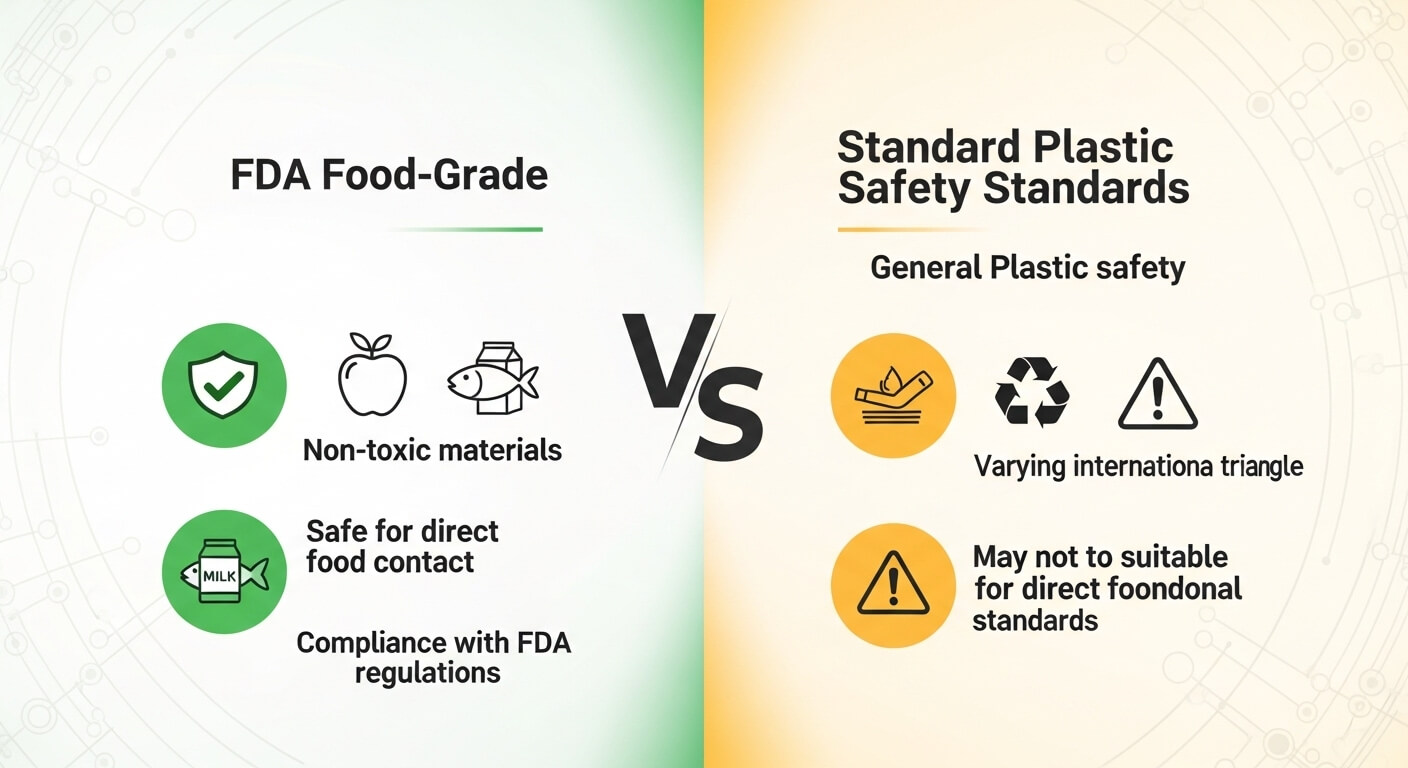
Coolers that do not carry FDA food-grade designation for their liner may still be manufactured to legitimate safety standards, but those standards were designed for different purposes. The most common general plastic safety standards applied to consumer products include ASTM International standards for plastic material properties, ISO standards for dimensional and mechanical performance, and consumer product safety standards administered by the CPSC.
These standards evaluate things like structural integrity, impact resistance, flammability, and whether the product poses physical hazards under normal use. They do not evaluate chemical migration from plastic into food or beverages. A cooler that passes ASTM D4976 (a standard for polyethylene plastics) has been evaluated for material consistency and mechanical properties. It has not been evaluated for whether its colorants, stabilizers, or processing aids are safe for food contact.
The chemical migration gap: plastics used in non-food-contact applications routinely contain UV stabilizers, processing lubricants, colorants, and antioxidants that are appropriate for structural or aesthetic purposes but not evaluated for food safety. When these plastics contact food or wet ice for extended periods at varying temperatures, these additives can migrate into the contents at low but measurable concentrations. Standard plastic safety certifications do not test for or restrict this migration.
For a cooler used to store beverages and prepackaged food where direct contact between liner and contents is minimal, this gap is a modest concern. For a cooler used to store unwrapped fish, game meat, direct ice contact with food, or beverages that are drained and consumed without further preparation, the liner chemistry is more directly relevant.
Which Cooler Components the Certification Applies To
A cooler is not a single material. It is an assembly of components, each potentially made from different plastic formulations, and FDA food-grade certification does not automatically apply to all of them. Understanding which components matter most for food safety helps interpret certification claims accurately.
The Interior Liner
This is the most important component for food contact safety. The liner is in direct contact with ice meltwater, food items, and any condensation that accumulates inside the cooler. Premium rotomolded coolers that advertise FDA food-grade certification typically mean their liner specifically. High-density polyethylene (HDPE) and linear low-density polyethylene (LLDPE) liners made from FDA-compliant resins are the industry standard for this commitment.
The Drain Plug and Gasket
The drain plug is a frequently overlooked food-contact component that sits in extended contact with meltwater. In a cooler used for raw meat or fish, that meltwater carries biological contaminants and chemical leaching from the plug material matters. Quality coolers specify FDA-compliant thermoplastic elastomers or silicone for drain plugs. Budget coolers often use unspecified rubber or plastic compounds for this component.
The Lid Gasket
The compression gasket sealing the lid is in continuous contact with the cooler interior atmosphere and any splash or condensation. EPDM rubber gaskets in premium coolers are generally food-safe, but the certification status of gasket material is rarely disclosed by manufacturers unless it is part of a broader food-grade commitment. For users concerned about food safety, verifying gasket material is as important as verifying liner material.
The Exterior Shell and Insulation
These components do not contact food under normal use and are not subject to food-grade requirements. Polyurethane foam insulation and rotomolded HDPE exterior shells are typically manufactured from formulations appropriate for their structural purpose, not food contact. The insulation is fully sealed within the cooler structure and does not contact food contents directly.
FDA Food-Grade vs. Standard Plastic: Side-by-Side Comparison
| Factor | FDA Food-Grade Standard | Standard Plastic Safety Standard |
| Governing regulation | 21 CFR Parts 174 to 186 (US FDA) | ASTM, ISO, CPSC consumer standards |
| Primary safety focus | Chemical migration into food | Physical safety and structural performance |
| Additive restrictions | Prohibited substances list; positive list only | No food-contact-specific restrictions |
| Plasticizer controls | Restricted; phthalate limits apply | No food-contact restrictions |
| Colorant restrictions | Food-safe colorants required | Any permitted colorant for consumer products |
| Independent testing required | No; manufacturer self-attests compliance | Varies; some standards require third-party |
| Temperature range evaluated | Specific conditions of use | Mechanical performance range |
| Migration testing | Required for compliance claims | Not required |
| Applies to which components | Food-contact surfaces only | All structural components |
| Cooler price tier | Mid-range to premium typically | All tiers |
Third-Party Certifications Worth Knowing
Beyond FDA food-grade, several third-party certifications appear on premium coolers with increasing frequency. Understanding what each verifies helps separate meaningful quality signals from marketing claims.
NSF International (NSF 51)
NSF 51 is the food equipment materials standard administered by NSF International, a globally recognized public health organization. Unlike FDA food-grade self-attestation, NSF 51 certification requires independent product testing by NSF laboratories and ongoing facility audits. A cooler carrying NSF 51 certification has been physically tested for chemical extraction under specified conditions, and the manufacturer’s ongoing production is audited for consistency. This is the most rigorous food safety certification available for cooler materials and represents a meaningful step beyond FDA self-attestation.
USDA Approved Materials
The USDA evaluates materials used in federally inspected meat and poultry processing facilities. USDA-approved plastic materials meet food contact requirements verified through a separate federal agency process. Some commercial-grade coolers used in meat processing and food service environments carry USDA materials approval as evidence of food safety compliance. For consumer coolers, USDA approval is uncommon but occasionally appears on products positioned for hunting and fishing use.
BPA-Free Designation
BPA (bisphenol A) is a chemical used in certain polycarbonate plastics and epoxy resins that has been associated with endocrine-disrupting effects at elevated exposures. BPA-free certification means the product does not use BPA-containing formulations. It is not the same as FDA food-grade certification and does not guarantee the absence of other migration concerns. Most reputable cooler liners are already HDPE or LLDPE, which have never used BPA. A BPA-free label on an HDPE cooler is technically accurate but provides no additional meaningful safety information beyond what the material choice already implies.
LFGB (European Food Contact Standard)
Germany’s LFGB (Lebensmittel- und Futtermittelgesetzbuch) is one of the strictest food contact material standards globally, requiring comprehensive migration testing across multiple food simulants. Products bearing LFGB certification have been independently tested against German and EU food contact regulations, which in several respects are more comprehensive than US FDA self-attestation. European market coolers and some premium US brands with international distribution increasingly carry LFGB certification as a verifiable food safety signal.
Price Analysis: Certification Standards Across Cooler Tiers
| Price Tier | Typical Liner Certification | Drain Plug Standard | Third-Party Cert | Example Brands | Price Range |
| Budget | Unspecified or standard plastic | Unspecified | None | Generic brands | $20 to $60 |
| Mid-range | Often FDA food-grade claimed | Unspecified or basic | BPA-free only | Coleman, Lifetime | $60 to $150 |
| Premium | FDA food-grade liner confirmed | TPE or food-safe rubber | BPA-free, some LFGB | YETI, ORCA, Pelican | $200 to $400 |
| Commercial or specialty | NSF 51 or USDA approved | NSF-compliant | NSF 51, USDA | Igloo Marine, Engel | $300 to $700 |
The most important investment for food safety is not necessarily the most expensive cooler but rather a cooler from a brand that discloses its liner material and certification status explicitly. Brands that cannot or do not specify the certification status of their food-contact components warrant the same skepticism you would apply to any undisclosed food contact material. Transparency is itself a quality signal.
User Experiences: Hunters, Anglers, and Food Safety Professionals
- Professional fishing guides and hunting outfitters who store raw fish and game meat in direct ice contact overwhelmingly select coolers with confirmed FDA food-grade or NSF 51 liner certification, citing client food safety responsibility as the non-negotiable driver. Several noted that a single food safety incident from contaminated cooler contents would be more costly than the price difference between a certified and uncertified cooler.
- Home brewers and food preservation enthusiasts reported that FDA food-grade liner claims were their primary filter when selecting coolers for fermentation temperature control and direct-contact food storage applications, stating that standard coolers left them uncertain about chemical interactions with acidic or yeast-active contents.
- Outdoor catering professionals operating under state food safety regulations reported that NSF 51 certified coolers were required or strongly preferred by their local health department inspectors for cold food holding at permitted events, representing a regulatory compliance driver beyond personal preference.
- Budget cooler users who stored only commercially packaged beverages and sealed food items reported no food safety concerns in practice, a finding consistent with the lower risk profile of indirect food contact through packaging versus direct contact with cooler liner surfaces.
- Users who specifically tested their coolers by storing loose raw fish or marinating meat with meltwater accumulation reported that off-flavors were more common with unspecified plastic liner coolers than with confirmed FDA food-grade liner options, a subjective but consistent finding across forum communities and user reviews in the hunting and fishing space.
Product Recommendations by Certification Standard
Best FDA Food-Grade Liner: YETI Tundra 45
YETI’s Tundra 45 at $325 to $375 specifies an FDA-approved food-grade liner in its product documentation, and YETI discloses that all components in direct contact with food meet FDA food contact requirements. The liner is HDPE, the drain plug is a food-safe thermoplastic, and the EPDM gasket meets food contact standards. For buyers who want a transparent, verifiable food-grade commitment from a mainstream premium brand, YETI’s documentation is among the clearest in the consumer category. Recommended for: anglers, hunters, and outdoor cooks who store raw food in direct cooler contact.
Best NSF-Level Certification: Igloo Marine Ultra
The Igloo Marine Ultra series at $150 to $250 is built to commercial marine and food safety standards with liner materials compliant with NSF guidelines. Its antimicrobial liner treatment adds a biological safety layer relevant for fish and raw meat storage in warm-weather conditions. Igloo’s marine line represents the highest food safety specification available in the mid-to-premium consumer segment without crossing into commercial food service equipment pricing. Recommended for: serious anglers, coastal and boat-based food storage, anyone requiring commercial adjacent food safety standards.
Best Transparent Mid-Range Option: Pelican 45 Qt Elite
Pelican’s Elite series at $270 to $310 specifies food-safe liner materials and provides material disclosure that goes beyond most mid-range competitors. The antimicrobial press-in liner uses a silver-ion treatment that has been evaluated for food contact safety under EPA and FDA guidelines. Pelican’s product documentation is unusually detailed about material certifications, making it the best choice for buyers who need verified material information rather than general marketing claims. Recommended for: food safety-conscious buyers who want documented material disclosure at a premium but not ultra-premium price.
Best Budget Verified Option: ORCA 20 Qt Cooler
ORCA’s 20 Qt at $200 to $230 brings US-manufactured rotomolded HDPE construction with a food-grade liner into the smaller capacity category. ORCA’s transparency about liner materials and their US manufacturing compliance represents the lower price boundary for genuinely verified food-grade construction. Recommended for: buyers who need a smaller verified food-grade cooler for day trips, fishing, and food transport without the footprint or cost of a full-size premium unit.
Best for Commercial or Professional Use: Engel 35 Qt Live Bait Cooler
Engel’s commercial-grade cooler series at $300 to $400 is built to food service standards and used by professional fishing guides, food vendors, and outdoor catering operations. Its liner materials and construction meet the food safety requirements of commercial food handling in multiple US states. The brand’s focus on the professional fishing and outdoor food service market has driven a level of food safety engineering rarely found in consumer-positioned products. Recommended for: professional guides, caterers, and anyone whose cooler use falls under regulatory food safety oversight.
Frequently Asked Questions
Does every cooler need FDA food-grade certification for safe use?
No. If you primarily store commercially packaged beverages, sealed food containers, or wrapped items where direct contact between liner and food is minimal, standard plastic coolers present a low food safety risk in typical use. FDA food-grade certification becomes most relevant when raw food, unwrapped items, or ice that will be consumed directly contacts the liner surface for extended periods.
Is BPA-free the same as FDA food-grade?
No. BPA-free means the product does not contain bisphenol A, which is one specific chemical concern. FDA food-grade certification addresses a much broader range of substances including plasticizers, stabilizers, colorants, and processing aids across the full formulation. A BPA-free cooler can still contain other additives not evaluated for food contact safety. The two designations are independent and BPA-free does not substitute for FDA food-grade compliance.
Can I verify whether a cooler liner is truly FDA food-grade?
You can request the material safety data sheet or compliance documentation from the manufacturer. Reputable brands that make FDA food-grade claims can produce the applicable 21 CFR citation and resin supplier’s food-grade compliance letter upon request. Brands that cannot produce documentation when asked should be treated as unverified regardless of their marketing claims. Third-party certifications from NSF International provide the highest level of independent verification.
Does FDA food-grade certification affect how long food stays safe in the cooler?
Certification affects chemical safety of the liner, not thermal performance. How long food stays safe is primarily determined by the cooler’s insulation quality, ice volume, and how often the lid is opened. A food-grade liner does not extend the time food remains at safe temperature. Both variables matter: you need an insulating cooler to keep food cold and a food-grade liner to ensure the cold storage environment does not introduce chemical contamination.
Are cooler certifications regulated or self-reported?
FDA food-grade compliance for cooler liners is primarily self-reported by manufacturers. The FDA does not conduct routine inspections of cooler manufacturing or independently verify food-grade claims. NSF International certification and LFGB certification involve independent third-party testing and ongoing audits, providing a higher level of verification. When a food-grade claim matters for your use case, look for third-party certification rather than manufacturer self-attestation alone.
The Verdict
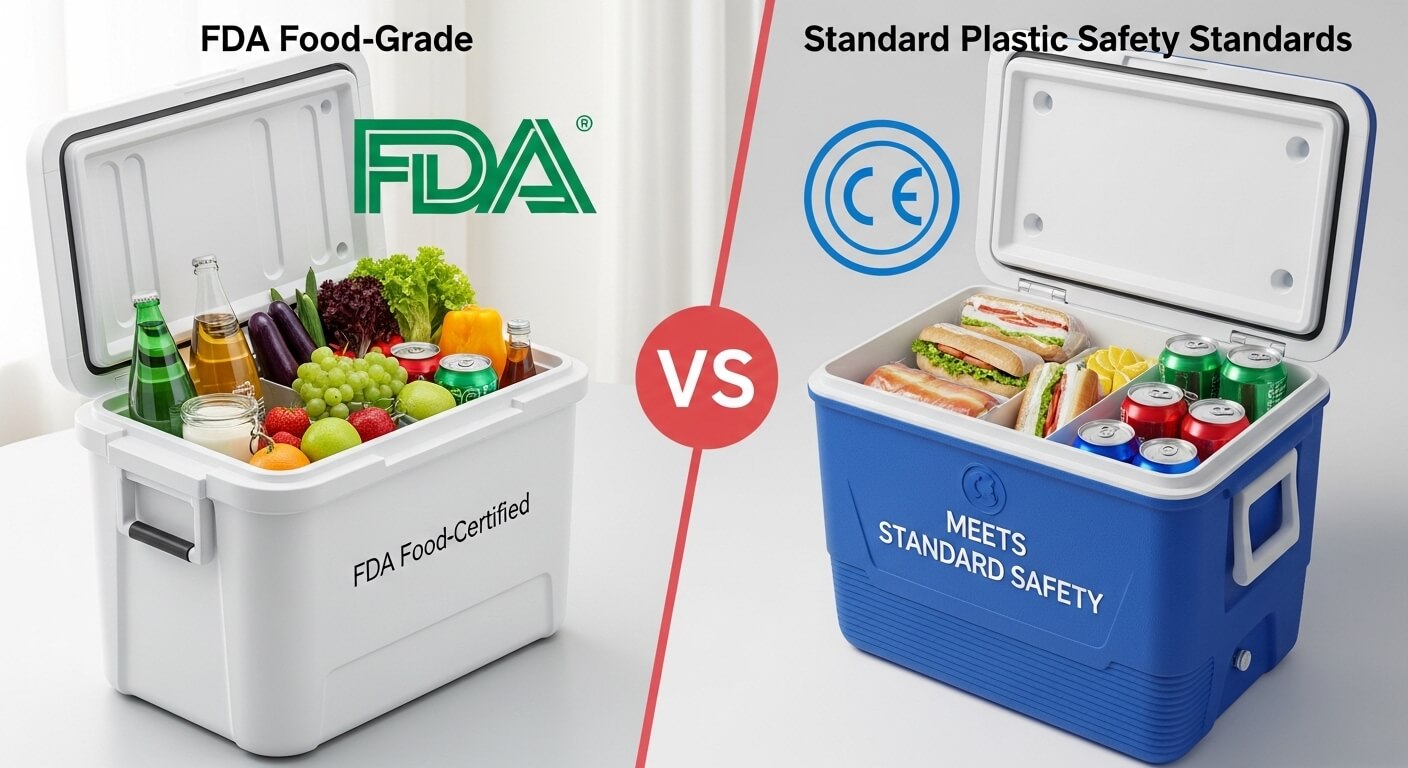
FDA food-grade certification on a cooler liner is not marketing language when it is backed by material documentation. It represents a genuine chemical safety commitment that matters most for users who store raw food in direct contact with the cooler interior, consume ice that has been in contact with the liner, or operate under food safety regulations that require compliant equipment.
Standard plastic safety certifications are not inadequate. They serve their intended purpose of ensuring physical safety and structural performance. They simply were not designed to evaluate food contact chemical migration, which is a separate safety dimension that FDA food-grade and NSF 51 standards specifically address.
For casual cooler use with sealed and packaged contents, standard construction is safe and appropriate. For hunting, fishing, food service, or any application involving direct food-to-liner contact, buying a cooler whose manufacturer can document its food-grade material compliance is a straightforward investment in food safety that the price difference between certified and uncertified options rarely makes difficult to justify..