
The cooler lid has quietly become one of the most versatile surfaces in outdoor recreation. Hunters rest rifles across them. Anglers use them as cutting boards. Tailgaters park drinks, plates, and laptops on them. Kids and adults sit on them at campsites where chairs ran out. In all these scenarios, one variable separates a functional platform from a frustrating or dangerous one: surface traction.
Cooler manufacturers have responded to this reality in two distinct ways. The first is the rubberized or textured non-slip top, engineered with grip and load-bearing in mind. The second is the smooth molded lid, simpler to manufacture, easier to clean, and often found on budget and mid-tier models. The performance gap between these approaches is wider than most buyers appreciate, and the implications extend well beyond comfort.
This article tests both surface types against the real-world demands of seating, work surface use, and object stability, and helps you determine which lid construction matches your outdoor lifestyle.
Surface Technology: What’s Actually Under Your Gear
Smooth cooler lids are a byproduct of standard injection or rotational molding; the same process that creates the shell itself. The lid surface is simply the top face of the mold, polished or lightly textured at the factory. Some manufacturers add cosmetic embossing (brand logos, grid patterns) that provides minimal functional grip but creates the visual impression of a textured surface. In wet conditions or when bearing smooth-bottomed objects, these surfaces perform much like a slightly worn plastic cutting board.
Rubberized non-slip surfaces, by contrast, are either co-molded thermoplastic rubber (TPR) pads bonded to the lid during manufacturing, or post-process applied rubber coatings. The best implementations use molded TPR islands or full-coverage pads with Shore A hardness ratings between 40–60 — soft enough to deform slightly under load and grip irregularities, firm enough to support seated weight without bottoming out. Integrated TPR systems are chemically bonded to the lid substrate and resist separation; adhesive-applied systems vary widely in longevity.
The friction coefficient tells the story clearly: smooth polyethylene lids measure approximately 0.25–0.35 static friction coefficient (dry) and drop to 0.15–0.20 when wet. TPR-rubberized lids measure 0.60–0.80 dry and maintain 0.45–0.65 wet; a 2–3x traction advantage that scales directly to object stability and seated safety.
Effectiveness as a Seating Surface
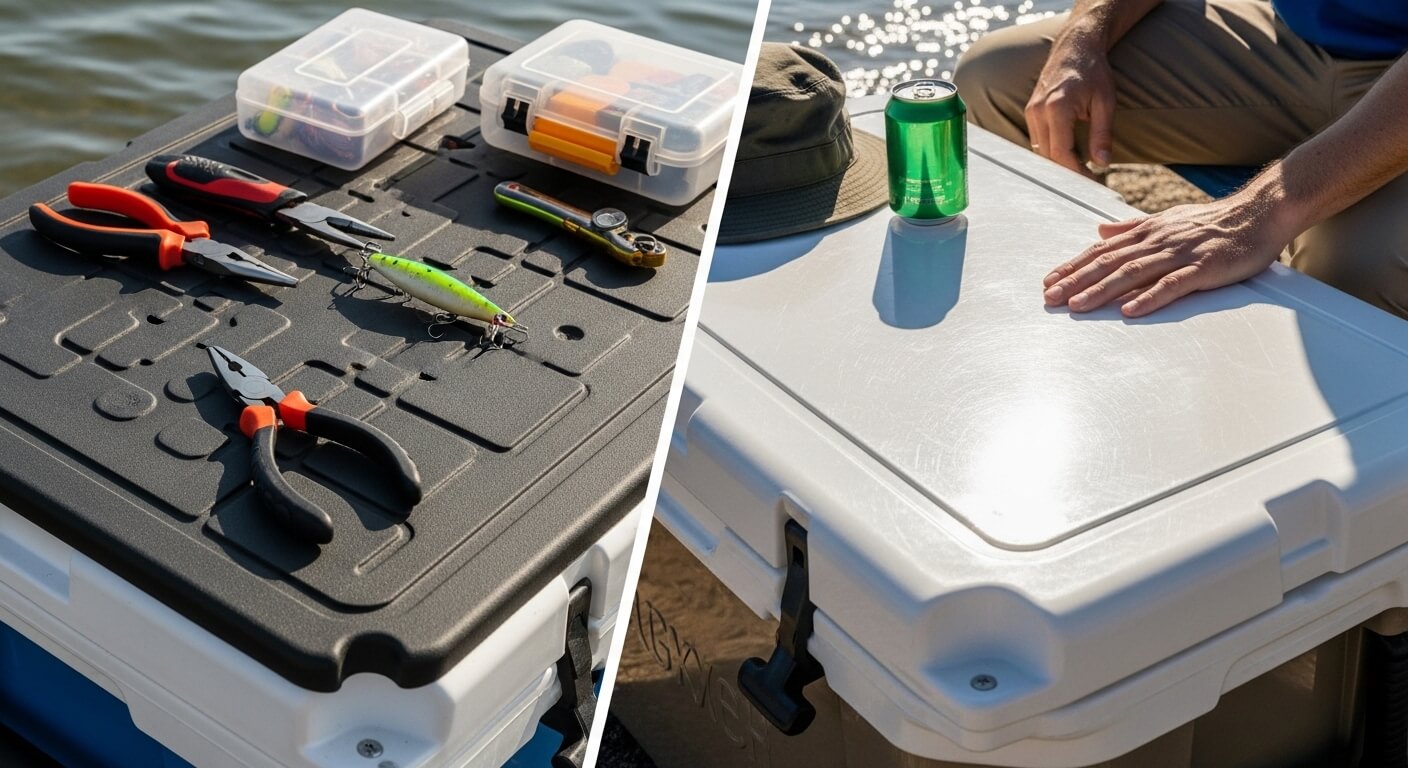
The cooler-as-seat scenario is ubiquitous in outdoor settings, and lid construction matters in two dimensions: slip resistance for the person sitting, and load-bearing integrity under body weight. Most premium coolers are rated for 250–500 lbs of seated load, a specification tied primarily to lid hinge and latch construction rather than surface material. Both rubberized and smooth lids exist across this load range.
Where surface material diverges sharply is slip behavior. Seated users on smooth lids in shorts or synthetic fabrics; the most common outdoor clothing experience measurable lateral slippage, particularly on slight inclines like boat decks, hillside campsites, or truck beds. Field incident reports from outdoor recreation surveys consistently cite smooth-lid coolers as a contributing factor in minor falls and awkward dismounts that result in ankle and knee injuries.
Rubberized tops fundamentally change the biomechanics of cooler seating. The higher friction coefficient grips fabric, denim, and even wet swimwear, allowing the seated person to shift their weight, reach, and stand without the surface sliding beneath them. For users with limited mobility, elderly campers, or children, this difference transitions from a comfort preference to a genuine safety consideration.
Seating verdict: rubberized surfaces are meaningfully safer and more comfortable as seats, particularly in mobile environments (boats, truck beds) and for users who need stable footing to stand from a seated position.
Head-to-Head Comparison Across Key Factors
| Performance Factor | Smooth Lid | Rubberized/TPR Lid | Winner |
| Dry Friction (Static) | Low (0.25–0.35 CoF) | High (0.60–0.80 CoF) | Rubberized |
| Wet Friction (Rain/Splash) | Very Low (0.15–0.20 CoF) | Good (0.45–0.65 CoF) | Rubberized |
| Object Stability (Cups/Plates) | Poor — slides freely | Excellent — holds position | Rubberized |
| Seated Safety (Flat Ground) | Adequate with care | Secure; minimal shift | Rubberized |
| Seated Safety (Inclined/Moving) | High slip risk | Controlled; grip retained | Rubberized |
| Work Surface (Writing/Cutting) | Surface slides under paper | Stable platform | Rubberized |
| Ease of Cleaning | Excellent; wipes clean | Good; grooves trap debris | Smooth |
| Durability of Surface | No wear; permanent | TPR may peel if adhesive-applied | Smooth (long-term) |
| Aesthetic / Appearance | Sleek, premium look | Functional, utilitarian | Tie / Preference |
| Weight Added | None | Minimal (~0.2–0.5 lbs) | Smooth |
| Cold Weather Performance | Becomes slicker when cold | Maintains grip below freezing | Rubberized |
| Price Premium | None — standard | $15–$60 upcharge typical | Smooth |
Performance as a Work Surface
The cooler-lid work surface scenario encompasses everything from field dressing game to preparing campsite meals, sorting tackle and gear, writing on maps or notebooks, and using electronics outdoors. Each use case exposes the smooth-lid limitation: without grip, the work surface itself moves.
A smooth-lidded cooler on a boat deck will skate across the surface when you press down on a knife to cut bait. Paper placed on a smooth lid blows away or slides at the slightest angle. A laptop balanced on a smooth lid while checking trail maps is one small bump away from a hard lesson about polished polyethylene and gravity. These aren’t edge cases; they’re the normal operating environment for outdoor coolers.
Rubberized lids solve the two-way grip problem: the cooler stays stationary on the surface beneath it, and objects placed on top stay stationary relative to the lid. Anglers who use cooler lids as cutting stations report that TPR-topped coolers require no repositioning between cuts — a practical time-saver that also reduces the risk of knife slippage. Hunters preparing field lunches appreciate the stability of plates and cutting boards that don’t require a free hand to hold in place.
The laptop and electronics use case deserves special mention: a rubberized cooler lid in a truck bed or boat becomes a functional mobile workstation in a way a smooth lid simply cannot replicate. At festivals, tailgates, and remote campsites, this single feature changes the cooler’s utility profile entirely.
Price Analysis: What Rubberized Tops Actually Cost
Non-slip lid technology is not exclusively a premium feature; it appears across price tiers, though implementation quality scales with cost. Understanding what you’re paying for at each level helps calibrate the investment.
| Price Tier | Typical Lid Surface | TPR Quality | Seating Rating | Work Surface Rating |
| Budget ($30–$80) | Smooth molded plastic | None | Poor | Poor |
| Mid-Range ($100–$199) | Light texture or partial grip pad | Adhesive-applied; variable | Fair | Fair |
| Premium ($200–$350) | Full TPR pad or co-molded grip | Co-molded; durable | Excellent | Excellent |
| Ultra-Premium ($350+) | Integrated non-slip + load rating | Chemically bonded; lifetime | Excellent | Excellent |
The jump from no non-slip surface to a properly engineered TPR top typically adds $25–$60 to cooler cost when comparing similar-capacity units across brands. For users who regularly use the cooler lid as a functional surface, that premium pays dividends in every use. For buyers who keep their cooler on flat ground and never sit or work on it, the smooth lid’s easier cleaning and slightly sleeker appearance are reasonable trade-offs.
Product Recommendations by Use Case
Best for Seating & Stability: YETI Tundra 45
YETI’s non-slip pad system on the Tundra line is one of the most well-executed implementations in the category. The co-molded rubber feet on the underside keep the cooler from sliding on any surface, while the textured lid provides reliable seated grip. Rated to 300 lbs, it handles adult seating in boat and truck environments without flex or movement. At $325–$375, it’s the benchmark for lid-as-seat performance. Recommended for: boaters, anglers, tailgaters who regularly sit on their cooler.
Best Work Surface: Pelican 45 Qt Elite Cooler
Pelican’s press-and-pull latch system creates a uniquely flat, stable lid platform when closed, and the textured non-slip surface on the Elite line handles wet field conditions exceptionally well. Food prep, gear sorting, and electronics use are all well-supported. The lid’s slight concave geometry also keeps small items from rolling off the edge; a thoughtful design detail. Priced at $270–$310. Recommended for: hunters, anglers, and backcountry campers who use the lid as a prep or work station.
Best Mid-Range Non-Slip: Lifetime 77 Qt High Performance
Lifetime’s blow-molded cooler line includes a textured non-slip surface that punches above its $150 price point. While not co-molded TPR, the surface geometry provides meaningful grip improvement over smooth lids and holds up well in dry-to-damp conditions. Load rating of 250 lbs makes it viable for occasional seating. Best value non-slip lid available under $200. Recommended for: casual campers and tailgaters wanting non-slip benefits without the premium price.
Best for Cold Climates: ORCA 40 Qt
ORCA’s rubberized lid performs especially well in cold conditions where competitive smooth lids become skating rink-level slick. The TPR compound maintains flexibility and grip characteristics down to well below freezing, a feature that matters significantly for ice fishing setups, winter hunting camps, and ski lodge tailgates. Priced at $350–$400 with a lifetime warranty. Recommended for: cold-weather outdoor users for whom surface grip in freezing conditions is a priority.
Best Budget Non-Slip Option: Coleman Xtreme 5 Series
Coleman’s Xtreme 5 line includes a molded grip texture that, while not true TPR, delivers noticeably better traction than flat smooth lids at its $50–$70 price point. It won’t match premium rubberized performance in wet conditions, but for dry tailgating, camping, and picnic use, it’s the most accessible entry point into improved lid stability. Recommended for: budget-conscious buyers who want basic grip improvement for casual use.
Frequently Asked Questions
Q: Can I add non-slip surface to a smooth-lid cooler aftermarket?
A: Yes, with caveats. Self-adhesive TPR grip mats (marketed for tool drawers, shelving, and boat decks) can be cut to fit and adhere to smooth cooler lids. Grip tape (similar to skateboard deck tape) also works for temporary applications. The limitation is longevity; outdoor UV exposure and repeated wet-dry cycles degrade most adhesive systems within 1–2 seasons. Non-slip shelf liner without adhesive works well for stationary use but won’t stay put on a moving platform.
Q: Does a rubberized lid affect the cooler’s seal or insulation performance?
A: No. The non-slip surface is applied to or molded into the exterior top of the lid only and has no relationship to the lid’s gasket or insulation. Ice retention performance is unaffected by whether the lid surface is smooth or rubberized; those specs are determined by wall thickness, foam density, and gasket quality.
Q: How do I clean a deep-textured rubberized cooler lid effectively?
A: A stiff-bristled brush (a dedicated dish brush or an old toothbrush for tight grooves) with warm soapy water removes most debris from TPR grid patterns. For mold or mildew in deeper channels, a diluted bleach solution (1 tablespoon per quart of water) applied and allowed to sit for 10 minutes before scrubbing is effective. Rinse thoroughly. Avoid abrasive cleaners that can degrade the rubber over time.
Q: Are rubberized tops safe for food preparation directly on the surface?
A: Directly using a rubberized cooler lid as a food prep surface is not recommended — TPR materials are not food-safe certified, and the porous texture of rubber provides a hosting environment for bacteria. Place a cutting board on the lid surface instead. The grip provided by the rubberized top actually makes a cutting board more secure and stable than it would be on a smooth lid, which is the better use of the surface for food prep.
Q: What weight capacity should I look for if I plan to regularly sit on my cooler?
A: Look for a minimum 250 lb lid rating for single-adult seating, and 300 lb for a more comfortable margin. These ratings are typically listed in product specifications and relate primarily to hinge and latch engineering rather than surface material. Always confirm the rating applies to the closed lid (some manufacturers rate the body separately from the lid), and check that the cooler rests on a stable, level surface when being used as a seat.
Q: Do all premium rotomolded coolers come with non-slip lids?
A: No; rotomolded construction and non-slip lid surfaces are independent features. Several premium rotomolded coolers still ship with smooth or lightly textured lids. If a non-slip surface is important for your use case, verify it specifically in the product listing rather than assuming it comes with premium pricing. YETI, ORCA, and Pelican Elite lines include robust non-slip surfaces; some other rotomolded brands at similar price points do not.
The Verdict
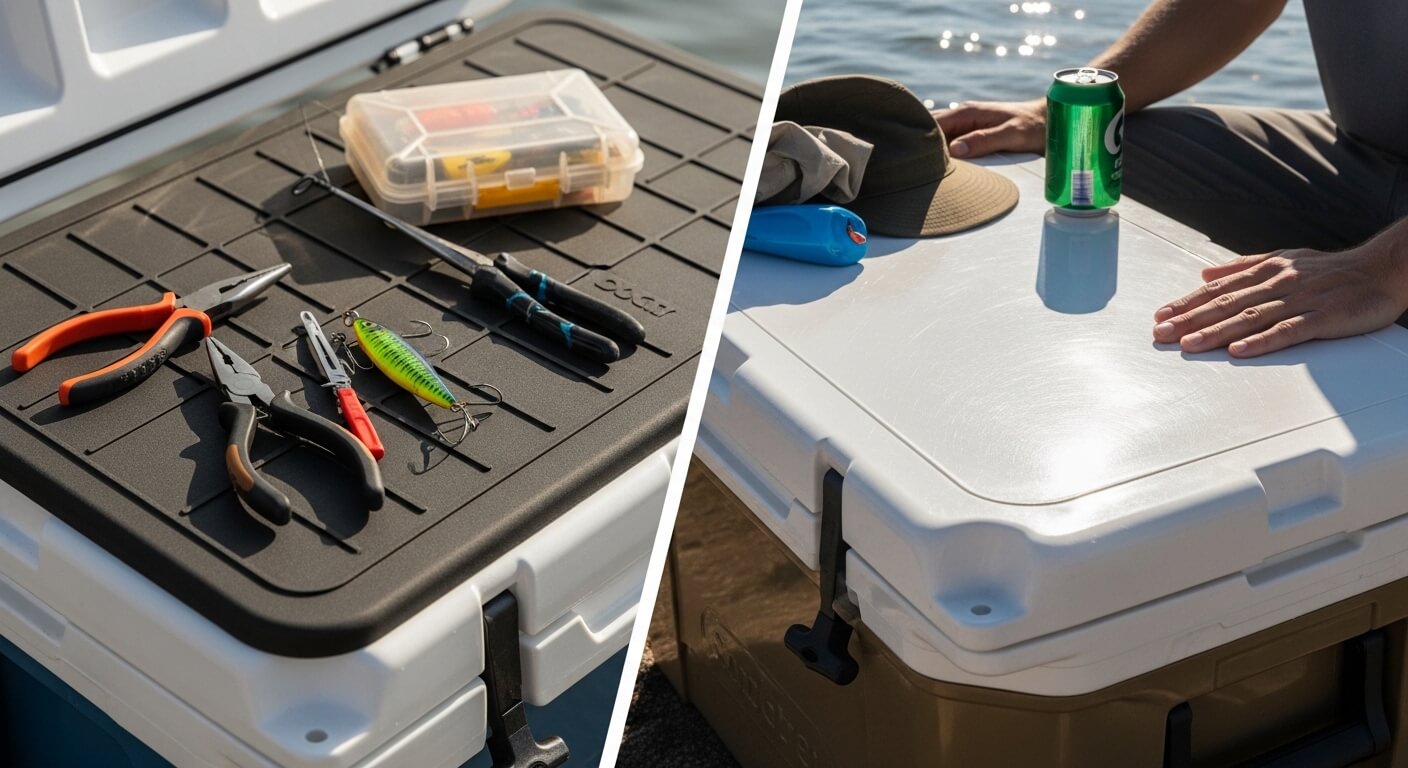
For users who treat the cooler lid as a functional surface; a seat at the campsite, a prep station on the boat, a platform for drinks and gear at the tailgate; rubberized non-slip construction is not a luxury feature. It is the difference between a surface that works reliably and one that works only under ideal, dry, flat, stationary conditions. The friction coefficient data is unambiguous, and the field reports reinforce what physics predicts: TPR wins every meaningful performance category.
The smooth lid retains two genuine advantages: it is easier to clean thoroughly and it carries no risk of adhesion failure over time. For buyers who want the simplest, lowest-maintenance surface and do not plan to sit or work on their cooler lid, smooth is perfectly functional. For everyone else, especially boaters, hunters, anglers, and anyone sharing a cooler with children in active outdoor environments, the upgrade to a rubberized top is one of the most practical investments a cooler lid can offer.