
Travel content creators face unique challenges balancing photogenic outdoor adventures with practical logistics. Coolers enable extended trips, beach content creation, and remote location shoots, but size, weight, and airline compatibility create complications traditional campers never consider. Compact carry-on coolers maximize portability and eliminate baggage fees, while mega check-in coolers provide capacity for week-long productions and group collaborations. This comprehensive guide examines both approaches to help travel influencers, digital nomads, and adventure content creators choose optimal cooling solutions.
Understanding Travel Creator Needs
The Unique Challenges of Content Creation Travel
Travel influencers and content creators operate differently from traditional vacationers. Their trips combine leisure with work, requiring equipment that serves both production and practical needs. A cooler isn’t just for keeping drinks cold; it’s potential prop, necessary production support, and practical life solution.
Content creators often travel to remote or underdeveloped locations where food safety and quality control matter intensely. A week shooting content in rural areas without reliable restaurants makes cooler capacity crucial. The ability to store fresh food, beverages, and potentially sensitive equipment determines trip feasibility.
Production schedules create different usage patterns than typical vacations. Creators might need early morning golden hour shoots requiring breakfast on location, all-day filming sessions needing lunch and hydration, and sunset content requiring dinner supplies. The cooler supports professional productivity, not just leisure comfort.
Collaboration trips with multiple creators, models, assistants, or crew compound capacity needs. A solo traveler manages with small coolers, but a production team of 4-6 people requires substantial cooling capacity for multi-day remote shoots.
Budget considerations differ dramatically from hobbyist travelers. Successful influencers treat equipment as business investments generating income. A $300 cooler enabling better content that attracts sponsors easily justifies itself. Struggling creators pinch pennies, making budget optimization critical.
The Airline Compatibility Question
TSA regulations and airline policies fundamentally shape travel cooler decisions. Understanding these constraints prevents costly surprises at airports and streamlines travel logistics.
Carry-On Dimensions: Most airlines limit carry-on items to approximately 22″ x 14″ x 9″, including wheels and handles. Soft-sided coolers fitting these dimensions include models from 12-24 quart capacity. Hard-sided coolers rarely fit within carry-on limits due to thick insulation walls.
Checked Baggage Rules: Standard checked bag limits are typically 62 linear inches (length + width + height) and 50 pounds. Large coolers easily exceed dimensional limits, triggering oversized baggage fees of $75-$200+ per flight, depending on airline and route.
Weight becomes problematic with large coolers. A 50-quart rotomolded cooler weighs 25-30 pounds empty. Add ice, food, and contents, and total weight approaches or exceeds 70-80 pounds. This triggers both oversized and overweight fees.
Special Item Considerations: Some airlines classify coolers as “sporting equipment” with different fee structures than standard baggage. Others treat them as regular luggage. Policies vary dramatically between carriers—Southwest includes two free checked bags while Spirit charges for all luggage.
International travel compounds complications. International baggage allowances often differ from domestic policies, and some countries restrict certain cooler materials or impose import duties on equipment above specific values.
Carry-On Cooler Category
Size and Capacity Realities
Carry-on compatible coolers max out around 20-24 quarts, holding approximately 18-28 cans plus ice. The capacity suits 1-2 people for day trips or overnight stays but struggles with extended multi-day needs.
Soft-sided coolers dominate the carry-on category. Brands like YETI Hopper, Hydro Flask, Arctic Zone, and RTIC offer collapsible options fitting overhead bins when compressed. The flexibility allows meeting airline dimensions while maximizing usable interior space.
Hard-sided carry-on coolers exist but sacrifice capacity to meet size limits. A hard-sided 20-quart cooler’s thick walls reduce interior volume compared to soft coolers with thin but effective insulation.
The limited capacity forces strategic packing. Creators must prioritize essentials: hydration, perishable items for immediate meals, and temperature-sensitive production items (certain cosmetics, medications). Everything else requires alternative solutions like hotel mini-fridges or daily grocery runs.
Portability and Convenience
The defining advantage of carry-on coolers is complete control. The cooler travels with you rather than disappearing into checked baggage. This prevents lost luggage disasters that could derail entire trips.
Immediate access matters for content creators. Landing in a destination and immediately heading to a shoot location works when your cooler is accessible. Waiting at baggage claim wastes time and disrupts tight production schedules.
The lighter weight (12-18 pounds when loaded) allows solo handling through airports. Rolling luggage carts or backpack-style coolers make navigation manageable even with additional camera gear and production equipment.
Security concerns favor carry-on coolers. Expensive equipment, medications, or irreplaceable items stay under your control rather than risking checked baggage theft or rough handling.
However, the constant carrying creates fatigue. Hauling a loaded cooler through large airports, making connections, and managing additional carry-ons becomes exhausting. The convenience of control trades against physical burden.
Suitable Use Cases for Creators
Weekend Content Trips: Two-day shoots to nearby destinations work perfectly with carry-on coolers. Pack Friday through Sunday essentials without checking bags, shoot content Saturday and Sunday, return home Sunday night. The efficiency maximizes productivity while minimizing travel hassle.
Urban Adventures: City-based content creation benefits from carry-on coolers. Store makeup and skincare needing refrigeration, pack day-trip snacks for rooftop shoots, keep beverages cold during all-day neighborhood explorations. Hotel mini-fridges supplement but don’t replace the portable cooler.
Beach/Pool Content: Beach days and pool shoots within walking distance of accommodation suit carry-on coolers. The capacity handles a day’s beverages, lunch, and snacks. Return to base each evening to restock rather than attempting multi-day self-sufficiency.
Solo Creator Travel: Individual influencers managing their own needs find carry-on capacity adequate. One person’s hydration and meals for 1-2 days fits comfortably. The solo flexibility allows responsive travel without crew coordination.
Budget-Conscious Creators: Avoiding checked bag fees preserves budget for other production needs. Some creators travel exclusively with carry-on luggage including coolers to eliminate all baggage fees. The savings add up across frequent travel.
Check-In Mega Cooler Category
Capacity and Self-Sufficiency
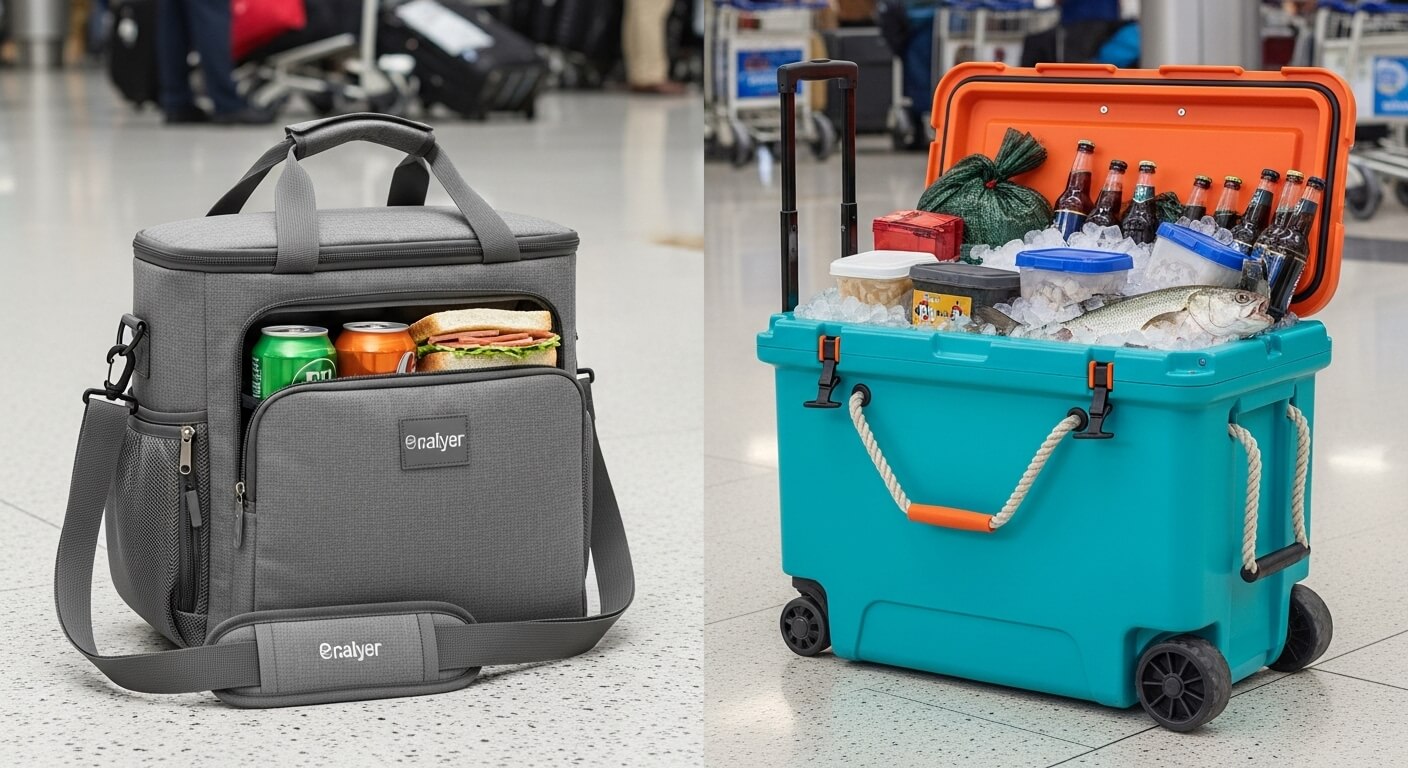
Large check-in coolers range from 45 to 100+ quarts, holding 50-120+ cans plus substantial ice. The capacity enables multi-day or even week-long self-sufficiency in remote locations.
The volume accommodates diverse needs simultaneously: beverages for hydration, fresh produce for meals, proteins requiring refrigeration, backup food supplies, and potentially backup ice or frozen gel packs extending overall duration.
For group productions, mega coolers become essential infrastructure. A crew of 4-6 people shooting for 3-5 days requires substantial cooling capacity. One large cooler serves everyone, simplifying logistics compared to multiple small coolers.
The capacity allows packing efficiency. Buying groceries once rather than daily shopping saves time and often money in tourist-heavy locations where prices are inflated. Bulk purchasing at suburban grocery stores before heading to expensive beach towns or remote areas reduces overall food costs.
Remote location shoots benefit enormously. Destinations without reliable restaurants, stores, or infrastructure require bringing comprehensive supplies. A 70-quart cooler stocked with a week’s food enables shooting in locations that would otherwise be logistically impossible.
The Baggage Fee Reality
Checking large coolers triggers fees on most airlines. Budget carriers like Spirit, Frontier, and Allegiant charge $30-$75 each way for first checked bag, $40-$85 for second bags, plus oversized fees of $75-$150 if coolers exceed standard dimensions.
Legacy carriers (American, United, Delta) include one free checked bag on most routes but charge $30-$35 for second bags. Large coolers often count as both regular baggage and incur oversized fees, creating total charges of $100-$200 per round trip.
Southwest’s two free checked bags policy makes them favorites among cooler-traveling creators. The policy saves $100-$300 per trip compared to other carriers. Successful creators specifically book Southwest when cooler travel is planned.
International flights complicate economics. International routes typically include checked baggage but have stricter weight limits. A 70-pound loaded cooler may trigger overweight fees of $100-$200 each way.
The fees must be calculated against alternatives. Renting coolers at destinations costs $30-$100 per week. Buying cheap coolers locally and discarding them wastes money and creates environmental concerns. For frequent travelers, owning quality coolers and paying occasional baggage fees often costs less than rental over time.
Suitable Use Cases for Creators
Week-Long Production Trips: Extended shoots in remote or expensive locations justify mega coolers. A week filming in Alaska’s backcountry, a Caribbean island with limited groceries, or desert locations far from stores requires substantial self-sufficiency. The cooler enables the production.
Collaboration Content: Group shoots with multiple creators, models, assistants, or crew need mega capacity. Four people for five days require ice, beverages, breakfast items, lunch supplies, and dinner ingredients. A 70-quart cooler barely suffices; smaller options fail entirely.
Destination Base Camping: Trips establishing base camps for daily excursions benefit from large coolers. Stay at a central Airbnb or campground, stock a mega cooler, and execute daily shoots in various locations. Return to base each evening to refresh supplies from the well-stocked cooler.
Exotic Location Shoots: Destinations where food safety and quality are uncertain make mega coolers valuable. Bring familiar foods ensuring dietary needs are met and eliminating uncertainty about local food safety standards. The health security enables better content creation.
Established Creators with Budget: Influencers with sponsor support or successful monetization treat baggage fees as business expenses. The $150 round-trip cooler fee is negligible against a $5,000 production budget. The right tool matters more than minor cost optimization.
Performance Comparison
Ice Retention Duration
Small carry-on soft coolers maintain ice for 24-48 hours with proper pre-chilling and minimal opening. The limited insulation (typically 0.5-1 inch) and soft construction restrict maximum performance. Expect one full day of good ice retention, then rapid decline.
Large hard-sided mega coolers retain ice for 5-10 days depending on quality and conditions. The thick rotomolded walls (2-3 inches of insulation) and superior sealing create dramatically better performance. Premium brands like YETI, Pelican, and ORCA deliver on week-long ice retention promises.
The performance gap matters enormously for extended trips. Carry-on coolers require daily ice resupply or switching to non-refrigerated foods after day two. Mega coolers enable week-long self-sufficiency without ice source access.
However, most travel includes accommodation with refrigeration access. Hotel mini-fridges, Airbnb refrigerators, or campground ice machines reduce the value of extreme ice retention. The cooler supplements rather than replaces these resources.
Versatility and Multi-Use
Carry-on coolers serve multiple roles: airplane carry-on, day-trip cooler, photo prop, hotel supplemental refrigeration. The versatility maximizes utility across diverse travel scenarios.
The collapsible nature of soft carry-on coolers allows empty storage without consuming precious luggage space on return trips. Pack the deflated cooler flat among clothing and souvenirs.
Mega coolers serve single primary purpose: substantial cooling capacity. They don’t multitask well. Too large for daily errands, too heavy for casual portability, too bulky for most content creation scenarios as visible props.
However, mega coolers double as seating, tables, or step stools at campsites and outdoor productions. The sturdy construction supports adult weight, creating impromptu furniture for crew.
Content Creation Considerations
Small coolers work well as props in lifestyle content. A cute pastel soft cooler looks natural in beach photos, picnic scenes, or casual outdoor content. It suggests attainable, relatable adventures rather than extreme expeditions.
Large coolers create problems as props. They’re unwieldy in photos, dominate frames unless carefully positioned, and suggest serious camping or expedition content rather than aspirational lifestyle adventures. Most lifestyle influencers hide large coolers from content entirely.
However, adventure and outdoor influencers showcase large coolers as essential gear. The equipment validates their outdoor credentials and provides natural product placement opportunities. Cooler brands sponsor outdoor creators specifically for authentic integration into expedition content.
Color and aesthetic matter differently by cooler size. Carry-on coolers in trendy colors photograph well. Mega coolers in neutral colors or camo blend into backgrounds better during shoots.
Cost Analysis for Travel Creators
Initial Investment
Quality carry-on soft coolers cost $80-$200 depending on brand and features. YETI Hopper models reach $300 but most creators find $100-$150 options adequate. The lower entry cost makes experimentation affordable.
Premium mega coolers range from $200-$450 for 50-70 quart models. Budget rotomolded options from RTIC or Lifetime cost $100-$200. Mid-range brands like Pelican or ORCA fall around $250-$350. YETI commands premium pricing at $350-$450.
For creators just starting, the cost difference is substantial. Spending $150 on a carry-on cooler feels reasonable; committing $300+ to a mega cooler requires confidence in future travel frequency and needs.
Established creators often own both: a carry-on for quick trips and a mega cooler for major productions. The total investment of $400-$600 for both options provides comprehensive flexibility.
Ongoing Travel Costs
Carry-on coolers eliminate baggage fees entirely on most trips. Over 10 round trips, saving $30-$60 per flight totals $300-$600 annually. This quickly offsets the cooler’s purchase price.
Mega coolers trigger fees on most carriers. Assuming $100 average round-trip baggage fees across 10 trips, annual cooler-specific travel costs reach $1,000. This doesn’t include other checked baggage—just the cooler.
Southwest Airlines changes the equation. Two free checked bags eliminate cooler fees entirely. Creators flying Southwest primarily recover the mega cooler economics, paying only the cooler’s purchase price without ongoing fees.
Ice purchases also factor in. Carry-on coolers requiring daily ice resupply in destinations cost $3-$7 per bag. A week-long trip needs 5-7 ice bags totaling $20-$50. Mega coolers requiring one or two ice resupplies during the same week cost $6-$15 total.
Rental alternatives provide comparison baseline. Cooler rentals cost $30-$100 per week depending on destination and cooler quality. Occasional travelers might find rentals cheaper than purchasing mega coolers plus baggage fees.
Return on Investment
Successful creators monetizing content justify cooler investment through enabling better productions. A cooler allowing a week-long remote shoot producing 20+ posts, stories, and videos that attract sponsor interest generates thousands in revenue.
Struggling creators without monetization must carefully evaluate whether cooler investment makes financial sense. A $300 mega cooler plus $1,000 annual baggage fees represents $1,300 first-year cost with uncertain returns.
The calculation changes for creators building brands. The cooler enables content that might not otherwise exist, potentially accelerating growth. It’s infrastructure investment similar to camera upgrades or editing software.
Recommendations
Lifestyle and Fashion Influencers
Recommendation: Carry-On Soft Cooler
Lifestyle content rarely requires extended remote location shoots. Weekend trips to photogenic cities, beach resorts with amenities, or accessible outdoor locations suit carry-on capacity. The cooler supplements hotel facilities rather than replacing them.
The aesthetic options for carry-on coolers align better with lifestyle branding. Pastel colors, sleek designs, and compact proportions photograph well in lifestyle content. Mega coolers look utilitarian and clash with curated aesthetics.
Budget optimization matters for many lifestyle influencers who monetize through affiliate links and modest sponsorships rather than major brand deals. Eliminating baggage fees preserves margins.
The portability suits solo travel that dominates lifestyle content creation. One person packing for themselves needs carry-on capacity, not mega volume.
Specific Product Suggestion: YETI Hopper M30 ($325) provides 26-can capacity, attractive design, and lifestyle brand appeal. Alternative: Arctic Zone Titan Deep Freeze ($60) offers budget-friendly carry-on cooling.
Adventure and Outdoor Influencers
Recommendation: Check-In Mega Cooler
Adventure content demands extended remote location shoots. Multi-day backcountry access, expedition content, or remote destination features require self-sufficiency that mega coolers enable.
The capacity supports collaboration content common in outdoor niches. Partnering with other creators, bringing guides, or coordinating with outdoor brands involves group logistics needing substantial cooling.
The rugged coolers serve as content elements. Showcasing quality outdoor gear validates expertise and attracts outdoor brand partnerships. A premium YETI or Pelican cooler is production equipment and potential sponsored content.
Adventure creators monetize through outdoor brand partnerships paying enough to cover baggage fees as business expenses. The $100-$200 cooler fee is minor against $3,000-$10,000 brand partnership payments.
Specific Product Suggestion: Pelican 70QT Elite ($400) offers bear-resistance, extreme durability, and serious outdoor credibility. Alternative: RTIC 52-Quart ($200) provides rotomolded quality at accessible pricing.
Food and Travel Content Creators
Recommendation: Both Options for Different Trip Types
Food creators need flexibility. Destination food tours in developed cities suit carry-on coolers storing groceries, local market finds, and portable meals between restaurant shoots. Remote culinary adventures require mega coolers stocking ingredients for cooking content in vacation rentals or outdoor settings.
The dual investment makes sense for successful food travel creators. Use carry-on for quick city trips, mega cooler for villa rentals and culinary destination deep dives.
Food safety concerns make quality cooling essential. Showcasing local ingredients, creating recipe content, or documenting food experiences demands reliable refrigeration preventing spoilage and foodborne illness.
Specific Product Suggestion: Carry-on: Hydro Flask 20L Soft Cooler ($200) for urban food exploration. Mega: ORCA 58-Quart ($380) for villa stays and culinary productions.
Budget Travel and Digital Nomad Creators
Recommendation: Carry-On Soft Cooler
Budget optimization drives every decision for this category. Eliminating baggage fees preserves limited funds for other travel expenses and content needs.
The flexibility of carry-on travel aligns with spontaneous, responsive travel styles. Digital nomads moving frequently between destinations need streamlined packing without bulky equipment.
Longer stays in destinations with refrigeration access reduce need for mega cooling capacity. When spending 2-4 weeks in a location with kitchen access, supplement small coolers with refrigerator storage.
The carry-on cooler serves double duty as camera equipment transport, laptop protection, or general storage beyond just cooling. The versatility maximizes value for every item carried.
Specific Product Suggestion: Coleman Soft Cooler 16-Can ($25) provides ultra-budget cooling. Upgrade to RTIC 20 Soft Cooler ($100) for better performance while maintaining budget consciousness.
Frequently Asked Questions
Can I bring a frozen cooler pack on airplanes?
TSA allows frozen ice packs in carry-on luggage if completely frozen solid at security screening. Partially melted ice packs are subject to liquid rules (3.4 oz limit). Check coolers can include any quantity of ice or ice packs. Most creators recommend checking coolers with ice for hassle-free security clearance.
What’s the best way to pack a cooler for checked baggage?
Drain all water and ice before checking to reduce weight. Secure the lid with tape or straps since baggage handlers may open coolers. Remove or secure any loose parts. Place fragile items in protective bags within the cooler. Some creators pack clothes around the cooler in checked bags for additional padding and space efficiency.
Do influencers really need premium coolers or do budget options work?
Budget coolers work adequately for occasional use and short trips. Premium coolers justify their cost through superior durability, warranty support, and performance for frequent travelers. Creators using coolers 10+ times annually benefit from premium quality. Occasional users (2-4 trips yearly) find budget options sufficient.
How do you handle ice and contents when flying?
Most creators empty coolers completely before flying, purchasing ice and supplies at destinations. Some freeze gel packs at home, pack them frozen in checked coolers, and they remain cold enough at destinations to immediately use. For carry-on coolers, buy ice after landing. Airport ice costs 2-3x grocery store prices but provides immediate cooling.
What about international travel with coolers?
International airline policies vary widely. Research specific carriers and destination country customs regulations. Some countries restrict importing certain cooler materials or charge duties on equipment above value thresholds. Hard-sided coolers often face more scrutiny than soft coolers. Consider rentals or purchases at international destinations rather than dealing with cross-border cooler logistics.
Can coolers serve as additional luggage for non-food items?
Many creators pack non-perishables, camera equipment, or general supplies in coolers, using them as both luggage and eventual cooling equipment. The hard-sided protection benefits electronics and fragile items. Pack strategically with cooling needs in mind; items touching ice will get wet. Use waterproof bags for anything moisture-sensitive.
Do Southwest’s two free bags make mega coolers economically viable?
Absolutely. Southwest’s policy transforms mega cooler economics from expensive to reasonable. Creators who primarily fly Southwest gain mega cooler benefits without ongoing baggage fees. This significantly favors check-in coolers over carry-on options when Southwest serves your typical routes.
How do you prevent cooler theft from checked baggage?
Use TSA-approved locks on cooler latches. Avoid checking obviously expensive branded coolers when possible. Remove or obscure brand logos that signal value. Consider travel insurance covering baggage and equipment. Pack nothing irreplaceable in checked coolers. Theft does occur but remains relatively rare with basic precautions.
Conclusion
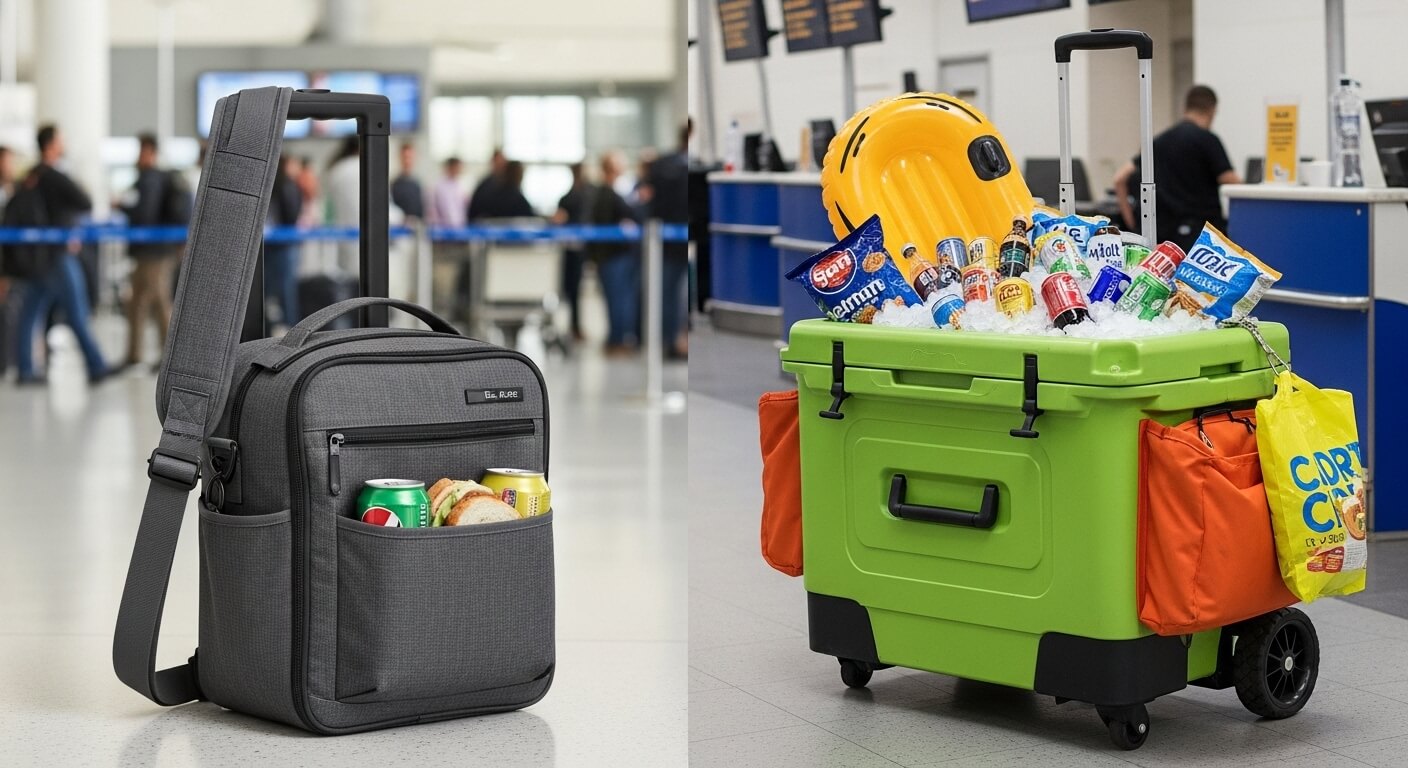
The carry-on versus check-in mega cooler decision reflects broader creator choices about travel style, content focus, and business model. Neither option is universally superior—the right choice aligns with specific creator needs, trip types, and budget realities.
Carry-on soft coolers maximize flexibility, eliminate baggage fees, and provide adequate capacity for solo weekend creators focused on lifestyle content in developed destinations. The portability and control suit spontaneous travel styles and budget-conscious operations. The $100-$200 investment serves most casual to moderate travel creators well.
Check-in mega coolers enable remote productions, collaborative shoots, and week-long self-sufficiency impossible with carry-on capacity. The substantial cooling capacity justifies baggage fees for established creators with sponsor support and outdoor/adventure focus. The $200-$400+ investment makes sense for frequent travelers executing major productions.
Many successful creators ultimately invest in both options, deploying appropriate tools for specific trips. The total commitment of $400-$700 provides comprehensive flexibility across diverse content creation scenarios.
For creators just starting, begin with carry-on soft coolers. They serve immediate needs without major investment, provide valuable experience understanding cooler requirements, and remain useful even after upgrading to mega coolers for certain trips. Graduate to mega coolers when trip frequency, collaboration opportunities, and monetization justify the investment.
The cooler choice ultimately enables content creation rather than being content itself. Select equipment that removes logistical barriers, maintains health and comfort during productions, and allows creative focus on content quality rather than survival logistics. Whether that’s a sleek carry-on or a rugged mega cooler depends entirely on the specific adventures you’re creating and sharing with your audience.