
Cooler construction methods fundamentally determine performance, durability, and price. Rotomolding and injection molding represent two distinct manufacturing processes that create coolers with dramatically different characteristics. Understanding these differences helps explain why some coolers cost $300+ while others sell for $30, and more importantly, which construction method suits your specific needs. This comprehensive comparison examines both manufacturing processes and their practical implications for cooler performance.
Understanding the Manufacturing Processes
Rotomolding: The Premium Process
Rotomolding, or rotational molding, creates hollow plastic products through a unique heating and rotation process. Manufacturers place powdered plastic resin inside a mold, then heat the mold while rotating it on two axes simultaneously. The heat melts the plastic, which coats the interior mold surface evenly as rotation distributes the molten material.
The process continues until the plastic fully melts and creates a uniform wall thickness throughout the entire mold cavity. The mold then cools while still rotating, allowing the plastic to solidify evenly. This creates a seamless, one-piece construction with no joints, seams, or weak points where separate pieces connect.
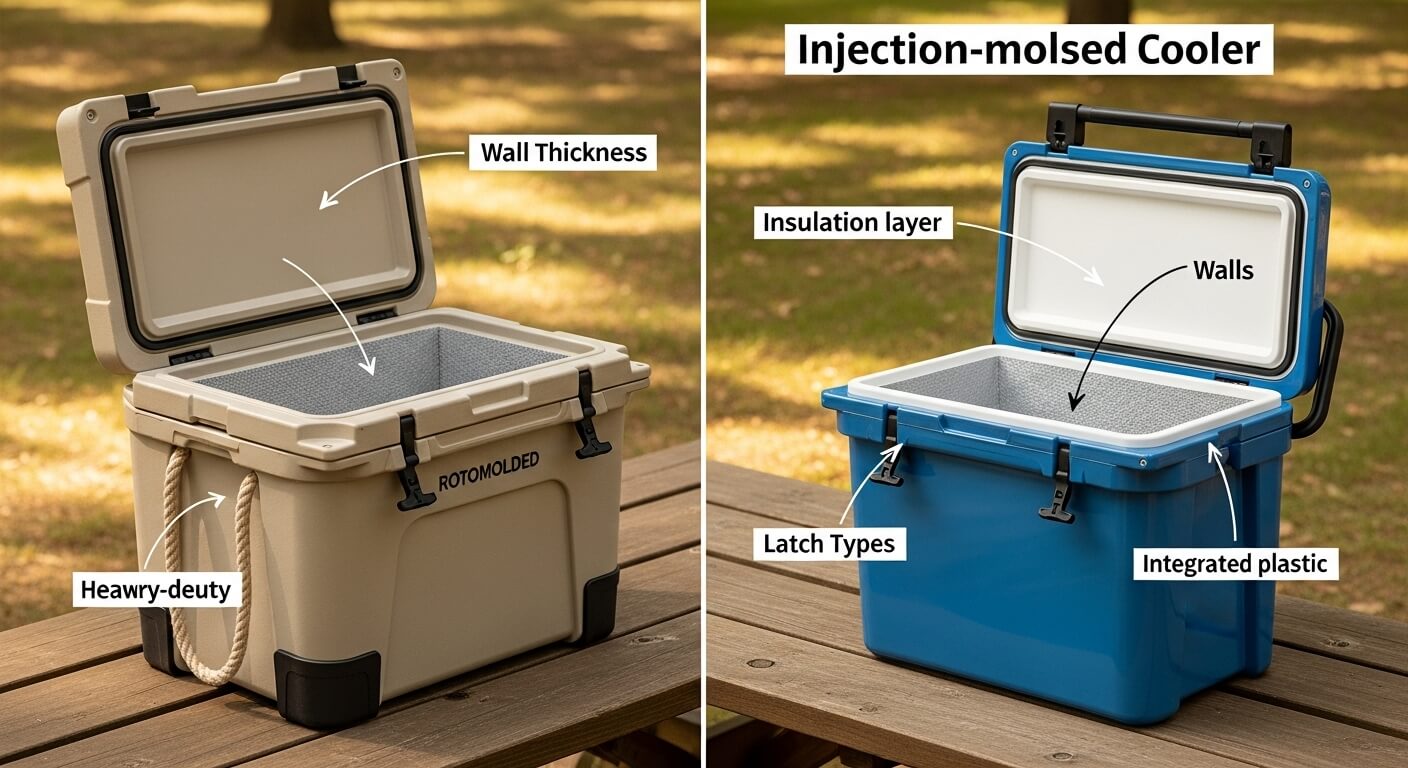
Wall thickness in rotomolded coolers typically ranges from 1.5 to 3 inches, depending on the manufacturer and model. The thick walls accommodate substantial insulation—usually 2 to 3 inches of polyurethane foam injected between inner and outer plastic shells after the rotomolding process completes.
The seamless construction eliminates potential leak points and ensures consistent insulation thickness throughout. Every part of the cooler—body, lid, even integrated handles—can be formed as a single piece, creating inherent structural strength.
Rotomolding allows for complex shapes and features to be molded directly into the cooler body. Tie-down points, cup holders, rulers, and handles become integral structural elements rather than attached components prone to failure.
The process is relatively slow and expensive compared to alternatives. Each cooler requires extended time in the mold as plastic melts and cools. The equipment costs are substantial, and production volume is limited compared to faster manufacturing methods. These factors directly contribute to higher retail prices.
Premium cooler brands like Yeti, Pelican, Orca, and RTIC’s standard line all use rotomolding for their flagship products. The process has become synonymous with high-performance coolers willing to sacrifice manufacturing efficiency for superior quality.
Injection Molding: The Efficient Alternative
Injection molding creates plastic products by injecting molten plastic under high pressure into closed molds. The process is fast, efficient, and well-suited for high-volume manufacturing. Manufacturers melt plastic pellets and force the liquid plastic into mold cavities where it rapidly cools and solidifies.
For coolers, injection molding typically creates separate pieces—an outer shell, inner liner, and lid; that are assembled after molding. The pieces snap, bond, or mechanically fasten together, creating the final cooler structure. This multi-piece construction introduces seams where components join.
Wall thickness in injection-molded coolers is generally thinner than rotomolded alternatives, typically 0.25 to 1 inch. The thinner walls result from the injection process working best with relatively thin cross-sections. Attempting to inject-mold very thick walls causes cooling inconsistencies and internal voids.
Insulation in injection-molded coolers usually consists of expanded polystyrene foam (like styrofoam) or thin polyurethane layers. The thinner walls limit insulation volume, directly impacting ice retention capability. Some premium injection-molded coolers use vacuum insulation panels to maximize performance within thin-wall constraints.
The rapid cycle times make injection molding highly efficient. A single mold can produce dozens or even hundreds of coolers daily, compared to the much slower rotomolding process. This efficiency translates directly to lower manufacturing costs and retail prices.
Injection molding excels at creating precise, complex features with tight tolerances. Details like latch mechanisms, hinges, and decorative elements can be formed with greater precision than rotomolding allows. This makes injection molding ideal for coolers emphasizing features and aesthetics over maximum thermal performance.
Most budget and mid-range coolers use injection molding or related processes like blow molding. Brands like Coleman, Igloo (most models), and Ozark Trail rely on these efficient manufacturing methods to deliver functional cooling at accessible prices.
Performance Differences
Ice Retention Comparison
Rotomolded coolers consistently outperform injection-molded alternatives in ice retention tests. The thick insulation and seamless construction minimize heat transfer, keeping contents cold for 5-10 days under ideal conditions. Premium rotomolded coolers regularly maintain ice for a full week with proper pre-chilling and minimal opening.
The seamless construction eliminates thermal bridges—points where heat can conduct through the cooler structure. In injection-molded coolers, the seams where pieces join create pathways for heat infiltration. Even with gaskets and careful assembly, these seams compromise thermal performance.
The thick polyurethane insulation in rotomolded walls provides superior thermal resistance compared to the expanded polystyrene commonly used in injection-molded coolers. Polyurethane has better insulating properties per inch of thickness, and rotomolded coolers incorporate 2-3 inches versus 0.5-1.5 inches in typical injection-molded designs.
Injection-molded coolers typically maintain ice for 1-4 days depending on quality and conditions. Budget injection-molded coolers might keep ice 24-48 hours, while premium injection-molded designs with enhanced insulation can approach 3-4 days. This represents significant performance but falls well short of rotomolded capabilities.
The lid seal quality dramatically affects both cooler types, but rotomolded coolers generally achieve tighter seals. The one-piece lid construction and precision gasket channels create superior sealing surfaces. Injection-molded lids, being assembled from components, sometimes show slight warping or gaps that reduce sealing effectiveness.
Real-world testing consistently shows rotomolded coolers maintaining ice 2-5 days longer than similar-capacity injection-molded alternatives under identical conditions. This performance gap justifies the price premium for users requiring extended ice retention.
Structural Strength and Rigidity
Rotomolded coolers exhibit exceptional structural strength. The seamless, one-piece construction distributes stress evenly without weak points where pieces join. You can sit, stand, or even drive over many rotomolded coolers without damaging them. The thick walls resist denting, cracking, and flexing.
The material thickness allows rotomolded coolers to withstand impacts that would crack or break injection-molded alternatives. Dropping a loaded rotomolded cooler from truck bed height typically results in minor scuffs rather than structural damage. The resilience makes them ideal for harsh use in boats, trucks, or rugged outdoor environments.
Injection-molded coolers vary widely in strength depending on design and material quality. Budget models flex noticeably when lifted fully loaded, and the thin walls can crack under impact. The seams where pieces join represent potential failure points that may separate with rough handling or age-related degradation.
Premium injection-molded coolers incorporate reinforcement ribs, thicker corner sections, and stronger materials to improve durability. These design enhancements narrow the strength gap with rotomolded coolers but rarely eliminate it entirely. The multi-piece construction inherently creates stress concentration points.
The practical implication is that rotomolded coolers tolerate abuse that would destroy injection-molded alternatives. For professional use, commercial applications, or anyone who regularly subjects coolers to harsh conditions, the durability difference proves significant.
Weight Considerations
Rotomolded coolers are substantially heavier than injection-molded alternatives of equivalent capacity. A 50-quart rotomolded cooler typically weighs 25-35 pounds empty, while a comparable injection-molded cooler weighs 10-18 pounds. The thick walls and dense insulation account for the weight difference.
The heavy construction becomes challenging when coolers are fully loaded. A 50-quart rotomolded cooler with ice and contents can weigh 80-100 pounds, requiring two people to lift safely. Injection-molded coolers in the same scenario weigh 60-75 pounds—still heavy but more manageable for solo carrying.
For applications requiring frequent cooler movement, the weight difference matters considerably. Loading and unloading from vehicles, carrying to campsites, or moving between locations favors lighter injection-molded designs. The convenience trade-off balances against performance benefits.
Some manufacturers address weight concerns by offering lighter rotomolded designs with thinner walls. These “ultra-light” rotomolded coolers bridge the gap, weighing 15-25% less than standard models while maintaining structural advantages. However, ice retention decreases proportionally with reduced insulation thickness.
The weight of injection-molded coolers makes them practical for solo users, elderly individuals, or anyone with physical limitations. The ease of handling may outweigh performance differences for users prioritizing convenience over maximum ice retention.
Durability and Longevity
Rotomolded Cooler Lifespan
Rotomolded coolers routinely last 10-20+ years with proper care. The seamless construction resists the common failure modes that retire injection-molded coolers. Users report rotomolded coolers purchased a decade ago still performing like new.
The thick plastic walls resist UV degradation better than thin injection-molded shells. While prolonged sun exposure eventually affects any plastic, the depth of material means surface degradation doesn’t compromise structural integrity for years.
Hinges on rotomolded coolers, typically thick rubber components, last 5-10 years before needing replacement. The heavy-duty construction withstands thousands of opening cycles. Some premium brands offer hinge replacement kits, extending cooler life indefinitely.
Latches and handles integrated into the rotomolded body last essentially forever barring accidental damage. Unlike attached components that tear away or break, molded-in features share the cooler’s structural longevity. External metal latches may eventually need replacement but the attachment points remain solid.
Gaskets require occasional replacement as the seal compresses over years of use. Most manufacturers offer replacement gaskets, and the simple installation process extends cooler life easily. A new gasket can restore an aging rotomolded cooler to like-new performance.
The primary aging concern is cosmetic—scratches, scuffs, and fading. These don’t affect functionality but can make older coolers look worn. The robust structure ensures that even cosmetically aged coolers continue performing excellently.
Injection-Molded Cooler Durability
Injection-molded coolers typically last 2-5 years with regular use before showing significant performance degradation or structural failure. Budget models may fail within 1-2 years while premium injection-molded designs approach the lower end of rotomolded longevity.
The seams where components join represent the primary failure point. Over time, repeated thermal cycling, physical stress, and UV exposure weaken bonds and adhesives. Seam separation causes leaks and allows heat infiltration, degrading ice retention progressively.
Thin plastic walls develop stress cracks more readily than thick rotomolded construction. Impact damage, dropping, or flexing under load creates micro-fractures that propagate over time. These cracks may leak or create structural weak points.
Attached handles frequently fail on injection-molded coolers. The connection points experience concentrated stress when lifting heavy loads. Handle failures often occur suddenly when fully loaded, potentially causing dropped coolers and spilled contents. This represents the most common and frustrating failure mode.
Hinges on budget injection-molded coolers tend to break or degrade within 2-3 years. The plastic components crack from UV exposure and repeated flexing. Once hinges fail, the cooler becomes difficult to use even if the insulation remains functional.
Latches on injection-molded coolers vary widely in durability. Simple snap latches may break within a season, while quality latches last several years. Latch failure renders coolers difficult to secure, reducing their utility significantly.
Insulation compression occurs in injection-molded coolers over time, particularly with expanded polystyrene foam. The foam gradually compresses under the plastic shell’s weight and external pressure, reducing insulation effectiveness. This degradation happens slowly but noticeably over 2-4 years.
Cost Analysis and Value Proposition
Rotomolded Cooler Investment
Rotomolded coolers cost $200-$500+ depending on brand, size, and features. A typical 50-quart rotomolded cooler from a quality brand costs $250-$350. Premium brands command $400+ for equivalent capacity, though the price often includes advanced features and prestige branding.
The upfront investment creates sticker shock compared to $30-$80 injection-molded alternatives. Justifying 5-10x price premiums requires understanding long-term value and performance benefits. The decision becomes easier when considering lifespan and per-use costs.
Over a 10-year period, a $300 rotomolded cooler costs $30 annually. If that cooler is used 20 times yearly, the per-use cost is $1.50. Compare this to an $80 injection-molded cooler replaced every 3 years: $27 annually or $1.35 per use at the same frequency. The lifetime value proposition narrows considerably when calculating actual usage costs.
However, the comparison assumes equivalent usage frequency and lifespan. Casual users who camp 3-4 times yearly struggle to justify rotomolded investments when injection-molded coolers adequately serve limited needs. The per-use cost for infrequent use remains high regardless of lifespan.
The superior ice retention of rotomolded coolers saves money on ice purchases over time. Extended trips requiring ice resupply in injection-molded coolers might not need additional ice with rotomolded alternatives. For frequent users, ice savings of $5-$10 per trip accumulate to $100-$200 annually, offsetting the purchase premium.
Rotomolded coolers maintain strong resale value. Used premium coolers in good condition sell for 50-70% of retail price. This residual value recovers significant portions of the initial investment if you later upgrade or change needs.
Injection-Molded Cooler Economics
Injection-molded coolers cost $20-$150 depending on size, brand, and features. A typical 50-quart injection-molded cooler from a quality brand costs $50-$80. This accessible pricing removes financial barriers to functional cooling.
The lower upfront cost makes injection-molded coolers ideal for testing whether you need serious cooling capability before investing heavily. New outdoor enthusiasts can start with injection-molded coolers and upgrade to rotomolded if usage frequency and needs justify the expense.
Budget-conscious families appreciate injection-molded pricing that makes outdoor recreation financially accessible. A family spending $50 on a cooler rather than $300 saves $250 for other camping gear, activities, or simply remains within budget.
The shorter lifespan means potential replacement costs over time. Replacing a $70 cooler every 3 years costs $23 annually; approaching the annual cost of more expensive rotomolded alternatives that last longer. However, the expense distributes over time rather than requiring large upfront payment.
For occasional users (3-5 trips yearly), the total investment remains low even if coolers need replacement every few years. Five years of occasional camping might cost $140 in coolers ($70 replaced once) versus $300+ for rotomolded alternatives used equally infrequently.
Injection-molded coolers have minimal resale value. Used budget coolers in good condition sell for 20-30% of retail if they sell at all. Most people donate or discard aging injection-molded coolers rather than attempting resale.
Practical Use Scenarios
When Rotomolded Excels
Extended wilderness trips requiring 5+ days of ice retention benefit enormously from rotomolded construction. The superior insulation means you can pack for week-long adventures without ice resupply access or concerns about spoilage.
Commercial and professional use demands rotomolded durability. Fishing guides, outdoor outfitters, and businesses using coolers daily need equipment that withstands constant abuse and lasts years. The investment justifies itself through reliability and longevity.
Marine environments favor rotomolded coolers that tolerate saltwater exposure, constant movement, and harsh sun without degrading rapidly. The seamless construction prevents saltwater intrusion into insulation where it would accelerate degradation.
Serious outdoor enthusiasts who camp, hunt, or fish 15+ times annually maximize rotomolded value. The frequent use justifies the investment, and the performance benefits enhance every trip. The durability withstands regular use that would wear out injection-molded alternatives.
Anyone requiring absolute maximum ice retention—perhaps for medications, scientific samples, or extended off-grid living; needs rotomolded performance. When cooling failure has serious consequences, the premium investment provides peace of mind.
When Injection-Molded Suffices
Day trips and short outings requiring 24-36 hours of cooling work perfectly with quality injection-molded coolers. The ice retention adequately serves brief adventures while saving substantial money for other expenses.
Casual recreational users enjoying 3-5 camping trips annually don’t need rotomolded performance or durability. Injection-molded coolers serve these limited needs entirely adequately at a fraction of the cost.
Budget-constrained families or individuals beginning outdoor recreation benefit from accessible injection-molded pricing. The lower barrier to entry makes outdoor activities possible without major financial commitments.
Secondary coolers for beverages separate from food work well as injection-molded units. Since beverage coolers open frequently (reducing ice retention anyway), premium insulation provides limited benefit. Save money on the beverage cooler and invest in rotomolded for critical food storage if desired.
Urban and developed camping where ice resupply is convenient makes injection-molded limitations manageable. If you can buy ice daily or every other day, extended ice retention becomes less critical than initial cooling performance.
Environmental Considerations
Manufacturing Impact
Rotomolding requires extended heating cycles consuming substantial energy per cooler produced. The process efficiency is lower than injection molding, resulting in higher energy consumption per unit. However, the longer product lifespan means fewer coolers manufactured over time, potentially offsetting manufacturing inefficiency.
Injection molding is highly energy-efficient per unit produced. The rapid cycle times and process optimization minimize energy consumption. However, shorter product lifespans mean more total coolers manufactured over equivalent time periods, potentially negating manufacturing efficiency advantages.
Both processes use similar plastic materials—primarily polyethylene. The environmental impact of plastic production is comparable regardless of manufacturing method. The difference lies in volume used—rotomolded coolers consume more plastic per unit due to thicker walls.
End-of-Life Considerations
Rotomolded coolers’ extreme durability creates environmental benefits through longevity. One cooler serving 10-20 years prevents 3-6 injection-molded coolers from entering waste streams. The extended lifespan represents significant waste reduction.
When rotomolded coolers eventually wear out, their seamless construction complicates recycling. The foam insulation bonded inside the plastic shell makes separation difficult. Most recycling facilities cannot process integrated foam-plastic assemblies, leading to landfill disposal.
Injection-molded coolers enter waste streams more frequently due to shorter lifespans. However, the simpler construction sometimes allows separation of components for recycling. In practice, most injection-molded coolers still end up in landfills since consumers rarely bother with component separation.
Neither cooler type is particularly environmentally friendly at end-of-life. The best environmental choice involves maximizing product lifespan through quality selection and proper maintenance, making rotomolded coolers marginally preferable from a sustainability perspective.
Making Your Decision
Choose Rotomolded If:
Extended ice retention (5+ days) matters for your typical cooler use. The performance justifies the investment when you regularly need ice to last beyond what injection-molded coolers provide.
You use coolers frequently (15+ times annually) and need durability to withstand regular use. The long lifespan and robust construction provide better long-term value for serious users.
Budget allows $250+ investment and you’re committed to outdoor recreation long-term. The upfront cost pays dividends through years of reliable performance.
Professional or commercial use demands equipment that tolerates daily abuse and lasts years. The durability and reliability justify the premium for business applications.
You value having the best equipment and appreciate quality construction. The superior materials and manufacturing appeal to users who prioritize excellence.
Choose Injection-Molded If:
Short trips (1-3 days) represent your typical cooler needs. The adequate ice retention serves brief adventures while saving substantial money.
You use coolers occasionally (3-8 times yearly) and can’t justify premium investments for limited use. The lower cost better matches infrequent utilization.
Budget constraints make $250+ cooler purchases impractical or unreasonable. Injection-molded coolers deliver functional cooling at accessible prices.
Weight concerns make 30+ pound empty coolers unmanageable. The lighter construction suits solo users or those with physical limitations.
You’re beginning outdoor recreation and want to test interest before major investments. Start with injection-molded coolers and upgrade if needs and frequency justify it.
Frequently Asked Questions
Can injection-molded coolers ever match rotomolded ice retention?
Premium injection-molded coolers with vacuum insulation panels can approach lower-tier rotomolded performance, maintaining ice for 4-5 days. However, they typically cost nearly as much as entry-level rotomolded alternatives while lacking the structural durability. For most users seeking maximum ice retention, rotomolded coolers provide better value at similar price points.
Why do some expensive coolers use injection molding?
Some manufacturers use injection molding for specialized coolers prioritizing features, weight reduction, or aesthetics over maximum ice retention. Precision injection molding allows complex features and exact specifications difficult to achieve with rotomolding. These niche products serve specific markets valuing particular attributes over ice retention duration.
How can I tell if a cooler is rotomolded or injection-molded?
Rotomolded coolers feature seamless construction with no visible seams or joint lines on the body. The walls are noticeably thick (1.5-3 inches), and handles often integrate into the body structure. Injection-molded coolers show seam lines where components join, have thinner walls (typically under 1 inch), and feature attached handles. Weight also indicates construction—rotomolded coolers are substantially heavier for equivalent capacity.
Do rotomolded coolers require special maintenance?
Rotomolded coolers need the same basic maintenance as any cooler—cleaning after use, drying before storage, and leaving slightly open during storage to prevent mildew. The gasket benefits from occasional cleaning and protective treatment to maintain sealing effectiveness. The robust construction requires no special care beyond avoiding prolonged direct sun exposure when stored to minimize UV degradation.
Are all premium coolers rotomolded?
Most premium coolers use rotomolding, but not universally. Some premium brands use advanced injection molding with premium materials and sophisticated insulation. The construction method doesn’t solely determine quality—manufacturing precision, materials, insulation quality, and component design all contribute. However, rotomolding remains the dominant process for top-tier coolers due to superior ice retention and durability.
Can I repair cracks in either cooler type?
Minor cracks in rotomolded coolers can often be repaired with plastic welding or specialized adhesives. The thick walls provide material for effective repairs. Injection-molded cooler cracks are more difficult to repair effectively, particularly if they occur at seams or in thin wall sections. For both types, prevention through careful handling proves easier than repair.
Which construction is better for extreme heat?
Rotomolded coolers perform significantly better in extreme heat due to superior insulation thickness and seamless construction. In desert or summer conditions exceeding 100°F, rotomolded coolers may maintain ice 3-4 days while injection-molded alternatives struggle to reach 2 days. The performance gap widens as ambient temperature increases.
Do thinner injection-molded coolers cool down faster?
The cooling rate depends more on pre-chilling practices than wall thickness. Both cooler types perform best when pre-chilled before loading. The thinner walls of injection-molded coolers don’t provide meaningful advantages in initial cool-down. In fact, rotomolded coolers’ superior insulation maintains cold better once achieved, regardless of slightly longer initial cool-down time.
Conclusion
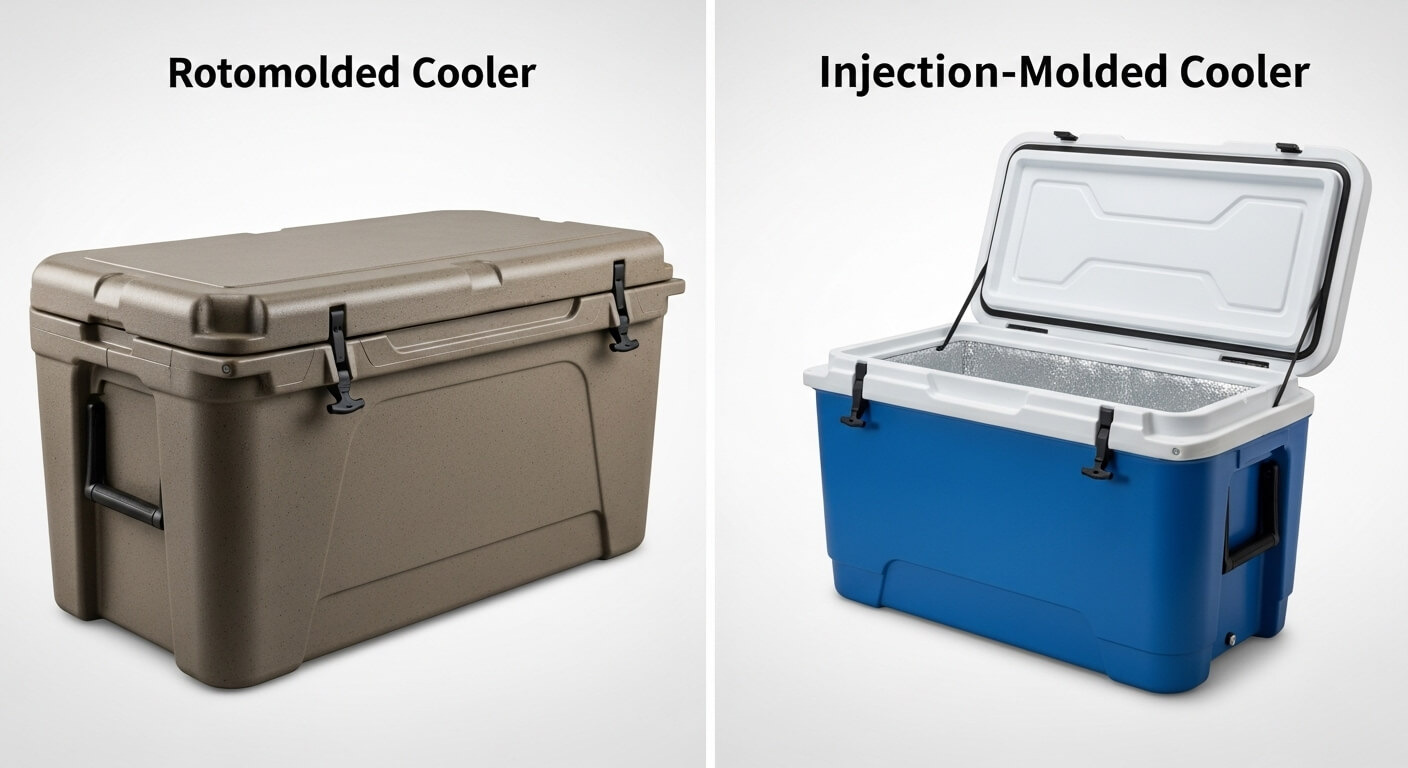
Rotomolded and injection-molded coolers represent fundamentally different approaches to portable refrigeration. Rotomolding creates superior ice retention, exceptional durability, and long-term value through thick-walled, seamless construction. The manufacturing process produces coolers that routinely last 10-20 years while maintaining ice for 5-10 days. This performance commands premium pricing of $200-$500+ depending on size and brand.
Injection molding prioritizes manufacturing efficiency, producing coolers at accessible prices through rapid, high-volume production. The multi-piece construction and thinner walls limit ice retention to 1-4 days and reduce lifespan to 2-5 years typically. However, the $20-$150 price points make functional cooling available to budget-conscious consumers and casual users.
For serious outdoor enthusiasts, professional users, or anyone requiring extended ice retention and maximum durability, rotomolded coolers justify their premium pricing through superior performance and longevity. The investment provides decades of reliable service and consistent ice retention exceeding injection-molded capabilities.
For casual users, infrequent campers, or budget-conscious families, quality injection-molded coolers deliver adequate performance at accessible prices. The shorter lifespan and limited ice retention prove acceptable trade-offs for occasional use when saving $150-$250 matters more than maximum capability.
Neither construction method is universally superior—the right choice depends on usage frequency, budget, performance requirements, and personal priorities. Understanding the manufacturing differences helps you select appropriate coolers matching your actual needs rather than overpaying for unnecessary capability or accepting inadequate performance through misguided budget constraints. Choose rotomolded for serious use requiring premium performance, injection-molded for casual recreation prioritizing accessibility and value.