
Since they provide a practical means of keeping food and beverages cold without the need for ice, electric coolers have become essential for long-distance travel, road trips, and camping excursions. The AC/DC dual power cooler and the 12V electric cooler are two of the most widely used choices. It’s crucial to determine which choice best suits your needs because, although both offer powered cooling, they differ greatly in terms of power flexibility, cooling performance, and general ease.
A 12V electric cooler is made to be plugged straight into a car’s 12V socket or cigarette lighter. These coolers, which offer consistent cooling while driving, are frequently used in vehicles, trucks, and RVs. They are perfect for short journeys, daily commutes, and weekend vacations because of their small size and straightforward operation. However, because of their dependency on vehicle power, cooling performance might change based on engine condition and outside temperature.
By using both DC power (12V from a car) and AC power (normal household plugs), an AC/DC dual power cooler, on the other hand, provides more adaptability. Whether you’re driving, camping at a powered site, or using it indoors, this dual functionality enables the cooler to provide steady chilling. This versatility can be quite helpful for travellers who need dependable cooling for long stretches of time or who move around a lot.
Depending on how, where, and how long you intend to use it, you can choose between an AC/DC dual power cooler and a 12V electric cooler. Making the best choice depends on a number of factors, including cooling efficiency, mobility, power availability, and long-term value.
We’ll examine the main distinctions in cooling performance, power options, pricing, ease, and optimal use scenarios in this comparison. By the time it’s all over, you’ll know exactly what kind of electric cooler is perfect for your lifestyle, whether you’re planning short road trips or long travels that require dependable, adaptable cooling.
What Is a 12V Electric Cooler?
A 12V electric cooler is a portable cooling device that runs on a car’s 12-volt power outlet, also referred to as the cigarette lighter plug. Drivers, campers, and travellers who want a dependable solution to keep food and beverages cold while travelling without the mess or trouble of ice are particularly fond of these coolers.
The majority of 12V electric coolers employ thermoelectric cooling technology, which transfers heat out from the cooler’s interior to lower the interior temperature. These coolers are ideal for beverages, snacks, and pre-chilled food because they usually cool objects to a particular degree below the surrounding ambient temperature rather than freezing them. When the car is running, its performance is usually constant, but when the engine is off or the temperature is too high, its cooling efficiency may drop.
A 12V electric cooler’s mobility and ease of use are two of its key benefits. Users may begin cooling nearly instantly with plug-and-play technology, and the lightweight design makes it simple to transport short distances or change between cars. Numerous types are small enough to fit between front seats, in the rear seat, or even in the trunk.
12V electric coolers do have several drawbacks, though. Their use is limited once you arrive at your destination, unless the motor is still running, because they are entirely dependent on vehicle power. They are therefore less suitable for prolonged stationary use or nighttime chilling. All things considered, a 12V electric cooler is best suited for small outdoor excursions, daily commuting, and short road trips. It provides fast ice-free cooling but has little versatility outside of the car.
What Is An AC/DC Dual Power Cooler?
A versatile electric cooler, an AC/DC dual power cooler may run on both DC power (12V from a car) and AC power (normal household plugs). Travellers who require reliable and adaptable cooling frequently choose this cooler because of its dual-power functionality, which enables it to operate flawlessly whether you’re travelling, camping at a powered location, or using it indoors.
AC/DC versions automatically switch between power sources based on what is available, in contrast to single-power coolers. The cooler usually provides more consistent and effective cooling when plugged into a wall socket at home or in an RV as opposed to operating only on vehicle power. Many AC/DC coolers are ideal for overnight use or multi-day travels since they can sustain a constant internal temperature for lengthy periods of time.
These coolers are frequently used for tailgating, lengthy car trips, camping, RV travel, and emergency food storage. Users are able to keep food and beverages cold even after reaching their destination because they are not only dependent on a vehicle engine for power. To further improve efficiency and use, certain models now come with digital temperature controls, different cooling modes, and improved insulation.
There are several trade-offs associated with the additional capabilities. Compared to standard 12V electric coolers, AC/DC dual power coolers are frequently bigger, heavier, and more costly. For optimal convenience, they could also need extra accessories like power adapters or longer wires. All things considered, an AC/DC dual power cooler is perfect for consumers who require dependable cooling in a variety of settings, providing the adaptability to seamlessly switch from vehicle travel to stationary use without compromising performance.
Cooling Performance Comparison
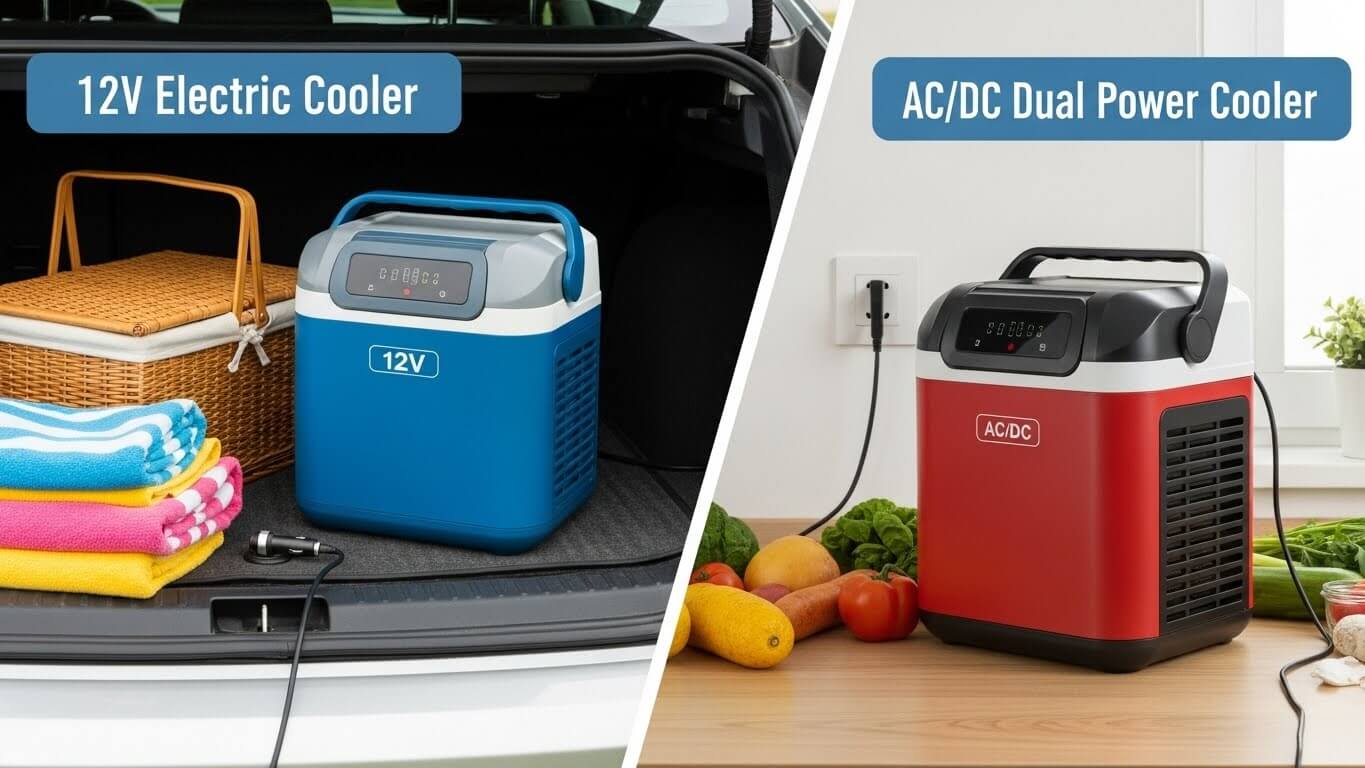
When comparing an AC/DC dual power cooler versus a 12V electric cooler, cooling performance is one of the most crucial considerations. Both are made to keep food and beverages cold without the need for ice; however, depending on the power source, technology, and usage circumstances, their capacity to maintain low and steady temperatures varies.
The electrical system of a car is the only source of power for a 12V electric cooler. Thermoelectric cooling, which is used in the majority of models, usually cools contents to a predetermined range below the ambient temperature. This implies that when the car is off or in hot weather, performance may change. The cooler typically provides steady cooling while driving; however, cooling effectiveness may decrease or stop completely when the engine is stopped. Therefore, 12V electric coolers are more appropriate for short-term use than for long-term cooling requirements.
An AC/DC dual power cooler, on the other hand, provides more dependable and constant cooling. These coolers frequently run more efficiently when linked to an AC power supply, sustaining lower interior temperatures for extended periods of time. They are therefore more reliable for multi-day travel, camping excursions, and overnight storage. Even in hotter conditions, certain AC/DC versions include enhanced insulation or sophisticated cooling systems that increase temperature stability.
Another distinction is cooling speed. Particularly when connected to a wall outlet, AC/DC dual power coolers usually cool contents more quickly and uniformly. 12V coolers frequently work best when goods are pre-chilled and may take longer to achieve ideal temperatures. Overall, an AC/DC dual power cooler offers a definite benefit if long-term performance and consistent cooling are your top priorities. The limits of a 12V electric cooler become more apparent during prolonged or fixed use, but it still works well for short drives and casual use.
Energy Efficiency and Power Options
When deciding between an AC/DC dual power cooler and a 12V electric cooler, power flexibility is crucial, particularly for travellers who move between cars, campgrounds, and indoor areas. Determining which model best suits particular travel and storage requirements requires an understanding of how each model consumes energy.
The sole power source for a 12V electric cooler is a car’s 12-volt DC socket. This makes it useful for brief outdoor excursions, daily commuting, and road vacations. However, if the motor is not running, prolonged use might deplete the car battery because it is totally dependent on vehicle power. Many customers only use these coolers when driving in order to save energy. Although 12V coolers are often energy-efficient, their limited power supply limits the locations and durations in which they can be utilised.
There is a lot more versatility with an AC/DC dual power cooler. Both a 12V car plug and a typical home AC outlet can power these coolers. The cooler usually uses less energy and maintains cooling performance without taxing a car battery when it is connected to AC power. This dual feature enables customers to keep food cold after arriving at a destination, continue cooling while travelling, and pre-cool goods at home.
In terms of energy economy, AC/DC coolers frequently have temperature control capabilities that cut down on needless energy use, optimized compressors or cooling elements, and automatic power switching. The option to select the most efficient power source helps balance energy usage, even though they might use more power overall because of their improved performance.
While AC/DC dual power coolers offer more energy control and versatility, 12V electric coolers are often the best for basic, portable cooling. Dual power models provide a more dependable and effective cooling option for long trips or stationary use.
Convenience, portability, and size
When comparing a 12V electric cooler with an AC/DC dual power cooler, portability and usability are important factors, particularly for consumers who move their cooler around a lot. Both are made for travel, however which is more practical may depend on factors like size, weight, and general convenience.
Generally speaking, a 12V electric cooler is smaller and lighter. These coolers are perfect for short vacations, commuting, and informal get-togethers because they are made to fit neatly in car trunks, back seats, or footwells. Their more straightforward design typically has a handle built in and a few knobs, making setup and transportation simple. They are more convenient because users don’t have to handle extra cords or converters, as they only require a car power outlet.
On the other hand, because of additional parts such as power converters, stronger insulation, and improved cooling systems, an AC/DC dual power cooler is typically heavier and bulkier. Even though many versions have wheels or ergonomic handles to increase mobility, they are typically less portable than standard 12V coolers. However, there are additional benefits to this trade-off. There is less need to move food between containers because the cooler can be used at home, in an RV, or at a powered campsite.
Additionally, storage capacity varies. Families or longer travels are better suited for AC/DC dual power coolers since they frequently provide additional internal room. For personal usage, 12V electric coolers, on the other hand, prioritise compactness over volume. In general, a 12V electric cooler may be preferred by consumers who value portability and speed. Despite its bigger size, an AC/DC dual power cooler might be more practical for people who value capacity, adaptability, and multi-location use.
Cost, Upkeep, and Total Value
When comparing an AC/DC dual power cooler versus a 12V electric cooler, cost and long-term value are crucial factors to take into account. Both provide the comfort of ice-free cooling, but their initial costs and continuing maintenance needs might vary greatly.
In general, a 12V electric cooler is more economical. These coolers are appealing to casual users or those who just require cooling for brief excursions because they are generally accessible at lower price points. Because of their straightforward design, there are fewer parts that potentially need to be fixed, requiring less upkeep. A 12V cooler may typically be kept in good working order over time with regular cleaning and appropriate storage.
Because of its additional features, dual power capability, and improved cooling performance, an AC/DC dual power cooler usually has a higher starting cost. However, better durability and versatility are frequently reflected in this higher price. The investment may provide more long-term benefits for individuals who travel frequently or want dependable cooling in a variety of settings. Stronger insulation and more durable internal parts are included in several models, which lessens the need for frequent replacements.
To guarantee effective functioning, maintenance for AC/DC coolers may include inspecting power cords, adapters, and ventilation systems. Although maintenance is a little more demanding, it is still doable and contributes to the cooler’s longer lifespan.
In general, an AC/DC dual power cooler offers a higher return on investment for customers who require reliable, multipurpose cooling, whereas a 12V electric cooler offers good value for brief and infrequent use. The frequency and intensity of the cooler’s use will determine the optimal setting.
Pros And Cons
To help you make a decision, below is a concise summary of the benefits and drawbacks of 12V electric coolers versus AC/DC dual power coolers.
12V Electric Cooler
Pros
- Lightweight and portable: Perfect for cars and quick trips, it’s simple to carry and store.
- Reasonably priced: Less expensive initially than dual power variants.
- Easy to use: Its plug-and-play architecture makes it easy to use.
- Compact design: Suitable for cars or cramped areas.
Cons:
- Limited power source: Only uses the 12V socket in the car.
- Smaller capacity: Ideal for short excursions or personal use.
- Unsuitable for lengthy trips: Without vehicle power, cooling cannot be maintained for longer periods of time.
AC/DC Dual Power Cooler
Pros
- Versatile power options: Uses regular AC outlets or 12V from a car.
- Reliable cooling: keeps the temperature constant over extended periods of time.
- Greater capacity: Ideal for long vacations or families.
- Improved features: Some models have enhanced cooling capabilities, improved insulation, and digital controls.
Cons:
- Costlier: Compared to 12V-only coolers, it is more costly up front.
- Less portable and heavier: Bulkier designs may be more difficult to transport.
- A little more upkeep: Needs to pay attention to internal parts, cords, and adapters.
Verdict: For portability, casual use, and quick journeys, pick a 12V electric cooler. For long trips, flexible power requirements, and reliable cooling performance, go with an AC/DC dual power cooler. Finding the cooler that best suits your lifestyle by weighing the trade-offs between portability, affordability, and cooling efficiency is made simpler by our pros and cons comparison.
Final Verdict

Your choice between an AC/DC dual power cooler and a 12V electric cooler should be based on your lifestyle choices, travel habits, and cooling requirements. Convenient ice-free cooling is provided by both choices, but they perform better in different situations.
For people who value portability, cost, and brief use, the 12V electric cooler is ideal. It works well for road trips, daily commuting, and informal get-togethers because of its small size, which also makes it simple to store and transport. Its lightweight design and plug-and-play functionality make it a great option for travellers who require easy, dependable cooling while on the go, even though it might not be suitable for prolonged stationary use or intense heat.
The AC/DC dual power cooler, on the other hand, is perfect for customers who need more storage space, longer cooling performance, and versatility. It can sustain constant temperatures in a range of situations, including car travels, RV excursions, and home use, thanks to its flexibility to switch between vehicle and domestic electricity. Its bigger interior room, versatility, and improved cooling capabilities are especially useful for families, long-distance travellers, and outdoor enthusiasts.
For short excursions and personal use where mobility and affordability are important considerations, opt for a 12V electric cooler. When capacity and flexibility are important, choose an AC/DC dual power cooler for longer travels, multi-location use, and dependable cooling performance. Both kinds offer efficient cooling options; nevertheless, the optimal option will rely on your own requirements, travel preferences, and frequency of ice-free chilling. Convenience, effectiveness, and the best possible freshness for your food and drinks are guaranteed when you choose the proper cooler.