
Dry ice is the closest thing the cooling world has to a cheat code. It holds food frozen solid for days where regular ice is already water by the second afternoon, it takes up less space for the cooling it delivers, and it leaves nothing behind when it is gone. It is also the one cooling product in common household use that can genuinely hurt you, and almost every problem people run into traces back to the same misunderstanding: treating it as very cold ice rather than as what it actually is, which is solid carbon dioxide turning into gas inside a sealed container.
This guide covers how much dry ice you need for a given trip, how to load a cooler so it works properly, the ventilation rule that matters more than any other, why a car is the highest risk place you will ever put it, what it does to cooler liners, and how to dispose of the leftovers. If you want the wider comparison of cooling methods first, our guide to how portable coolers actually workcovers where dry ice sits among the alternatives.
Quick Reference
| Question | Short Answer |
| Temperature | Around 109 degrees below zero Fahrenheit, or 78 below zero Celsius |
| Typical loss rate | Roughly 5 to 10 pounds per 24 hours in a good cooler |
| Amount for a full size cooler | 10 to 20 pounds per 24 hours depending on cooler quality and contents |
| Position in the cooler | On top, because cold air falls |
| Sealing | Never airtight. Gas must escape |
| Handling | Insulated gloves and tongs only, never bare skin |
| In a vehicle | Windows cracked, never in the passenger cabin of a sealed car |
| Disposal | Let it sublimate in a ventilated space away from people and pets |
| Never put it in | A freezer, a glass container, a sealed bottle, a drink you intend to swallow |
What Dry Ice Actually Is
Dry ice is carbon dioxide in solid form. At normal atmospheric pressure it does not melt into liquid. It goes directly from solid to gas, a process called sublimation, which is why it leaves no water behind and where the name comes from.
Two properties follow from that, and between them they explain every rule in this article.
The first is temperature. Dry ice sits at roughly 109 degrees below zero Fahrenheit. Water ice sits at 32 degrees Fahrenheit. That difference is not incremental. It is the reason dry ice keeps things frozen rather than merely cold, and it is also the reason skin contact causes injury within seconds.
The second is expansion. As dry ice sublimates it converts to carbon dioxide gas that occupies several hundred times the volume of the solid it came from. In an open or vented space this is harmless. In a sealed container it builds pressure until something gives. In an enclosed room or vehicle it displaces breathable air.
The Ventilation Rule
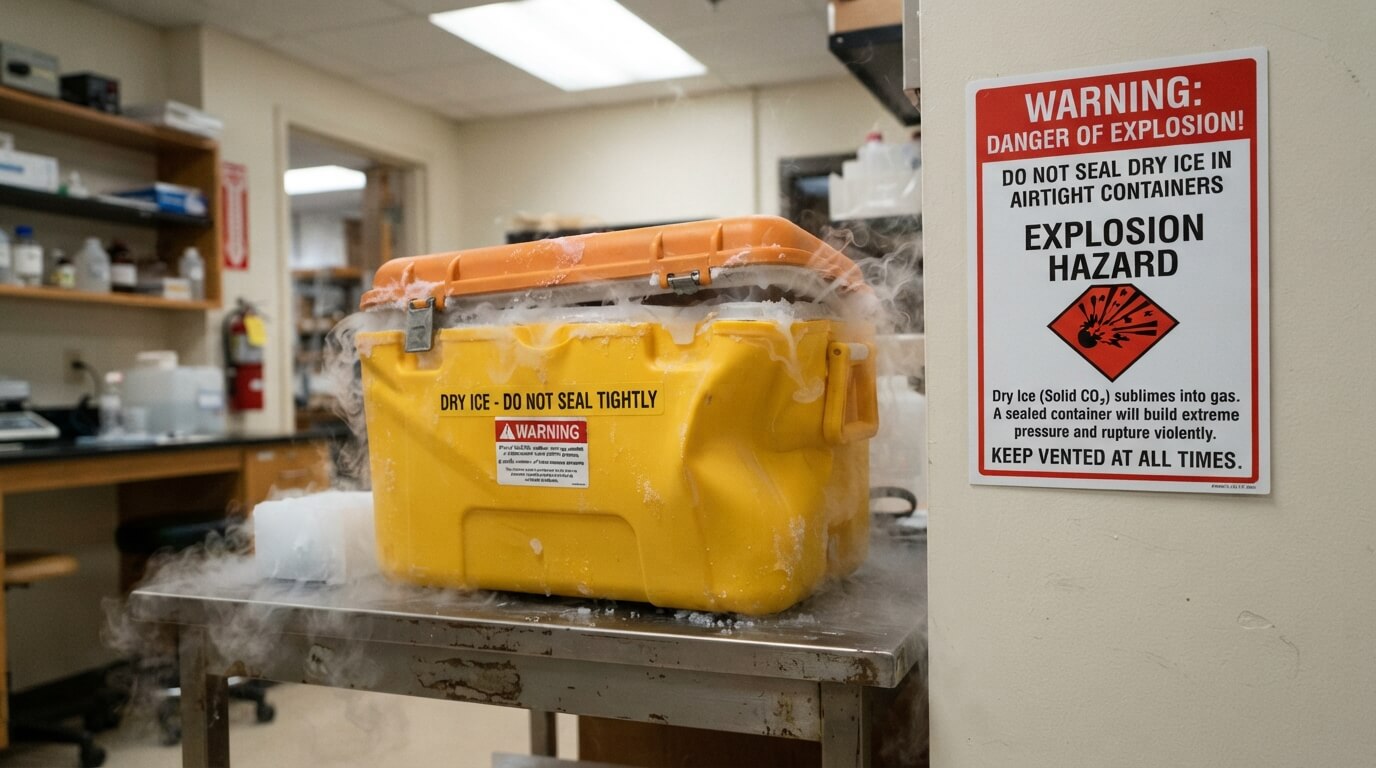
If you remember one thing from this article, this is it. A cooler holding dry ice must never be airtight.
Most quality coolers have a rubber gasket around the lid designed to seal completely, which is exactly what you want for ice retention and exactly what you do not want here. Gas produced inside a fully sealed cooler has nowhere to go, and pressure builds until the container ruptures or the lid is forced open violently.
There are three ways to handle this and all of them work.
• Leave the lid slightly ajar, propped by the dry ice itself or by a small object at one corner.
• Leave the drain plug open, which vents the cooler while keeping the lid usable. This is the neatest solution for most hard coolers.
• Use a cooler with a pressure relief vent, which some models designed for dry ice or vacuum sealed storage include as standard.
Never tape a cooler shut, never use a latching container without a vent path, and never use a screw top drinks cooler for dry ice. Sealed containers with dry ice inside are the cause of the most serious incidents in this category, and the failure is sudden rather than gradual.
How Much Dry Ice You Need
Dry ice sublimates continuously from the moment you buy it, so the calculation is about time as much as volume.
As a working figure, expect to lose somewhere between five and ten pounds every 24 hours in a reasonably insulated hard cooler. Cheaper coolers with thin walls lose considerably more, and the wall construction differences are covered in our breakdown of cooler materials and insulation.
| Trip Length | Keeping Food Frozen | Keeping Food Cold Only |
| Day trip, under 12 hours | 5 to 10 pounds | 5 pounds plus regular ice |
| Overnight, 24 hours | 10 to 20 pounds | 10 pounds plus regular ice |
| Two days | 20 to 30 pounds | 15 pounds plus regular ice |
| Three days | 30 to 45 pounds | 20 pounds plus regular ice |
| Five days or more | Resupply is usually necessary | Resupply is usually necessary |
Three factors move these numbers substantially.
• Cooler quality: A rotomoulded cooler with thick walls and a good gasket can halve the loss rate of a thin walled budget model.
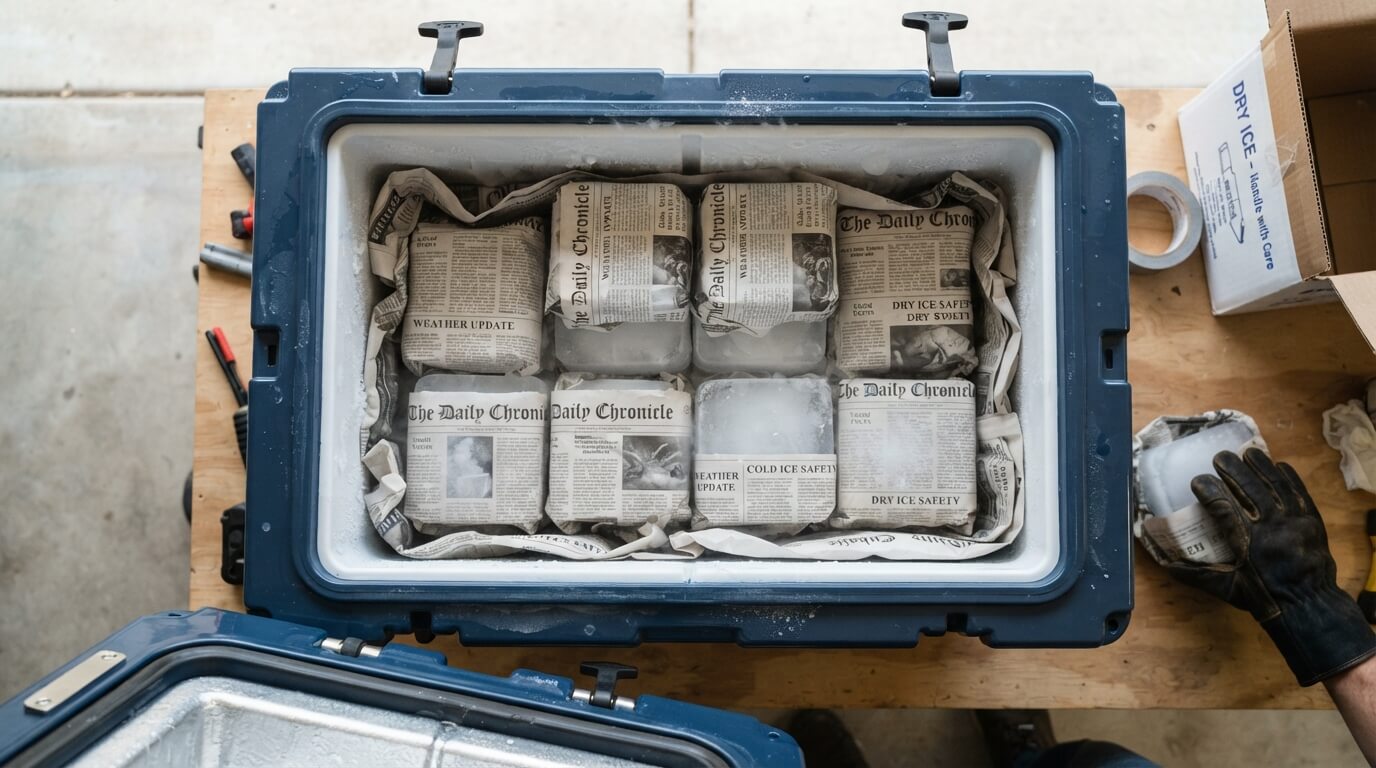
• How full the cooler is: Empty air space accelerates loss. Fill the gaps with newspaper, towels or regular ice.
• Ambient temperature and sun exposure: A cooler in direct sun in a hot vehicle loses dry ice far faster than one in shade.
Buying more than you need is the safer error. A surplus sublimates harmlessly with proper ventilation. A shortfall on day two of a trip means thawed food and a genuine food safety problem.
How To Load a Cooler With Dry Ice
Order matters, and it is the opposite of what people do with regular ice.
1. Pre chill the cooler. A cooler that has been sitting in a hot garage absorbs a significant amount of your dry ice just cooling its own walls. Chill it overnight with regular ice first if you can, then drain it.
2. Put the items you want kept coldest at the bottom. Frozen goods, meat, anything that must not thaw.
3. Add a layer of cardboard or newspaper between food and dry ice. Direct contact freezes items solid and can damage packaging, and it also protects cooler liners from cracking.
4. Place the dry ice on top. Cold air falls, so dry ice on top cools the entire contents. Dry ice at the bottom cools only what is directly above it.
5. Fill remaining air gaps. Crumpled newspaper, towels or bags of regular ice.
6. Vent the cooler. Drain plug open or lid slightly ajar.
If you are mixing dry ice with regular ice, which is a good strategy for trips where some items need freezing and others only need chilling, put the dry ice on top and the regular ice around the sides. The dry ice will extend the life of the regular ice considerably.
Avoid direct contact between dry ice and the cooler liner where possible. Extreme cold makes some plastics brittle, and cracked liners are a real outcome on cheaper coolers. A layer of cardboard between the block and the plastic solves it.
Transporting Dry Ice in a Vehicle
This is where the most serious risk sits and where it is most often overlooked, because a car feels like an ordinary place rather than an enclosed space.
Carbon dioxide gas is heavier than air and it accumulates low down in enclosed spaces. In a sealed car with air conditioning on recirculation, gas released by a subliming block builds up in the cabin. Rising carbon dioxide concentrations cause headache, drowsiness, dizziness, rapid breathing and confusion before they cause anything more serious, and the insidious part is that drowsiness and poor judgement arrive before the person recognises the cause. The NIOSH pocket guide entry for carbon dioxide sets out the exposure thresholds involved.
The practical rules are simple.
• Carry it in the boot or cargo area rather than the passenger cabin wherever possible.
• Keep at least one window partly open for the whole journey, even in cold weather.
• Set ventilation to fresh air, not recirculation.
• Do not leave dry ice in a parked closed vehicle, and be especially careful about children or pets being in a vehicle where dry ice is present.
• Ventilate the car thoroughly before getting back in if it has been parked with dry ice inside.
• Never carry it in the cabin of a small enclosed vehicle for long periods.
The same logic applies to any small enclosed space. Do not store dry ice in a walk in cupboard, a small windowless room, a basement, a tent, a boat cabin, or a caravan without ventilation.
Air Travel and Shipping
Dry ice is classified as a dangerous good for air transport, and there are specific limits on how much a passenger may carry, how it must be packaged and labelled, and whether the airline must be notified. Quantities are typically capped around 5.5 pounds per passenger with the package required to permit gas release, but the detail varies by carrier and jurisdiction. The FAA PackSafe guidance is the authoritative starting point, and the airline itself should be contacted before you travel.
For people weighing checked coolers against cabin options generally, our comparison of carry on coolers and check in mega coolers covers the practical trade offs.
Handling Without Injuring Yourself
Contact with dry ice produces a cold burn that behaves like a thermal burn, and it happens fast. A few seconds of skin contact is enough to cause injury.
• Wear insulated gloves, not thin cotton ones and not oven mitts that have been used for cooking. Cryogenic or heavy leather gloves are the right tool.
• Use tongs for handling blocks and pellets wherever practical.
• Never handle it with bare hands, even briefly, and even if it does not feel cold immediately.
• Keep it away from bare skin, eyes and mouth. Never put it in a drink you intend to swallow, and never put it in your mouth.
• Keep children and pets away from it entirely.
• Wear eye protection when breaking up blocks, because fragments travel.
If skin contact occurs, treat it as you would a burn: move away from the source, run the area under cool water, do not rub it, and seek medical attention if the skin blisters, turns white or grey, or if the area is large. Numbness that persists needs assessment.
What Never To Do With Dry Ice
• Never put it in a freezer. The freezer thermostat reads the extreme cold, shuts the compressor off, and in some units this causes damage. It also wastes the dry ice.
• Never put it in a sealed bottle, jar or container. This is the mechanism behind the homemade device incidents that appear in news reports every year. Pressure builds until the container bursts.
• Never put it in a glass container. Thermal shock cracks glass.
• Never place it directly on a laminate, tile or stone worktop. Extreme cold can crack surfaces and damage finishes.
• Never dispose of it in a sink, drain or toilet. It can crack plumbing and freeze traps.
• Never leave it unattended in a room where people sleep.
• Never assume a small amount is harmless in a small space. Volume of space matters as much as quantity of dry ice.
Dry Ice Versus Regular Ice Versus Gel Packs
| Factor | Dry Ice | Block Ice | Gel Packs |
| Temperature | 109 below zero Fahrenheit | 32 Fahrenheit | Around 32 Fahrenheit |
| Keeps food frozen | Yes | No | No |
| Duration in a good cooler | 18 to 24 hours per 10 pounds | 2 to 5 days | 24 to 48 hours |
| Leaves water behind | No | Yes | No |
| Safety requirements | Significant | None | None |
| Cost per trip | Higher, and must be bought fresh | Low | Reusable |
| Best use | Frozen goods, long hauls, resupply free trips | General cooling | Lunch boxes, short trips |
The honest conclusion for most weekend trips is that block ice in a good cooler is sufficient and far simpler. Our roundup of coolers that hold ice for five days or more covers what is achievable without touching dry ice at all. Dry ice earns its place when things must stay genuinely frozen, when the trip runs past the point where water ice gives up, or when meltwater in the cooler is unacceptable.
Disposal
Leftover dry ice disposes of itself. Place the cooler or a suitable container somewhere well ventilated and out of reach, such as a garage with the door open, a covered outdoor area, or a shaded spot outside, and allow it to sublimate completely. Keep it away from doorways and low lying enclosed areas where gas can collect, and keep children and pets clear of it while it does so.
Do not accelerate the process with hot water in an enclosed space, since this releases a large volume of gas and a dense fog very quickly. Do not put it in a bin, a drain, or a sealed bag.
After the Trip: Cooler Care
Dry ice leaves no meltwater, which means people often skip cleaning entirely. That is a mistake if raw meat or packaging leaked at any point, and a cooler that goes into storage with residue inside is a cooler that smells next season. Our guide to cooler odor retention and plastic typescovers which liners hold smell and how to get it out.
Check the liner for cracking or stress marks after heavy dry ice use, particularly on budget coolers, and store the cooler with the lid propped open so air can circulate.
Where To Buy It and What To Ask For
Dry ice is sold by many supermarkets, welding and gas suppliers, ice distributors and some hardware retailers. Availability varies enormously by region, and the single most useful habit is to phone ahead rather than drive somewhere hopeful.
• Ask for the format, not just the weight. Blocks sublimate more slowly because they have less surface area per pound, which makes them better for long trips. Pellets and small nuggets cool faster and pack around items more closely, which suits shorter trips and irregular loads.
• Ask when the delivery arrives. Dry ice begins subliming the moment it is made. A supplier who receives stock on Thursday morning will have a noticeably better product on Thursday than on Sunday.
• Buy it last. It should be the final stop before you load the cooler, not the first errand of the morning.
• Bring the cooler with you. The paper bag it is handed over in is a transport wrapper, not storage, and every minute in it is wasted product.
• Check whether identification is required. Some retailers restrict sale by age or require a signature.
Expect pricing to be quoted per pound, with block formats sometimes sold in fixed sizes. Prices vary widely by region and supplier type, so it is worth calling two or three.
Common Mistakes People Make
Most dry ice problems are not exotic. They repeat in the same handful of forms.
• Sealing the cooler out of habit. The gasket that makes a cooler excellent at holding ice is the thing that makes it dangerous with dry ice. Open the drain plug before you load, not after you remember.
• Buying it too early. Several hours of driving around with dry ice in the car is both wasteful and a ventilation risk you did not intend to take.
• Putting it at the bottom. This single error accounts for a lot of the disappointment people report, because the upper two thirds of the cooler stays warm.
• Letting it touch food directly. Produce, eggs, bread and anything in thin packaging will freeze solid and often split.
• Underestimating the sun. A cooler left in direct sunlight on a roof rack or truck bed loses dry ice dramatically faster than one in shade under a blanket.
• Using it in a small sealed space at home. Garages with the door closed, utility cupboards and camper interiors are all poor choices.
• Forgetting to tell other people. Anyone else travelling in the vehicle or using the cooler should know dry ice is in it, particularly if children are around.
Dry Ice for Power Outages
This is the use case people rarely plan for and most often need. When a freezer loses power, dry ice can hold its contents frozen for a day or more while the supply is restored.
• Keep the freezer closed as long as possible first. A full freezer holds temperature for a surprisingly long time if the door stays shut.
• Use roughly 10 pounds of dry ice per cubic foot of freezer space for about 24 hours as a rough planning figure, more in hot weather.
• Place it on a sheet of cardboard on top of the frozen food, never directly against the appliance walls or shelving.
• Prop the freezer door very slightly or leave a vent path. A domestic freezer is an enclosed container and the same gas rules apply.
• Ventilate the room. A kitchen with dry ice subliming in a freezer needs airflow, especially overnight.
• Do not refreeze food that has fully thawed and warmed. Food safety takes precedence over saving the contents.
For the broader question of how long food survives without power and when it must be discarded, the time and temperature rules in our companion guide on food safety in a cooler apply directly.
Frequently Asked Questions
How much dry ice do I need for 24 hours?
Around 10 to 20 pounds for a full size hard cooler if you need the contents kept frozen, and roughly 10 pounds alongside regular ice if you only need things cold. Expect to lose between five and ten pounds per day through sublimation, more in a thin walled cooler or in direct sun.
Can you put dry ice in a regular cooler?
Yes, provided the cooler is vented rather than sealed. Leave the drain plug open or the lid slightly ajar so carbon dioxide gas can escape, and place cardboard between the dry ice and the liner to protect the plastic from cracking.
Does dry ice go on top or bottom of a cooler?
On top. Cold air falls, so dry ice placed above the contents cools everything below it. Dry ice at the bottom cools only what sits directly on it and leaves the upper contents warm.
Is it safe to transport dry ice in a car?
It can be, with ventilation. Carry it in the boot or cargo area, keep a window partly open, set the climate control to fresh air rather than recirculation, and never leave it in a closed parked car. Carbon dioxide accumulating in a sealed cabin causes headache, drowsiness and confusion.
Can you touch dry ice?
Not with bare skin. Contact causes a cold burn within seconds. Use insulated gloves and tongs, and keep it away from eyes and mouth entirely. Never put dry ice in a drink you intend to swallow.
How do you dispose of leftover dry ice?
Leave it in a well ventilated place out of reach of children and pets and let it sublimate completely on its own. Never put it in a sink, drain, toilet or sealed bag, and never leave it to sublimate in a small enclosed room.
Can I put dry ice in the freezer?
No. The extreme cold can trip the appliance thermostat, causing the compressor to shut down, and in some units this leads to damage. It also wastes the dry ice, since a freezer is not the environment where it is needed.
The Short Version
Dry ice works superbly for the specific job of keeping things frozen for days without meltwater, and it demands respect in return. Buy around 10 to 20 pounds per 24 hours, put it on top of the load with cardboard between it and the food, never seal the cooler, ventilate any vehicle it travels in, and handle it only with gloves and tongs. For most weekend trips block ice in a well insulated cooler does the job with none of these considerations. When the trip is longer, hotter, or the contents genuinely must stay frozen, dry ice is the tool, and the rules above are what make it a safe one.
This article is for general information. Follow the handling and quantity guidance supplied by your dry ice retailer and check current airline and carrier rules before travelling with dry ice.