
There is a day every summer that confuses everybody. The thermometer reads exactly what it read last week, the number you handled perfectly well seven days ago, and yet this time you are wrung out by lunchtime. Nothing about the reading changed. Everything about the experience did.
The missing variable is water. Not the water in the sky, the water already in the air around you, and it does more to determine whether a room is bearable than almost anything else you can measure.
This matters practically, not just academically. Humidity decides which cooling device will work in your home and which one will waste your money. It is the single most common reason people buy the wrong machine, and it is almost never mentioned on the box.
Why Does Humid Heat Feel So Much Worse Than Dry Heat?
Your body has one primary way of shedding heat when the air around you is warm, and it is evaporation. You sweat, that sweat evaporates off your skin, and the energy required to turn liquid into vapour is drawn out of you. That is what cooling you down actually consists of.
Now the catch. Evaporation only happens if the surrounding air has room to accept more water vapour. Air that is already close to saturated cannot take much more, so your sweat sits there instead of leaving. You are still producing it, you are still wet, but the cooling step never completes.
That is the whole of it. In dry heat your cooling system works and you feel hot. In humid heat your cooling system is jammed and you feel ill.
It explains a set of things people notice without knowing why:
- Why 35 degrees in a desert is survivable and 32 in a coastal city is not. The desert lets you sweat productively. The coast does not.
- Why a fan stops helping at a certain point. A fan speeds evaporation from your skin. If the air cannot absorb moisture, there is little evaporation to speed up.
- Why you wake at 3am in a muggy room. Your body drops its core temperature to sleep, and it does that partly through the skin. Saturated air makes that harder.
- Why the same washing takes a day to dry. Same physics, different fabric.
Relative Humidity Versus Dew Point: Which Number Should You Actually Watch?
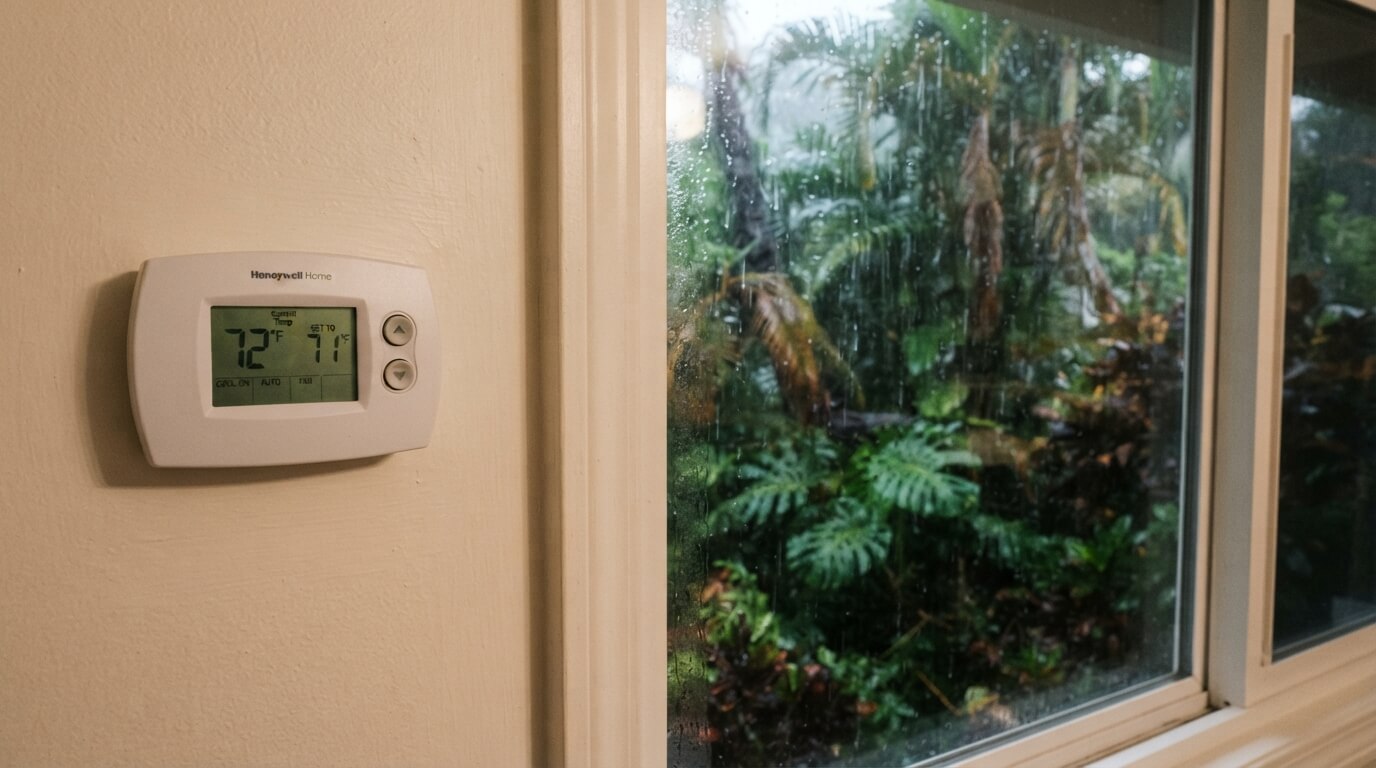
Weather reports give you relative humidity. It is the more famous number and the less useful one.
Relative humidity is the percentage of the moisture the air could hold at its current temperature. The trap is in the word relative. Warm air can hold far more water than cool air, so the same actual quantity of moisture produces wildly different percentages depending on the temperature. Air at 70 percent relative humidity on a cold morning is dry air. Air at 70 percent on a hot afternoon is soup. The number moved because the temperature moved, not because anything came into or left the air.
Dew point is the honest number. It is the temperature at which the air would have to be cooled for its moisture to start condensing out, and unlike relative humidity it does not swing around as the day heats up. It is a direct measure of how much water is actually in the air.
How to read a dew point, in Celsius:
- Under 10: dry. Evaporation works beautifully. This is where evaporative cooling shines.
- 10 to 15: comfortable for most people.
- 16 to 18: starting to feel sticky.
- 19 to 21: uncomfortable. Sweat stops working properly.
- 22 and above: oppressive. This is the territory where heat becomes a genuine health concern rather than a comfort one.
In Fahrenheit, the rough equivalents are under 50 for dry, 60 to 65 for sticky, and 70 plus for oppressive.
Why this matters when you shop. Every device in the cooling market performs differently across that range, and the marketing never tells you which end of it the product was designed for. If you learn your typical summer dew point, you can rule out half the market in about ten seconds.
What Is The Ideal Indoor Humidity Level?
The broadly accepted comfort band for indoor air is somewhere between 30 and 50 percent relative humidity, and there are good reasons for both ends of it.
Too dry, below about 30 percent:
- Dry throat and nasal passages, and worse sleep as a result
- Itchy skin and irritated eyes
- Static electricity everywhere
- Timber floors, furniture and instruments shrinking and cracking
Too damp, above about 60 percent:
- Everything feels warmer than it is
- Condensation on windows and cold walls
- Conditions that favour mould, mildew and dust mites, which is the part the EPA’s indoor air quality resources treat as the significant issue
- Musty smells in cupboards and soft furnishings
- Damp bedding that never quite feels fresh
That upper bound is the one worth taking seriously. A persistently damp house is a maintenance problem and an air quality problem, not merely a comfort one, and it develops slowly enough that people acclimatise to it without noticing.
Where Does All The Moisture In Your Home Come From?
More of it is generated indoors than most people expect, which is good news, because indoor sources are the ones you can do something about.
- People. An adult releases something in the region of a litre of moisture a day through breathing and perspiration. A family of four is a meaningful humidifier running continuously.
- Cooking. A pot boiling without a lid puts its entire volume into the room eventually.
- Showers and baths. The single largest short burst source in most homes.
- Drying laundry indoors. A full load holds a couple of litres of water, and all of it ends up in your air.
- Unvented appliances. Tumble dryers not vented outside, and some portable heaters.
- The ground and the structure. Rising damp, poor drainage, unsealed crawl spaces, leaking gutters.
- Houseplants. A minor contributor individually, less minor if you have a lot.
The practical takeaway: extraction beats treatment. A bathroom fan that actually runs during and after a shower, a lid on the pot, laundry dried outside or in a vented machine, and a working kitchen extractor will do more for your indoor humidity than any appliance you can buy, and they cost nothing to run by comparison.
Does A Dehumidifier Cool A Room?
This question comes up constantly and the answer has a genuine twist in it.
Strictly, no. A dehumidifier does not lower air temperature. It usually raises it slightly, because the process of condensing water out of air releases heat, and the machine’s own motor adds a little more. Put a dehumidifier in a sealed room and a thermometer will creep upward.
Practically, often yes. Because comfort is not temperature. If a dehumidifier takes a room from 65 percent down to 45 percent, your sweat starts evaporating again, your body’s own cooling system unjams, and the room feels considerably better even though it is technically a degree warmer.
So when is a dehumidifier the right purchase?
- Your problem is stickiness rather than heat
- You have condensation on windows, or mould appearing in corners and on cold walls
- Cupboards and wardrobes smell musty
- You live somewhere with mild but persistently damp summers, which describes a lot of the UK, Ireland and coastal northern Europe
- Laundry takes forever to dry indoors
When it is the wrong purchase: when the actual reading is 35 degrees. At that point you have a heat problem and no amount of moisture removal substitutes for removing heat.
One thing worth knowing is that an air conditioner is also a dehumidifier, and a good one. Passing air over a cold coil condenses moisture out of it as a side effect, which is why the back of a window unit drips. If you already run one, you are dehumidifying whether you meant to or not.
Which Cooling Device Suits Your Climate?
This is where all of the above turns into a buying decision, and it is the section I would want if I were starting from scratch.
Evaporative Coolers: Dry Climates Only
These cool by evaporating water into the airstream, which means they need dry air to work and they add moisture as they go. In genuinely arid heat they are excellent, cheap to run and pleasantly humidifying. In damp heat they deliver almost no cooling and make the room feel worse, and no setting or placement fixes that. The Department of Energy’s guidance on evaporative coolers is explicit that these are dry climate appliances.
Buy if: your typical summer dew point sits comfortably under 15.
Refrigerant-Based Air Conditioners: Anywhere, But With A Hose
Compressor units move heat out of the space entirely, and they dehumidify while they do it, which is exactly the right combination for muggy heat. The tradeoff is that the heat has to go somewhere, so they need a window, a hose or an outdoor unit, and they draw far more power.
Buy if: you need a room genuinely cooled, and especially if your summers are humid.
Fans: Useful Until They Are Not
A fan does not change air temperature at all. It moves air across your skin and accelerates evaporation, which feels like cooling and, up to a point, is. Past that point, when the air is too hot or too saturated for evaporation to keep up, a fan stops providing meaningful relief. Public health guidance including the National Weather Service’s heat safety pages makes exactly this point about extreme heat.
Buy if: your heat is moderate, or as a supplement to anything else. A fan paired with a real cooling device outperforms either alone, because circulation spreads the benefit.
Dehumidifiers: When Damp Is The Enemy
Covered above. The right tool when the number on the thermometer is fine and the feeling in the room is not.
If you want the full mechanical picture behind each of these, my guide to how portable coolers actually work breaks down the machines themselves, and BTU, CFM, EER and every cooling spec decoded covers the numbers you will meet on the box.
Why Does My Air Conditioner Leave The Room Cold But Clammy?
A specific and common complaint, and there is a real explanation.
An air conditioner dehumidifies while it runs, but only while it runs. An oversized unit cools the air to the thermostat setting very quickly and then shuts off, which means it spends most of its time not running, which means it spends most of its time not removing moisture. You end up with a room that is cold and damp at once, which feels unpleasant in a way that is hard to name.
A correctly sized unit runs longer at lower intensity, and that longer runtime is what pulls the moisture out. This is the counterintuitive reason that bigger is not better in cooling equipment, and it is why sizing guidance exists at all.
If this is happening to you:
- Raise the thermostat a degree or two so the unit runs for longer stretches
- Use a dry or dehumidify mode if the unit has one
- Deal with indoor moisture sources first, especially bathroom and laundry
- On a replacement, resist the temptation to size up
How Do You Measure Humidity In Your Own Home?
You do not need much, and the information changes how you use everything else.
A hygrometer is the tool, and a basic digital one costs very little. Some show temperature and humidity together, better ones show dew point directly.
Where to put it: at roughly the height you live at, away from windows, away from vents, away from the kitchen and bathroom doors, and out of direct sun. Give it half an hour to settle before you believe it.
What to watch for:
- The daily pattern. Humidity usually peaks in the early morning and falls through the afternoon. One reading tells you little.
- The difference between rooms. A bedroom reading 15 points above the rest of the house is telling you something about ventilation.
- The response to your habits. Take a reading before and after a shower, or with laundry drying indoors. The size of the jump is usually a surprise.
Two weeks of casual observation will tell you more about your home than any product review can, including this one.
Practical Ways To Manage Humidity Without Buying Anything
Worth exhausting these before spending money, because several of them are free and immediate.
- Run the bathroom fan during the shower and for twenty minutes after. Most people switch it off with the light, which is exactly too early.
- Put a lid on pans. Trivially simple, genuinely effective.
- Dry laundry outside whenever the weather allows, or vent the dryer properly.
- Ventilate at the right time of day. In dry climates, open up overnight when the air outside is cool and dry, and close up before the heat arrives. In humid climates, opening a window on a muggy afternoon imports moisture rather than removing it.
- Check the obvious leaks. Gutters, downpipes, a running toilet, a slow leak under a sink. Persistent damp usually has a boring physical cause.
- Improve air movement in still corners. Stagnant air holds moisture against surfaces, which is where mould starts. Leave wardrobe doors ajar occasionally and pull furniture a few centimetres off external walls.
Common Humidity Mistakes
Treating Relative Humidity As An Absolute
A 70 percent reading in a cold room and a 70 percent reading in a warm one describe completely different amounts of water. Learn the dew point and this confusion disappears.
Buying An Evaporative Cooler For A Humid Climate
The most expensive mistake in this whole category, and the most common. The device works exactly as designed and the design does not fit the air.
Sealing The House Completely
Sensible for an air conditioner, harmful for an evaporative cooler, which needs airflow through to carry moisture away. Match your ventilation strategy to your machine.
Ignoring Damp Because The Temperature Is Fine
Mould does not wait for a heatwave. A house that sits above 60 percent through a mild damp summer has a problem developing quietly, and the earliest sign is usually smell rather than sight.
Cooling The Air Without Fixing The Source
Running a dehumidifier while drying laundry in the same room is paying an appliance to undo what you are doing manually. Deal with the source first and the appliance has far less to do.
Frequently Asked Questions
Is humidity or temperature more important for comfort?
At moderate temperatures, humidity often matters more. A room at 26 degrees and 40 percent relative humidity is pleasant. The same room at 26 and 75 percent is unpleasant. At genuinely high temperatures the reading takes over, but in the range most homes spend their summer in, moisture is doing more of the work.
What is a comfortable indoor humidity level?
Between roughly 30 and 50 percent relative humidity suits most people and most houses. Below 30 you get dryness problems, above 60 you invite mould and dust mites.
Does a dehumidifier cool a room?
Not in temperature, and it warms the air very slightly. But by removing moisture it lets your body cool itself properly, so the room usually feels noticeably better despite being marginally warmer.
Why does my evaporative cooler stop working on humid days?
Because it has run out of the thing it needs. Evaporative cooling requires air with capacity to absorb moisture, and saturated air has none. The unit is functioning normally, the conditions simply do not permit the process.
Can high humidity be bad for my health?
Persistently damp indoor air encourages mould, mildew and dust mites, all of which are recognised triggers for respiratory irritation and allergy symptoms. It also interferes with the body’s ability to cool itself, which is why humid heat carries higher risk than dry heat at the same reading. If you have a respiratory condition or persistent symptoms you associate with your home, speak to a doctor rather than diagnosing it from an article.
Should I open windows on a hot day?
It depends on the air outside. In dry heat, ventilating overnight and sealing up during the day works well. In humid heat, an open window on a muggy afternoon brings moisture in faster than it takes heat out.
Does air conditioning dry the air too much?
It can, in already dry climates or when run hard for long periods, which is why some people get dry throats and sinuses from it. In humid climates the dehumidifying effect is a benefit rather than a side effect.
The Short Version

Temperature is the number everyone quotes and humidity is the number that decides how you feel. Learn your dew point, watch it for a couple of weeks, and you will understand your own home better than any spec sheet can tell you.
The one rule that saves the most money: dry heat means evaporative cooling is on your side. Damp heat means it is working against you, and you need something that removes moisture rather than adding it. Get that single decision right and everything else in cooling is detail.
If you want to see what your choices cost to run once you have made them, what cooling really costs puts numbers on it, and the Energy Star room air conditioner resources let you compare real efficiency figures rather than marketing ones.